
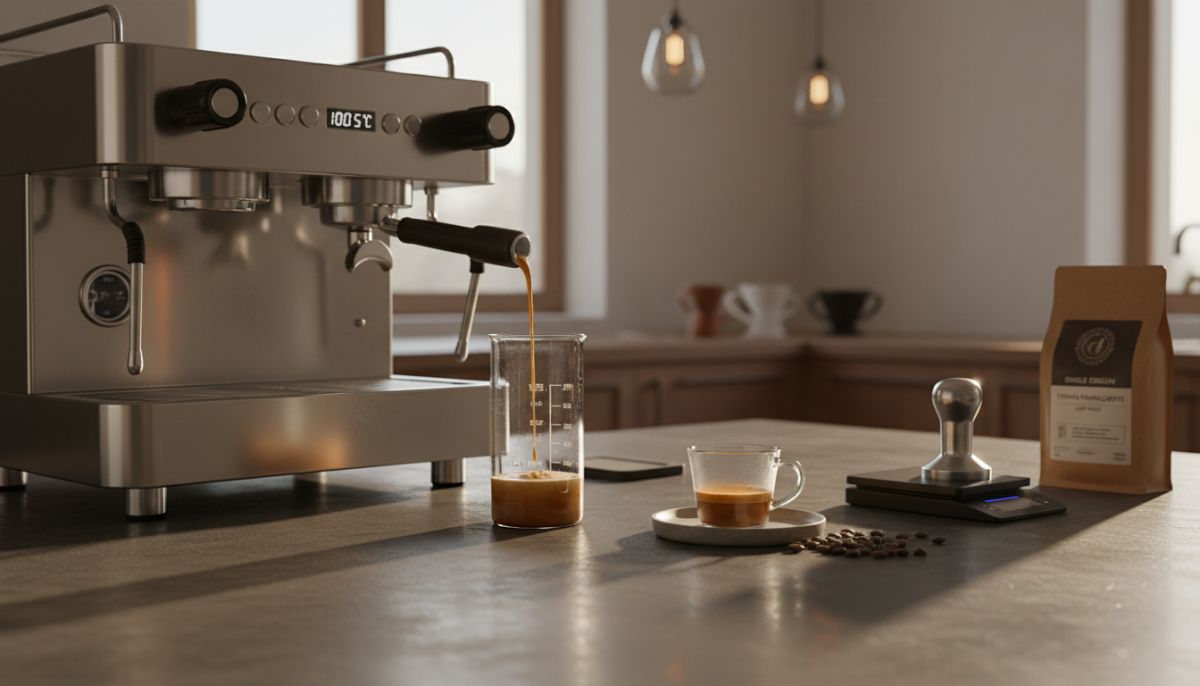
Unlock the vibrant potential of light roast espresso. Learn why increasing temperature and extending brew ratios are the keys to avoiding sour shots and achieving high-extraction sweetness.
Key Takeaways
- Heat is Energy: Light roasts are dense and require higher water temperatures (203°F–210°F) to dissolve solids effectively.
- Stretch the Ratio: Abandon the traditional 1:2 ratio. Aiming for 1:2.5 or 1:3 allows more water to extract difficult sugars and acids.
- Flow Rate Matters: Faster flow rates (Turbo Shots) can often yield better results with light roasts than slow, choked flows.
- Rest is Crucial: Light roasts need longer degassing periods post-roast compared to dark roasts to prevent carbonic acid sourness.
There is a specific moment in every home barista’s journey that I call the “Light Roast Wall.” You have mastered traditional chocolatey blends, dialed in your workflow, and decided to try that expensive, floral Ethiopian single-origin bean everyone is talking about.
You pull it exactly like your dark roast: 18 grams in, 36 grams out, in 30 seconds at 200°F.
The result? A shot that assaults your palate with battery-acid sourness, lacking any of the promised jasmine or peach notes. This isn’t a failure of your equipment; it is a failure of physics. Light roasts behave fundamentally differently than dark roasts. To tame them, you need to rewrite your rulebook, specifically focusing on two main levers: high heat and long ratios.
The Science of Density: Why Light Roasts Fight Back
To understand why your standard recipe fails, you must understand the bean structure. Dark roasts are porous and brittle. The cellular structure has been broken down by extended roasting, making the soluble compounds easy to wash out with water.
Light roasts, conversely, are dense and intact. They hold onto their flavor compounds tightly. When you apply standard brewing parameters to a light roast, the water cannot penetrate the dense particles effectively in a short time frame. This results in underextraction, which our tongues perceive as intense sourness and a lack of sweetness.
If you are struggling to visualize this, check out our guide on Understanding TDS and Extraction Yield. It explains the science behind what we are trying to pull out of the bean.
Lever 1: Crank Up the Heat
Temperature is a measure of energy. To extract solids from a dense medium, you need more energy. For traditional espresso, we often brew between 198°F and 202°F. For Nordic-style or ultra-light roasts, that is simply too cold.
The Target Zone
For most light roasts, you should start your dialing-in process at 205°F (96°C) and be willing to push as high as 210°F (99°C). This higher thermal energy increases the solubility of the coffee, helping to extract those stubborn sugars that balance out the natural acidity.
Equipment Consistency
High heat only works if it is stable. If your machine’s temperature fluctuates during the shot, you will get a mix of sour and bitter flavors. This is where PID controllers become essential for consistency.
If you are working with a machine that lacks a PID, don’t worry. You can still manage this by mastering temperature surfing to ensure you are hitting the boiler’s peak heat right as you pull the shot.
Lever 2: The Long Ratio
The second tool in your arsenal is the brew ratio. The classic Italian espresso is often a 1:2 ratio (e.g., 18g dose to 36g yield). However, with light roasts, the water becomes saturated with acid very quickly, leaving the sweetness traped in the puck.
By extending the ratio, you pass more solvent (fresh water) through the coffee. This dilutes the acidity to a pleasant level and gives you more opportunity to extract sweetness.
The New Standard: 1:2.5 to 1:3
Forget the 1:2 rule. For light roasts, try these parameters:
- Dose: 18 grams
- Yield: 45 to 55 grams
- Ratio: 1:2.5 to 1:3
This moves the drink away from a thick, syrupy body toward a tea-like clarity, which highlights the delicate floral and fruit notes typical of these beans. If you are unsure where this fits in the grand scheme of drinks, read our breakdown of the espresso ratio spectrum.
Advanced Taming Techniques
Once you have increased your heat and extended your ratio, you can fine-tune the extraction using flow and pressure.
Fast Extractions (Turbo Shots)
Counterintuitively, grinding coarser and pulling faster can improve light roasts. Fine grinds create more surface area but can also lead to channeling, where water finds the path of least resistance and bypasses clumps of coffee.
A “Turbo Shot” involves a coarser grind, a lower pressure (6 bars), and a fast shot time (15–20 seconds). This technique maximizes even extraction and minimizes channeling. Learn more about how Turbo Shots are changing the rules.
Pre-Infusion is Non-Negotiable
Because light roast grounds are so dense, they resist wetting. Blasting them immediately with 9 bars of pressure often causes the puck to fracture. A long pre-infusion (wetting the puck at low pressure) allows the puck to swell and soften before the main extraction begins.
If your machine supports it, aim for a 10–15 second pre-infusion. If you have a basic machine, you can still use specific pre-infusion hacks to achieve a similar effect.
Puck Prep: The Great Equalizer
You cannot tame a light roast with sloppy puck preparation. These beans produce a different particle distribution when ground, often creating more “fines” that can clog your basket.
Using a WDT (Weiss Distribution Technique) tool is critical to break up clumps and ensure the bed density is uniform. Without it, your high-heat water will channel, giving you a shot that is both sour and bitter. Check out the science of puck prep to see why this step creates the foundation for a good extraction.
Troubleshooting the Taste
Even with these tips, dialing in takes practice. Use your palate as the final guide.
- Still Sour? Grind finer or increase the yield (go from 1:2.5 to 1:3).
- Dry/Astringent? You may have pushed too far. Lower the temperature slightly or shorten the ratio.
- Hollow/Watery? Increase the dose slightly or grind finer to slow the flow.
If you are consistently getting sour shots despite your best efforts, consult our guide on troubleshooting underextraction for a deep dive into the variables.
Conclusion
Taming light roasts is the ultimate test of a home barista’s skill. It requires you to abandon the comfort of traditional recipes and embrace the extremes of brewing physics.
By pushing your temperature up to the boiling point and letting your ratios run long, you unlock a world of flavor that dark roasts simply cannot offer. It takes patience and precision, but that first perfectly balanced, fruit-forward shot makes every struggle worth it.
Frequently Asked Questions
For most light roasts, a temperature range between 203°F and 210°F (95°C–99°C) is ideal. The higher heat helps break down the dense cellular structure of the bean to extract sweetness.
Sourness is a sign of underextraction. Light roasts are dense and hard to extract. To fix this, try grinding finer, increasing your water temperature, or extending your brew ratio to 1:2.5 or 1:3.
Yes, high-flow precision baskets (like VST or IMS) are generally better for light roasts. They allow you to grind finer without clogging the holes, promoting higher extraction yields.
While 1:2 is standard for dark roasts, light roasts shine at longer ratios. Aim for 1:2.5 (e.g., 18g dose to 45g yield) or even 1:3 (18g dose to 54g yield) to reduce acidity and increase clarity.