
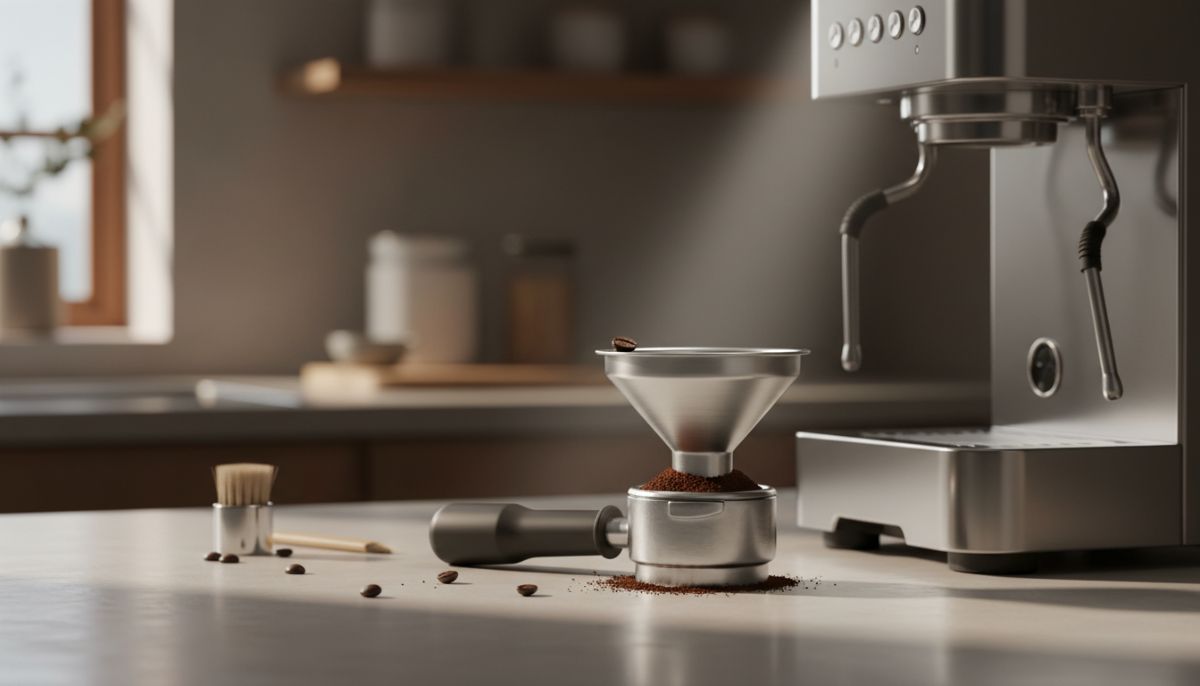
Tired of coffee grounds covering your countertop? Discover how a simple dosing funnel can save you money, improve your puck prep, and keep your espresso station spotless.
Key Takeaways
- Eliminate Waste: Dosing funnels prevent coffee grounds from spilling over the edge of the portafilter, potentially saving you the cost of an entire bag of beans annually.
- Enable Advanced Puck Prep: Techniques like the Weiss Distribution Technique (WDT) are nearly impossible to perform vigorously without a funnel to contain the grounds.
- Workflow Efficiency: A funnel speeds up your routine by allowing for faster grinding and distribution without the need for cautious, slow movements to avoid spills.
- Universal Fit: Whether you use a 58mm commercial standard or a smaller home machine setup, there is a funnel designed for your basket.
If there is one universal truth in the world of home espresso, it is that coffee grounds have a mind of their own. You meticulously weigh your beans, aim for a precise dose, and yet, somehow, a dusting of brown confetti ends up covering your drip tray and countertop every single morning.
For those buying commodity coffee, a pinch of wasted grounds might not seem like a tragedy. But if you have upgraded your setup and are buying single-origin specialty beans, every gram on the counter is literally money down the drain. This is where the humble dosing funnel becomes an essential piece of kit.
It is not just about cleanliness; it is about consistency and cost efficiency. In this guide, we will explore why this simple metal ring is the unsung hero of precision espresso and how it serves as the foundation for modern puck preparation techniques.
The Hidden Cost of “Coffee Confetti”
It is easy to dismiss a few stray grounds as part of the ritual. However, let’s look at the math. If you spill just 0.5 grams of coffee per shot—a conservative estimate if you are piling grounds high into a basket—and you pull two shots a day, you are wasting 365 grams of coffee a year.
That is roughly equivalent to a standard 12-ounce bag of specialty coffee. By failing to use a dosing funnel, you are essentially throwing away a free bag of high-end beans every year. Beyond the financial aspect, there is the issue of dosing accuracy. If you weigh 18 grams into your grinder but only 17.5 grams make it into the basket, your extraction ratio will be thrown off.
To truly master the art of dialing in, you need to know that the input weight is constant. For a deeper dive into why ratios matter so much, read our guide on how to dial in espresso ratios and yield. Keeping your dose consistent is the first step toward repeatable flavor.
The Gateway to Better Puck Prep (WDT)
The dosing funnel’s value skyrockets when you start using advanced distribution techniques. In recent years, the Weiss Distribution Technique (WDT) has become the gold standard for breaking up clumps and ensuring an even density of coffee in the basket.
WDT involves using thin needles to stir the grounds. To be effective, this stirring needs to be thorough and reach the very edges of the basket. Attempting this without a dosing funnel is a recipe for disaster. As you stir, the coffee volume expands and fluffs up, easily spilling over the rim.
With a funnel in place, you can whisk the grounds vigorously without losing a single particle. This ensures that you are declumping the entire bed, not just the center. If you are curious about the mechanics of this technique, check out our article on the science of puck prep and why the WDT tool matters. The funnel is the shield that makes aggressive WDT possible.
Types of Dosing Funnels: Material and Mechanism
Not all funnels are created equal. While they all serve the same basic purpose, the user experience varies significantly based on how they attach to your portafilter.
1. Magnetic Funnels
These are the most popular choice for home baristas. They feature small magnets embedded in the underside of the ring, allowing them to snap securely onto the rim of the filter basket. The magnets prevent the funnel from sliding off during grinding or WDT, yet they are easy to remove when it is time to tamp.
2. Friction Fit / Heavyweight
Some stainless steel funnels rely on sheer weight and a precise lip to stay in place. These are often heavier and feel substantial in the hand. They are excellent if you dislike the idea of magnets potentially gathering coffee dust, but they can be knocked off more easily if you are clumsy during the grinding process.
3. Twist-Lock (Grinder Specific)
Certain funnels are designed to lock into specific portafilter ears or grinder forks. While secure, these can sometimes be proprietary or difficult to find for generic setups. They are less common in the general accessory market but highly effective for specific machine ecosystems.
Workflow Integration: From Grinder to Tamp
How does a dosing funnel fit into a typical morning workflow? Seamlessly. In fact, it usually speeds things up.
If you are using a single-dosing workflow, where you weigh beans before grinding, the funnel ensures zero retention between the catch cup and the portafilter. You can dump the grounds from a dosing cup directly through the funnel without aiming carefully. If you are interested in how this workflow compares to traditional hoppers, read our breakdown of single dosing vs. hopper-fed grinder workflows.
The Routine:
- Place Funnel: Snap the magnetic funnel onto your naked or spouted portafilter.
- Grind: Grind directly into the basket. If your grinder creates static or fluffy grounds, the funnel acts as a high wall, containing the spray.
- Distribute: Use your WDT tool to break clumps. You can circle the perimeter of the basket aggressively.
- Tap: Give the portafilter a vertical tap on your tamping mat to settle the grounds. This drops the coffee level below the rim of the basket.
- Remove and Tamp: Lift the funnel off. The grounds should now be neatly contained within the basket, ready for tamping.
Speaking of tamping, keeping your station clean is a holistic effort. While the funnel protects the dose, you also need to protect your countertops from the pressure of tamping. We recommend pairing your funnel with a proper surface; learn more in our comparison of tamping mats versus stations.
Sizing and Compatibility
Before purchasing a dosing funnel, you must know your portafilter size. The industry standard for commercial machines (and many prosumer E61 grouphead machines) is 58mm. If you own an E61 machine, you might also be interested in the history of this component in our article on E61 groupheads mechanics.
However, many popular entry-level machines, particularly from brands like Breville or Sage, utilize 54mm baskets. Buying the wrong size will result in a funnel that either doesn’t fit or sits loosely, defeating the purpose. Always double-check your machine’s manual or basket diameter.
Another compatibility factor is your grinder’s clearance. Some grinders have a spout that sits very close to the portafilter forks. If you plan to grind directly into the portafilter with the funnel attached, you need to ensure the funnel isn’t too tall to fit under the chute. Standard “short” funnels are usually safe, but “tall” versions might require you to hold the portafilter by hand.
The Cleanliness Factor
We cannot overstate the psychological benefit of a clean station. Espresso making is a messy hobby by nature. There is steam, water, milk, and coffee dust. Reducing one of those variables—stray grounds—makes the entire process feel more controlled and professional.
A messy station often leads to hasty mistakes. If you are constantly wiping up grounds, you might rush your puck prep. By eliminating the mess, you can focus on what matters: the extraction. Furthermore, keeping stray grounds out of the locking mechanism of your group head extends the life of your gaskets. If you use a naked portafilter, you know that cleanliness and precision are visible components of the shot. A clean rim ensures a tight seal and prevents water from leaking over the side of the portafilter during the high-pressure brew cycle.
Conclusion
A dosing funnel is rarely the first accessory a new home barista buys, but it is often the one they value most after a few months of brewing. It solves three problems at once: it stops waste, it keeps the kitchen clean, and it enables better distribution techniques like WDT.
For an accessory that typically costs less than $30, the return on investment—both in saved coffee and saved sanity—is massive. If you are serious about refining your espresso workflow, stop sweeping grounds into the trash and start directing them into your cup.
Frequently Asked Questions
While not strictly necessary, a dosing funnel helps prevent mess during grinding, especially if your grinder produces fluffy grounds or has static issues. It ensures all the coffee you weigh makes it into the basket.
Most likely not. Many Breville (Sage) machines use 54mm portafilters. You must purchase a funnel specifically sized for 54mm baskets, or it will not fit securely.
Generally, no. Most standard tampers are the same diameter as the funnel’s inner rim, so they won’t fit through it. You usually remove the funnel after distributing and tapping the grounds, then tamp.
Magnetic funnels are generally preferred because they stay attached to the portafilter even if you turn it upside down or shake it vigorously. This adds stability to your workflow compared to friction-fit funnels.
The funnel itself doesn’t remove static, but it acts as a high wall that contains static-charged grounds that might otherwise fly sideways out of the grinder chute, keeping your counter clean.