
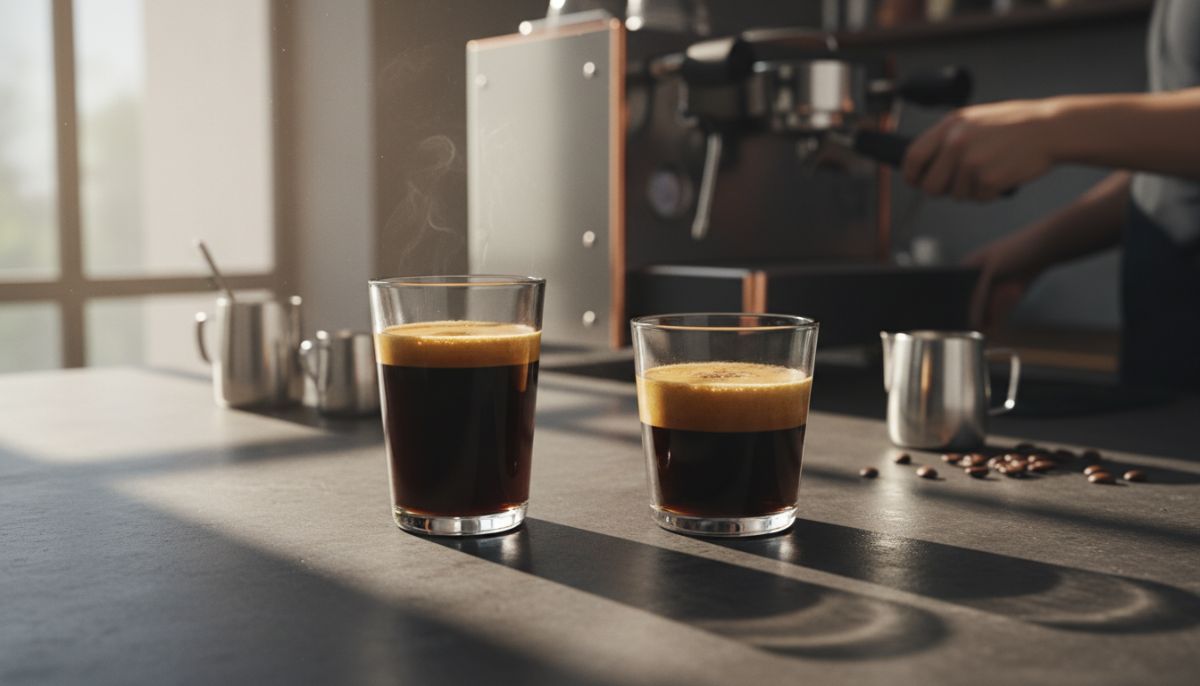
Think the Long Black is just an Americano by another name? Think again. Discover the crucial differences in brewing order, crema preservation, and flavor profile.
Key Takeaways
- Order Matters: A Long Black is brewed by pouring espresso over hot water, preserving the crema.
- Texture is King: Unlike the Americano, the Long Black retains a rich, viscous mouthfeel due to the undisturbed crema layer.
- Water Ratio: Typically uses less water (3-4 oz) than an Americano (6-8 oz), resulting in a more potent flavor concentration.
- Freshness is Non-Negotiable: Without fresh beans, you cannot achieve the signature crema required for a true Long Black.
You walk into a specialty coffee shop, perhaps one influenced by the booming cafe culture of Australia or New Zealand, and scan the menu. You see the standard latte, cappuccino, and flat white. Then, you see two black coffee options: the Americano and the Long Black.
To the untrained eye, they look identical. Both are essentially espresso and hot water. However, if you treat them as synonyms, you are missing out on a distinct sensory experience. The Long Black is not just a fancy name for a watered-down espresso; it is a deliberate method of extraction designed to highlight the aromatics and texture of the bean.
Mastering the Long Black requires an understanding of fluid dynamics, temperature stability, and the fragile nature of espresso crema. Here is why this drink deserves a spot in your home brewing repertoire.
The Origin Story: Down Under vs. The GI
To understand the drink, you have to understand the history. The Americano has its roots in World War II. American soldiers stationed in Italy found traditional Italian espresso too intense and small for their liking. They began diluting it with hot water to mimic the drip coffee they were used to back home. The method was utilitarian: dilute the espresso to make it palatable.
The Long Black, conversely, is a staple of Australasian coffee culture. It was developed to allow coffee drinkers to enjoy the nuances of a single origin or a complex blend without the milk masking the flavor, yet without the overwhelming punch of a straight double shot. It is a drink designed for appreciation, not just caffeine consumption.
The Anatomy of the Drink: It Is All About Order
The fundamental difference between these two drinks is the order of operations.
The Americano Approach
For an Americano, the barista pulls a shot of espresso into a cup and then pours hot water over it. This action breaks the surface tension of the espresso.
The result? The crema—that golden, flavorful foam on top of a shot—is dissipated. You are left with a consistent black liquid that tastes like a strong drip coffee. It is delicious, but it lacks texture.
The Long Black Technique
The Long Black reverses the physics. You start with a cup containing about 100ml to 120ml (roughly 3 to 4 ounces) of hot water. The espresso shot is then extracted directly from the grouphead onto the water.
By treating the water as a canvas, the espresso sits on top. The crema remains intact, floating as a golden layer above the black liquid. The first sip delivers the aromatic oils and the heavy mouthfeel of the espresso, followed by the diluted body. It is a layered tasting experience.
However, getting this right at home depends heavily on your equipment. For instance, if you are using a machine that grinds and brews automatically, the internal process might muddle this distinction. Understanding the mechanics of super-automatic vs. semi-automatic machines is key if you want to manually control the pour order.
The Critical Role of Crema
Why all this fuss about crema? Crema is composed of emulsified oils and CO2. It traps the volatile aromatics of the coffee. In a Long Black, preserving the crema means preserving the “nose” of the coffee. When you bring the cup to your lips, you should smell the fruit, nut, or chocolate notes immediately.
To achieve this, your beans must be fresh. Old beans lack the CO2 necessary to produce thick crema. If you are unsure if your current bag is up to the task, read our guide on coffee roast dates to ensure you aren’t brewing with stale ingredients.
Step-by-Step: Brewing the Perfect Long Black
Ready to brew? Here is the precise workflow to achieve cafe-quality results in your kitchen.
1. Water Preparation
Fill your cup with roughly 3 to 4 ounces of hot water. The temperature is crucial. If the water is boiling (212°F/100°C), it can scorch the espresso as it lands, leading to bitterness.
Aim for water around 175°F to 185°F. This is slightly cooler than brewing temperature but perfect for drinking immediately. Note that tap water can contain impurities that flatten flavor. We highly recommend reviewing the basics of water chemistry to see why filtration is essential for high-end machines.
2. The Grind and Puck Prep
Grind your beans fresh. You want a standard espresso grind—fine, like sand. Consistency is paramount here because the water in the cup will amplify any flaws in the shot.
If your grinder produces boulders and fines (inconsistent particle sizes), the resulting cup will be muddy. If you are struggling with consistency, it might be time to look at stepless vs. stepped grinders to find a tool that offers the micro-adjustments needed for espresso.
Once ground, distribute the coffee evenly in the basket. An even bed ensures the water flows through the coffee puck uniformly. We often debate the necessity of various tools, but knowing the difference between distribution tools vs. tampers will help you decide what you need for that level surface.
3. The Extraction
Place your cup with the hot water under the portafilter. Engage the pump. Watch the extraction closely. It should start as a dark trickle and evolve into a golden honey flow (the “mousetail”).
Stop the shot before it starts “blonding” (turning pale yellow and watery). A standard double shot (approx. 36g to 40g out) is ideal for this water ratio.
Troubleshooting Common Issues
Even with the right steps, things can go wrong. Here is how to diagnose a bad Long Black.
The “Flat” Cup (No Crema)
If the crema dissipates instantly, your beans are likely too old, or your water was too hot. Alternatively, the distance between the spout and the water surface might be too high, causing the espresso to splash rather than layer. Raise the cup closer to the spout if possible.
The Sour Punch
A Long Black is unforgiving. If the espresso is under-extracted, the sourness will cut through the water aggressively. This often happens if the water temperature of the machine drops during the pull or if your grind is too coarse. If you encounter this sharp, acidic flavor, refer to our troubleshooting guide on why your espresso tastes sour for immediate fixes.
Serving and Enjoying
A Long Black should be served immediately. As the drink sits, the crema will naturally break down, and the temperature will drop. It is a drink of immediacy.
Unlike a latte where milk sugar hides imperfections, or an Americano where volume dilutes them, the Long Black is transparent. It highlights the quality of your grinder, your machine, and your beans. It is the ultimate test for the home barista.
So, the next time you crave a black coffee, do not just add water to espresso. Pour the espresso over the water. Watch the gold layer form, inhale the aroma, and taste the difference intentionality makes.
Frequently Asked Questions
Flavor-wise, yes. Because a Long Black typically uses less water (3-4oz) compared to an Americano (8-12oz), the flavor is more concentrated and robust. However, if both use a double shot of espresso, the caffeine content is identical.
Traditionally, a Long Black is served black to highlight the nuances of the bean. However, you can add a dash of milk on the side. If you add too much milk, it begins to resemble a strong flat white or latte.
Avoid boiling water. Ideally, the water in the cup should be between 175°F and 185°F (80°C – 85°C). This ensures the drink is immediately sippable and prevents the hot water from scorching the espresso as it is extracted.
The most common culprits are stale coffee beans (older than 4-5 weeks), a grind that is too coarse, or pouring the water over the espresso (which makes it an Americano) instead of extracting the espresso over the water.