
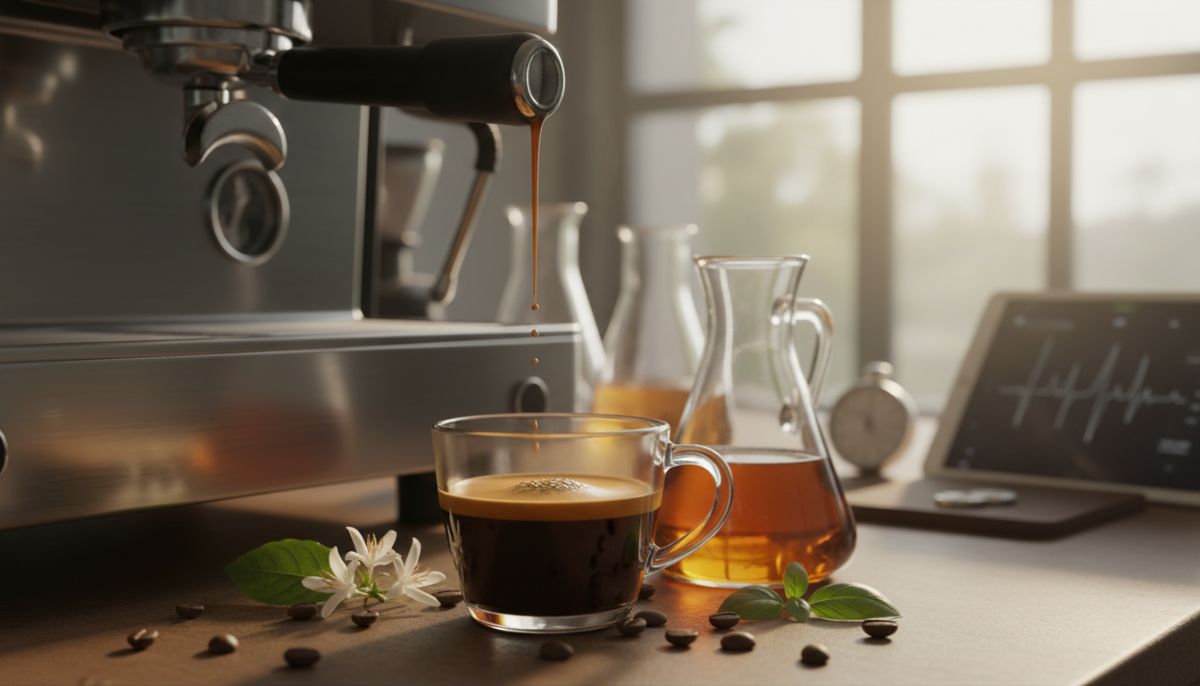
Discover how the ‘Blooming Espresso’ technique transforms acidic light roasts into sweet, syrup-like shots by borrowing the bloom phase from pour-over brewing. A complete guide to theory and application.
Key Takeaways
- The Concept: Blooming espresso borrows the ‘bloom’ phase from pour-over coffee, soaking the puck for 30 seconds or more before applying full pressure.
- The Flavor Payoff: This technique drastically increases extraction yield, tempering acidity and highlighting deep sweetness, especially in light roasts.
- The Requirement: Success requires a high-quality grinder capable of ultra-fine settings and a machine with flow or pressure profiling capabilities.
For decades, the definition of a perfect espresso was rigid: nine bars of pressure, 25 to 30 seconds of extraction, and a 1:2 ratio. While this traditional recipe produces excellent body and balance, it often struggles to tame the sharp acidity of modern, ultra-light roast coffees. Enter the “Blooming Espresso.”
This advanced brewing profile is changing how we understand extraction. by introducing a significant pause in the middle of the brew cycle—similar to how you bloom a pour-over—baristas can unlock texture and sweetness that traditional 9-bar shots simply cannot access. If you have been chasing higher extraction yields and wondering why your light roasts taste sour rather than vibrant, the blooming shot might be the missing link in your routine.
What is a Blooming Espresso?
The term “blooming espresso” was popularized by industry experts utilizing advanced machines like the Decent DE1 to manipulate flow profiling. At its core, the technique involves fully saturating the coffee puck with water and then halting the flow entirely for an extended period—typically between 30 and 45 seconds—before ramping pressure back up to finish the shot.
In a standard espresso shot, pre-infusion might last 3 to 5 seconds. In a blooming shot, the goal is to let the water perform a deep, passive extraction. This long contact time allows the water to penetrate the very center of every coffee particle, softening the soluble compounds before the aggressive phase of brewing begins. This is distinct from simply pulling a slower shot; it is a deliberate, multi-stage extraction event.
The Science: Why the Pause Enhances Sweetness
Why does stopping the water flow result in a sweeter cup? The answer lies in thermal equilibrium and extraction uniformity. When you grind coffee for espresso, you are creating millions of particles. In a fast, high-pressure extraction, water often follows the path of least resistance, potentially leading to uneven extraction where some grounds are over-extracted (bitter) and others are under-extracted (sour).
By introducing a long bloom phase, you allow capillary action to draw water into the densest parts of the coffee bed without the chaos of high pressure. This softens the cell structure of the bean fibers. When you finally apply pressure to finish the shot, the soluble solids—sugars, acids, and oils—release much more readily.
This process significantly reduces the risk of channeling. If you struggle with inconsistent shots, you likely know that dry pockets in the puck are the enemy. A long bloom ensures the puck is a cohesive, fully wet mass before high pressure is applied. To understand more about the mechanics of water resistance, read our guide on how to spot and fix uneven water flow.
The Gear: What You Need to Bloom
Not every espresso machine can pull off a true blooming shot. A standard appliance-grade machine with a vibration pump usually ramps straight to full pressure, making this technique impossible. To execute this properly, you need control over the water delivery system.
1. Flow Profiling or Manual Lever Machines
You need a machine that allows you to stop the pump or close the valve while maintaining the water that is already inside the group head. Manual lever machines are exceptional for this, as you can physically stop pulling down on the lever. Alternatively, E61 group head machines equipped with a flow control kit work perfectly. If you are considering an upgrade to handle these advanced variables, check out our breakdown of flow control explained.
2. A High-End Grinder
The blooming espresso technique requires a significantly finer grind than a traditional shot. Because the puck degrades and softens during the 30-second soak, it offers less resistance when the pressure returns. If you use a standard espresso grind setting, the water will gush through instantly after the bloom. You need a grinder capable of microscopic adjustments to go fine enough to hold back the water. This is where the debate between stepless vs. stepped grinders becomes critical; stepless is almost mandatory here.
3. Puck Protection
Because you are saturating the puck and letting it sit, the structural integrity of the coffee bed is vulnerable. Many baristas find that using a puck screen helps disperse the water evenly during the fill stage, preventing holes from forming before the bloom even starts. For a deeper dive into this accessory, read our analysis on whether puck screens improve flavor.
Step-by-Step: How to Pull a Blooming Shot
Ready to try it? Here is a baseline recipe to get you started. Note that this works best with light to medium-light roasts. Dark roasts may become overly bitter due to the high extraction yield.
Step 1: The Prep
Dose your coffee slightly lower than your basket’s capacity (e.g., 18g in a 20g basket) to allow for headspace expansion. Grind much finer than your standard espresso setting. Perform your WDT and tamping routine with precision.
Step 2: The Fill (Pre-Infusion)
Start your timer. Introduce water to the puck quickly. You want to fill the headspace and saturate the puck as fast as possible without building immense pressure. Ideally, you want to see about 2–3 bars of pressure on the gauge, or just until the first drops of liquid appear on the bottom of the basket.
Step 3: The Bloom (The Pause)
As soon as the puck is saturated, cut the flow. On a lever machine, hold the lever static. On a flow control machine, close the needle valve. On a Decent, the machine handles this automatically. Now, wait. Let the timer run to 30 or even 40 seconds. You might see a few drips fall into the cup—this is ‘blooping’ and is perfectly normal.
Step 4: The Extraction
Once the bloom phase is over, re-engage the flow. Ramp up the pressure. Because the puck is soft, you likely won’t hit 9 bars. A peak of 6 to 8 bars is standard for this style. Extract until you reach your target yield. Ratios for blooming shots are often higher, commonly 1:2.5 or 1:3 (e.g., 18g in, 45g out). The flow will likely be fast during this phase.
Flavor Expectations and Troubleshooting
A successful blooming shot should have a heavy, syrup-like body despite the high ratio. The acidity should be present but transformed—think ‘ripe fruit’ rather than ‘sour lemon.’ If the shot tastes dry or astringent, you may have extracted too much; try shortening the bloom time or coarsening the grind slightly.
Conversely, if it tastes empty or watery, you likely didn’t grind fine enough, and the water channeled through the degraded puck. Always ensure you are using fresh beans. Old coffee degasses too quickly and won’t hold up to the bloom phase. Learn how to read your bag by checking our guide on coffee roast dates.
Conclusion
The blooming espresso is more than a trend; it is a tool for salvaging light roasts that might otherwise taste grassy or underextracted. It requires patience and the right equipment, but the reward is a level of sweetness and clarity that traditional 9-bar brewing rarely achieves. Experiment with your bloom times, adjust your grind, and taste the difference that a simple pause can make.
Frequently Asked Questions
Light to medium-light roasts are ideal. The high extraction yield of blooming shots helps balance the acidity of light roasts, whereas dark roasts can become unpleasantly bitter and astringent with this method.
Generally, no. You need a machine capable of flow control or a manual lever machine to stop the water flow while maintaining pressure. Standard machines with vibratory pumps typically cannot pause mid-shot without venting pressure.
You need to grind significantly finer than you would for a traditional 9-bar shot. The long soak softens the puck, reducing resistance, so a finer grind is necessary to prevent the water from gushing through during the main extraction phase.
Channeling in blooming shots usually happens if the grind is not fine enough or if the pre-infusion fill was too aggressive. Using a puck screen can help distribute water evenly and keep the puck intact during the long pause.