
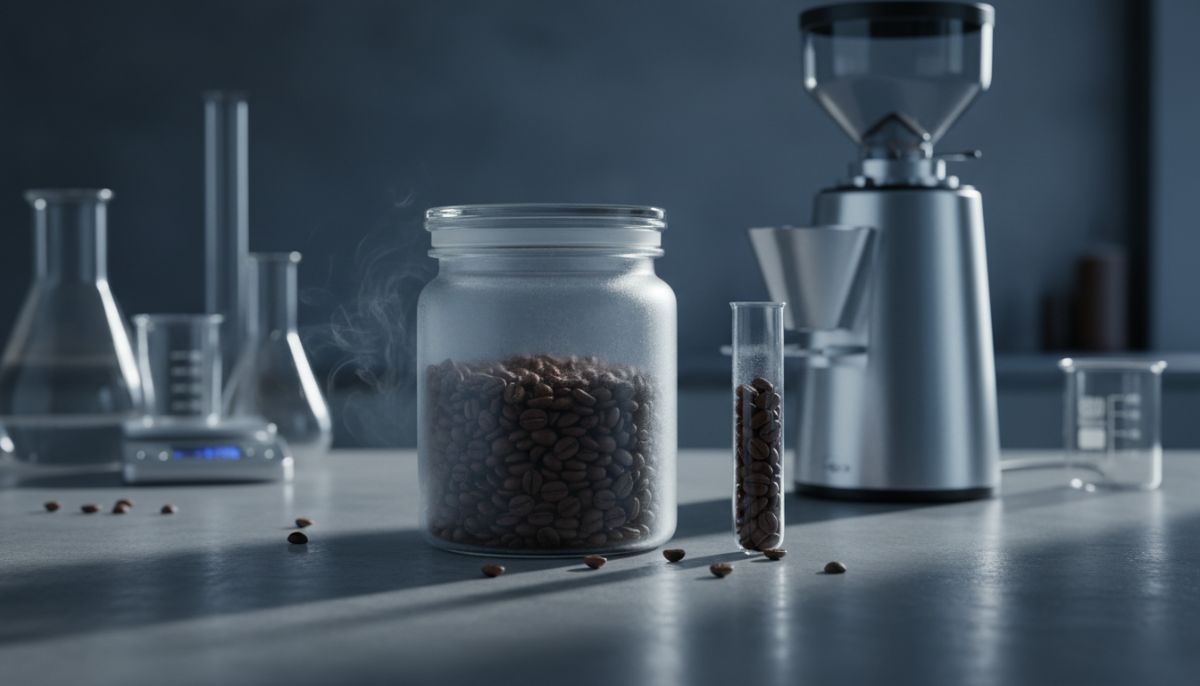
Learn the science behind freezing coffee beans to halt oxidation and improve grind consistency. This guide covers single dosing workflows, the best storage containers, and how to grind frozen beans for better extraction.
Key Takeaways
- Halts Aging: Freezing coffee reduces the rate of oxidation and volatile compound loss by over 90%, effectively pausing the aging process.
- Improves Grind Quality: Frozen beans are more brittle, shattering into a more uniform particle distribution with fewer fines.
- Single Dosing is Best: To avoid condensation damage, freeze individual doses in centrifuge tubes or vacuum-sealed bags rather than opening a frozen bulk bag repeatedly.
- Grind Frozen: Do not thaw beans before grinding. Grinding them frozen maximizes the particle distribution benefits without damaging standard burrs.
The Science of Coffee Staling and Preservation
Coffee beans begin to stale the moment they leave the roaster. This process is driven by oxidation, the loss of volatile organic compounds (aromatics), and the migration of lipids. According to the Arrhenius equation, the rate of chemical reaction roughly doubles for every 10°C increase in temperature. Conversely, lowering the temperature drastically slows these reactions.
Storing coffee at room temperature exposes it to oxygen and fluctuating humidity, leading to flat, woody flavors within 3-5 weeks. Freezing coffee at standard freezer temperatures (-18°C to -20°C) slows molecular activity to a near halt. Research suggests that coffee stored in a deep freezer can maintain its peak flavor profile for months or even years, provided moisture is managed correctly. This allows enthusiasts to buy expensive light roasts in bulk without fear of them going bad before they can be consumed.
Physics of Grinding: Why Frozen Beans Taste Better
Freezing does more than just preserve freshness; it fundamentally changes how the bean behaves inside your grinder. At room temperature, roasted coffee beans have a certain level of plasticity. When crushed by burrs, they can mash slightly before breaking.
Frozen beans are significantly more brittle. When they hit the burrs, they shatter cleanly. This change in fracture mechanics leads to a tighter particle size distribution. You achieve a specific target grind size with fewer "boulders" (chunks that are too big) and fewer "fines" (dust that clogs filters). A more uniform grind allows for higher extraction yields and greater clarity in the cup, particularly for filter coffee and light roast espresso.
The Condensation Risk
The biggest danger in freezing coffee is moisture. If you take a large bag of frozen beans out of the freezer, open it, and scoop out a dose, the warm air in the room will instantly condense onto the frozen beans remaining in the bag. This moisture accelerates staling and can lead to freezer burn. This is why bulk freezing in a single bag is not recommended unless you plan to thaw the entire bag at once. The solution is single dosing.
Workflow: How to Freeze Coffee Properly
To maximize longevity and convenience, follow this single-dosing workflow.
1. Degassing
Allow fresh coffee to rest and degas for 5 to 10 days after the roast date before freezing. If you freeze immediately off the roaster, the CO2 remains trapped inside the structure. While this preserves the gas, it can make dialing in difficult later. For a deeper understanding of freshness windows, read our guide on reading coffee roast dates.
2. Portioning
Weigh your coffee into single doses (e.g., 18g for espresso, 15-20g for pour-over). This ensures you never have to expose your main stash to room temperature air.
3. Selecting the Right Container
- Centrifuge Tubes (Top Choice): 50ml polypropylene laboratory tubes are the gold standard for budget-conscious single dosing. They are airtight, food-safe (look for BPA-free), and durable. They mimic expensive "bean cellars" at a fraction of the cost.
- Vacuum Sealer Bags: If tubes are not available, vacuum sealing individual doses is effective. This removes oxygen entirely, preventing freezer burn.
- Glass Vials/Bean Cellars: High-end options like Weber Workshops bean cellars offer a premium aesthetic and often include one-way valves, but the functional result is similar to centrifuge tubes.
- Avoid Mason Jars: Standard Mason jars leave too much headspace (air) if not fully filled, and they are cumbersome for single dosing.
4. Storage
Place your tubes or vacuum bags in a designated section of your freezer. Keep them away from strong odors (like fish or onions), as coffee lipids can absorb ambient smells.
How to Brew with Frozen Beans
Do Not Thaw
Take a single tube out of the freezer and grind the beans immediately while they are still frozen. Thawing is unnecessary and counterproductive, as the beans lose their brittleness as they warm up.
Adjusting Grind Settings
Because frozen beans fracture more efficiently, they generate less resistance in the puck. You will typically need to grind finer than you would with room temperature beans to achieve the same flow rate. This is true whether you are using flat or conical burrs.
Managing Static
Grinding frozen beans generates significantly more static electricity than room temperature beans. It is mandatory to use the Ross Droplet Technique (RDT). A single spray of water on the beans before grinding dissipates the charge and prevents retention. Learn more about this in our RDT method guide.
The Transition Phase
When you switch from room temperature to frozen beans, expect your shot times to change. If you have a high-end grinder with low retention, the switch is instant. If you use a grinder with a hopper, you must accept that the first bit of ground coffee will be a mix of old retention and new frozen grounds. This makes single dosing grinders the superior choice for frozen coffee workflows.
Equipment Guide: Budget vs. Luxury
You do not need to spend hundreds of dollars to start freezing coffee.
- Budget: 50ml Plastic Centrifuge Tubes + Masking Tape for labeling. (Cost: ~$0.50 per tube). Effective and practically indestructible.
- Mid-Range: FoodSaver Vacuum Sealer + Rolls. (Cost: ~$100). Excellent for bulk storage or single doses, though plastic waste is higher.
- Luxury: Glass Bean Cellars with Stand. (Cost: $200+). Aesthetics and workflow optimization for the high-end bar.
Common Myths Debunked
Myth: Freezing kills the flavor.
False. Freezing preserves flavor. "Freezer taste" only occurs if the container is not airtight and the beans absorb moisture or odors.
Myth: You will damage your grinder burrs.
False. Roasted coffee beans, even when frozen, are not hard enough to damage steel or ceramic burrs. The moisture content is too low to form a solid block of ice.
Myth: You can refreeze beans.
Avoid this. Once you remove beans and they reach room temperature, condensation forms. Refreezing them traps that moisture, leading to ice crystal formation and flavor degradation.
Frequently Asked Questions
No. You should grind the beans while they are still frozen. This takes advantage of the ‘shatter effect,’ which creates a more uniform particle size distribution and produces fewer fines. Thawing beans risks condensation forming on the surface.
No. Roasted coffee beans have very low moisture content, so they do not freeze into rock-hard ice. They simply become more brittle. Standard steel and ceramic burrs in electric or manual grinders handle frozen beans without issue.
If vacuum sealed or stored in airtight centrifuge tubes, roasted coffee can be stored in the freezer for 12 months or longer with no detectable degradation in flavor. This is significantly longer than the 4-6 week shelf life at room temperature.
Standard Ziploc bags are not recommended for long-term storage because they are somewhat permeable to air and odors. Vacuum sealed bags or rigid tubes (centrifuge tubes) are superior for preventing freezer burn and oxidation.
Yes. Frozen beans fracture more cleanly and produce fewer fines, which decreases resistance in the filter basket. You will usually need to adjust your grinder to a finer setting to achieve the same extraction time as room temperature beans.