
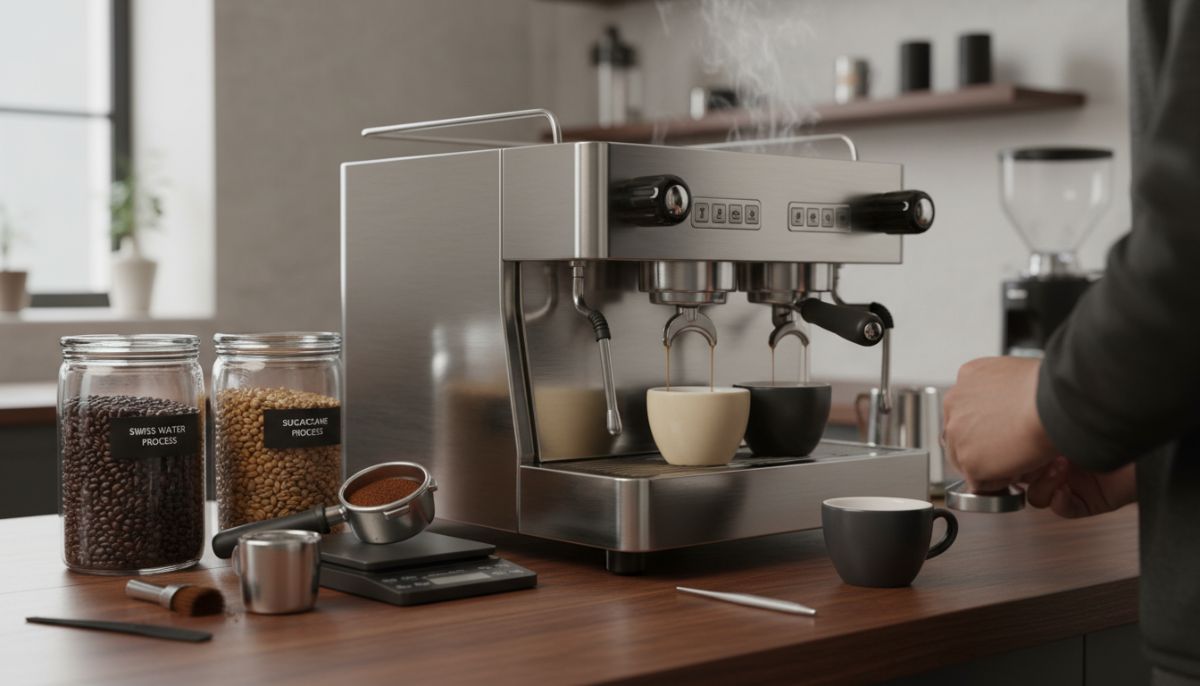
Master the art of brewing decaf espresso. This guide details specific dialing-in strategies for Swiss Water and Sugarcane process beans, troubleshooting fast flow rates, managing fines, and optimizing temperature for extraction.
Key Takeaways
- Structure Matters: Decaf beans are more porous and brittle than caffeinated beans, leading to faster flow rates and increased fines production.
- Process Differences: Swiss Water Process (SWP) beans often require finer grinds and lower temperatures compared to Sugarcane (EA) process beans.
- The “Fake Dark” Effect: Decaf beans appear darker than they roast. Do not rely on visual color to judge solubility or development.
- Dose Up: Due to lower density, decaf often requires a higher dose (up to 19-20g) to fill the basket and generate resistance.
- Temperature Drop: Reduce brew temperature by 2-4°F (1-2°C) to prevent harshness, as decaf extracts much easier than regular coffee.
The Decaf Dilemma: Why Your Shot is Running Like Water
For many home baristas, switching from caffeinated beans to decaf feels like relearning how to brew entirely. You lock in the portafilter, start the pump, and the shot gushes out in 15 seconds, creating a thin, watery mess with zero crema. This is not a failure of your equipment; it is a fundamental characteristic of decaffeinated coffee chemistry.
The decaffeination process—whether Swiss Water or Sugarcane—occurs when the coffee is still green (unroasted). The beans are soaked or steamed to swell the cellular structure, allowing caffeine to dissolve. This structural manipulation permanently alters the bean. The cell walls become compromised, making the coffee significantly more porous and brittle. When you grind decaf, it shatters rather than cuts, producing a high volume of fines (microscopic particles). Paradoxically, while fines usually clog shots, the porous nature of the larger particles allows water to permeate them rapidly, often resulting in erratic flow rates.
To master decaf, you must stop treating it like standard Arabica. It requires a dedicated approach to grind, dose, and temperature.
Swiss Water (SWP) vs. Sugarcane (EA): Dialing In by Process
Not all decaf behaves the same. Understanding the difference between the two primary processing methods is crucial for establishing your baseline parameters.
Swiss Water Process (SWP)
SWP relies on osmosis and solubility, using Green Coffee Extract (GCE) to remove caffeine. This process can degrade the cellular structure more aggressively than chemical solvents.
- Flavor Profile: Often heavier, maltier, with muted acidity.
- Dialing In Strategy: SWP beans are incredibly soluble. They offer little resistance to water pressure. You will generally need to grind significantly finer than you would for a washed caffeinated coffee.
- Temperature: Because the cellular walls are weak, SWP extracts fast. High temperatures often lead to immediate bitterness. Aim for 198°F – 200°F (92°C – 93°C).
Sugarcane Process (Ethyl Acetate/EA)
This method uses a naturally derived solvent (Ethyl Acetate from fermented sugar cane) to bond with caffeine molecules. It is generally gentler on the bean’s cellular architecture.
- Flavor Profile: distinct sweetness (often fruity or banana-like notes) with better preservation of organic acids.
- Dialing In Strategy: These beans retain more density than SWP. While they still flow faster than caffeinated beans, they behave more like a standard medium roast.
- Temperature: You can push the temperature slightly higher to highlight the acidity, around 200°F – 203°F (93°C – 95°C).
The “Fake Dark” Phenomenon: Visual Cues Deceive
One of the most common errors is judging decaf by its color. Decaf green beans start brown/grey rather than green. During roasting, they darken rapidly because the cellular damage accelerates the Maillard reaction. A decaf bean that looks like a dark roast often has the development level (and solubility) of a light-medium roast.
Do not dial in based on the oily sheen or dark color. If you treat a “dark looking” decaf like a dark roast (using low temps and coarse grinds), you will likely get sour, underextracted espresso. Trust your palate, not your eyes. For a deeper understanding of how roast age and color impact brewing, refer to our guide on reading coffee roast dates like a professional.
Step-by-Step Dialing In Guide
1. Adjusting the Dose for Density
Decaf beans are less dense than regular beans. If you weigh out 18g of caffeinated coffee and 18g of decaf, the decaf will take up more volume. However, the puck often compresses more easily once wet. To combat fast flow, you generally need to updose.
If your basket is rated for 18g, try dosing 19g or even 20g of decaf. This extra coffee mass increases the puck height and provides necessary resistance to water flow. Ensure you understand the limits of your equipment by checking our guide on espresso headspace and basket sizing.
2. Managing Fines and Grind Size
Because decaf is brittle, it creates excessive fines. In a poor quality grinder, this leads to “muddy” flavors or clogging followed by channeling. In high-end grinders, you often have to grind dangerously close to the zero point (burr touch) to get a standard 25-30 second shot.
The Fix: Use a high-quality distribution technique. Clumping is a major issue with decaf due to static and oil release. The use of a WDT (Weiss Distribution Technique) tool is non-negotiable for decaf to ensure the fines are distributed evenly throughout the puck rather than migrating to the bottom and clogging the holes. Read about the science of puck prep and WDT here.
3. Temperature and Flow Rate
Decaf is highly soluble. Water penetrates the grounds instantly. This means you can achieve a high Extraction Yield (EY) very quickly.
- Target Time: Don’t obsess over the 30-second rule. A beautiful decaf shot might finish in 20-22 seconds. Extending it longer often introduces hollow, cardboard-like flavors.
- Target Output: Because decaf lacks structural integrity, it can taste watery at higher ratios. Stick to tighter ratios, such as 1:1.5 or 1:2 (e.g., 19g in, 28-38g out).
- Thermal Stability: Since you are brewing at lower temperatures to avoid bitterness, stability is key. Temperature surfing or using a PID is essential. Learn why PID controllers are critical for temperature stability.
Troubleshooting Common Decaf Issues
Problem: The Shot Flows Like a Faucet
Solution: Grind finer. If you cannot grind finer without choking the machine, increase your dose. If you are still struggling, your beans may be stale. Decaf oxidizes faster than regular coffee; consume it within 3-4 weeks of roasting.
Problem: No Crema
Solution: Crema is composed of CO2 bubbles suspended in oil. The decaffeination process removes a significant amount of CO2. Consequently, decaf will always have less crema. This is aesthetic, not a flavor defect. Do not confuse lack of crema with bad extraction.
Problem: Hollow or Cardboard Taste
Solution: This is a classic sign of over-extraction or staling. The water has stripped everything pleasant and is now pulling out cellulose fibers. Coarsen the grind slightly, lower the temperature by 2 degrees, or cut the shot volume short.
Problem: Bitter and Harsh
Solution: If the shot is bitter despite a fast flow, you likely have channeling caused by fines migration. Focus on puck prep. Alternatively, your water might be too hot. If you cannot fix the bitterness, consult our guide on how to troubleshoot over-extracted espresso.
The “Rescue” Recipe: Turbo Shots for Decaf
If you have tried everything—fine grinding, updosing, WDT—and the coffee still tastes muddy or flows erratically, stop fighting the physics of the bean. Lean into the fast flow.
Adopt the “Turbo Shot” profile:
- Grind: Coarser (closer to pour-over).
- Dose: Lower (15g).
- Ratio: Long (1:2.5 or 1:3).
- Time: Fast (12-15 seconds).
- Pressure: Low (6 bar if possible).
Because decaf is so soluble, this rapid, turbulent flow can extract the sweet fruit notes without the heavy, muddy fines clouding the cup. This technique is explained fully in our guide to the Turbo Shot phenomenon.
Conclusion
Dialing in decaf requires abandoning standard brewing dogma. The beans are chemically distinct—more porous, more brittle, and darker in appearance than reality. By lowering your brewing temperature, updosing to account for density, and accepting faster flow rates, you can produce decaf espresso that rivals any caffeinated shot. Whether you are brewing a chocolatey Swiss Water roast or a fruity Sugarcane origin, the key is listening to the extraction rather than watching the timer.
Frequently Asked Questions
Decaf beans are more porous due to the decaffeination process, offering less resistance to water. To fix this, use a finer grind setting and consider increasing your dose (updosing) to create more resistance in the puck.
Decaf is highly soluble and extracts quickly. To avoid bitterness, use lower temperatures than standard beans. Aim for 198°F-200°F (92°C-93°C) for Swiss Water Process and 200°F-203°F (93°C-95°C) for Sugarcane Process beans.
The cellular structure of decaf is compromised, allowing oils to migrate to the surface faster. Additionally, decaf browns more quickly during roasting (Maillard reaction), making it look darker than its actual roast level. Do not judge decaf solely by visual appearance.
Yes. You generally need to grind finer for decaf compared to caffeinated beans to compensate for the faster flow rate. However, because decaf is brittle and creates more fines, good puck preparation (WDT) is essential to prevent channeling.
Yes. Ethyl Acetate (EA) is a naturally occurring compound found in ripening fruit (like bananas) and fermented sugar. The amount remaining in the coffee after roasting is trace to non-existent, as EA evaporates at a much lower temperature than coffee roasting temperatures.