
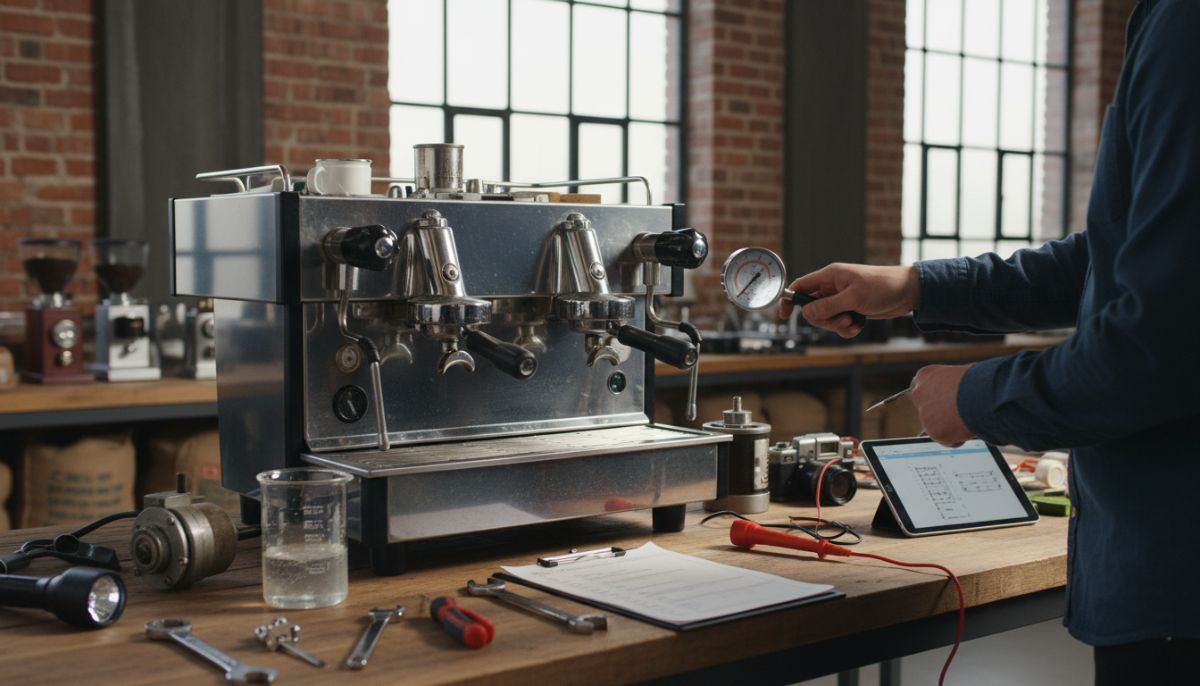
Don’t buy a boat anchor. Learn how to inspect second-hand espresso machines, diagnose dying pumps, spot boiler scale, and negotiate prices like a pro with this comprehensive guide.
Key Takeaways
- Test Cold First: Inspect wiring and internal rust before turning the machine on to prevent short circuits.
- Listen to the Pump: A fading hum indicates a dying vibration pump; a rattling sound suggests loose mounts.
- Winterize for Transport: Failure to drain the boiler before moving can freeze and crack the heat exchanger, ruining the machine.
- Know the Weak Points: Check Gaggia boilers for corrosion and Breville solenoid valves for buzzing.
- Bring Tools: A multimeter, screwdriver, and blind basket are mandatory for a proper inspection.
Buying second-hand espresso gear is the most effective way to access high-end extraction without the premium price tag. You can often secure a dual boiler machine for the price of an entry-level appliance. However, the used market is fraught with risks. A machine listed as “recently serviced” can often hide calcified boilers, dying pumps, or obsolete parts.
This guide provides a rigorous inspection workflow to ensure you purchase a functional tool, not a restoration project. By understanding the mechanical reality of the equipment, you can negotiate fairly and avoid machines that are dead on arrival.
Phase 1: Pre-Meetup Vetting
The inspection begins before you see the machine. Analyzing the listing prevents wasted trips.
Voltage and Power Requirements
If you are buying imported gear (e.g., a vintage La Marzocco or Olympia Cremina), verify the voltage. A 220v machine requires a dedicated circuit in 110v regions. Do not rely on cheap travel converters for high-wattage heating elements. Ask for a photo of the compliance plate.
Verify “Recently Serviced” Claims
Sellers often claim a machine is serviced. Ask for receipts. If they claim they performed the maintenance themselves, ask specifically if they descaled the boiler or backflushed the group. If they do not know what backflushing is, the machine likely has significant internal oil buildup.
Identify the Boiler Type
Know what you are buying. Repair costs differ significantly between machine types. Replacing a heating element in a Single Boiler is cheaper and easier than in a complex Dual Boiler system. Review the differences in boiler configurations to understand the potential maintenance load.
Phase 2: The Cold Inspection
Do not turn the machine on immediately. A cold inspection reveals neglect that heat can hide.
1. External Damage vs. Patina
Scratches on the drip tray are cosmetic. However, warped panels indicate the machine was dropped. Check the group head area. If the chrome is flaking off an E61 group head, it indicates heavy wear and potentially poor plating that can flake into your coffee.
2. The Internal Wiring Check
Ask the seller to remove the top panel. This is non-negotiable for machines over $500. Look for:
- Brittleness: Insulation on wires near the boiler should be flexible. If it cracks when touched, the wiring harness needs replacing due to heat exposure.
- Corrosion: White or green crust on copper pipes indicates slow leaks.
- Rust: Check the frame beneath the boiler. Rancilio Silvias are notorious for frame rust. Surface rust is treatable; structural rot is a dealbreaker.
Phase 3: The Hot Test and Functional Diagnostics
Fill the tank and turn the machine on. Note how long it takes to reach operating pressure.
1. The Pump Sound Test
The sound of the pump is your primary diagnostic tool. You must distinguish between a healthy pump and one near failure.
- Healthy Vibration Pump: Starts with a low hum and builds to a loud, consistent mechanical thrum as pressure builds.
- Dying Vibration Pump: The sound fades away or becomes whisper-quiet when under load (backflushing). This implies the internal piston is worn.
- Rotary Pump: Should be nearly silent with a slight motor hum. Grinding noises suggest bearing failure.
For a deeper understanding of what to expect, read about noise and pressure differences in pumps.
2. The Blind Basket Pressure Test
Insert a blind basket (a portafilter basket with no holes) and engage the pump. Watch the pressure gauge.
- Target: It should rise to 9-10 bars (or the setting of the OPV) and hold steady.
- Failure: If the needle flutters wildly or fails to reach 9 bars, the pump is weak, or the OPV (Over Pressure Valve) is stuck open.
- Solenoid Check: When you disengage the pump, you should hear a distinct “click” and see water vent into the drip tray. If there is no release of pressure (the “sneeze”), the 3-way solenoid valve is clogged or broken.
3. Steam and Vacuum Breakers
On Heat Exchanger and Dual Boiler machines, listen for a hissing sound as the boiler heats up. The vacuum breaker valve should hiss briefly and then snap shut as pressure builds. If it hisses continuously, the valve is stuck open (a $15 part, but annoying). Check the steam wand for power. Weak steam often indicates heavy scale buildup on the heating element or water level probe issues.
4. Group Head Condition
Lock the portafilter into the group head. It should lock in at the 6 o’clock position. If it moves way past to 5 or 4 o’clock, the gasket is rock hard or worn out. While this is a cheap fix, it indicates a lack of routine maintenance. Consider replacing rubber seals with silicone for longevity; see our guide on silicone vs. rubber gaskets.
Phase 4: Brand-Specific “Achilles Heels”
Every major brand has a specific failure point you must check.
Gaggia Classic
The Issue: Boiler Corrosion.
Inspection: Older Gaggias use aluminum boilers. If the previous owner did not use proper water, the boiler walls pit and corrode. Look for white flakes in the water coming out of the group head. This requires a full boiler replacement.
Breville (Sage) Dual Boiler
The Issue: Solenoid Buzz and O-rings.
Inspection: Listen for a loud, angry buzzing sound. This is a common failure of the solenoid assembly. Also, check for steam leaks inside the case, as the proprietary O-rings are prone to failure.
E61 Machines (Rocket, ECM, Lelit)
The Issue: Cam Lubrication and Mushroom Scale.
Inspection: The lever should move smoothly. Grittiness indicates the internal cam mechanism is dry and metal-on-metal wear is occurring. Learn more about the mechanics in our history of E61 groupheads.
Phase 5: Negotiation and Logistics
Estimating Repair Costs
Use identified faults to negotiate the price. Use this cheat sheet for cost estimation (excluding labor):
- Group Gasket/Shower Screen: $20 (Minor bargaining chip)
- Vacuum Breaker/Safety Valve: $20–$40
- Vibration Pump: $40–$60
- Rotary Pump: $150–$250 (Major bargaining chip)
- PID Controller: $100+
- Control Board/Gicar: $200–$400 (Walk away unless the machine is nearly free)
Transport: The Boiler Freeze Risk
If you are transporting a machine with a boiler (especially Heat Exchangers or Dual Boilers) in freezing temperatures or shipping it, you must drain the boiler. If water freezes inside, it expands and splits the copper boiler or heat exchanger. This totals the machine.
How to Drain:
- Turn the machine off while hot.
- Open the hot water tap and steam wand.
- Let the pressure force the water out.
- For complete draining (winterization), you may need to disconnect a fitting at the bottom of the boiler. Consult the specific manual.
Maintenance History as a Value Indicator
A machine with a documented history of backflushing and descaling is worth 20-30% more than one without. Scale is the hardest issue to diagnose without disassembly (using a borescope). If the seller has neglected daily and weekly cleaning, assume the boiler has scale buildup and factor a professional descaling service ($150+) into your offer.
Conclusion
Buying used espresso gear requires a shift in mindset from consumer to technician. By following this checklist—testing the pump sound, verifying pressure with a blind basket, and inspecting internal wiring—you eliminate the gamble. A well-maintained, ten-year-old E61 machine will outperform a brand-new appliance-grade machine every time, provided you know how to spot the gems among the junk.
Frequently Asked Questions
Severe scale often manifests as reduced water flow, lower steam pressure, or the machine struggling to reach operating temperature. If the water coming from the hot water tap has white floaters or sediment, the boiler is heavily calcified.
Generally, no. You should transport espresso machines upright. Laying them on their side can cause residual water in the boiler to flow into the electronics or pressure stat, causing short circuits upon startup. Always drain the boiler before transport.
Commercial machines (NSF rated) are durable but require 220v power, direct plumbing lines, and take 45+ minutes to heat up. They also have large boilers that stale water if you only pull two shots a day. For most homes, a prosumer machine is a better choice.
Bring a flashlight (to check inside the case), a stubby screwdriver (to remove top panels), a multimeter (if you know how to test continuity), and a blind basket (to test pump pressure and the OPV).
A standard Ulka vibration pump is relatively affordable, typically costing between $40 and $60 USD for the part. It is a common DIY repair that can restore a machine’s performance significantly.