
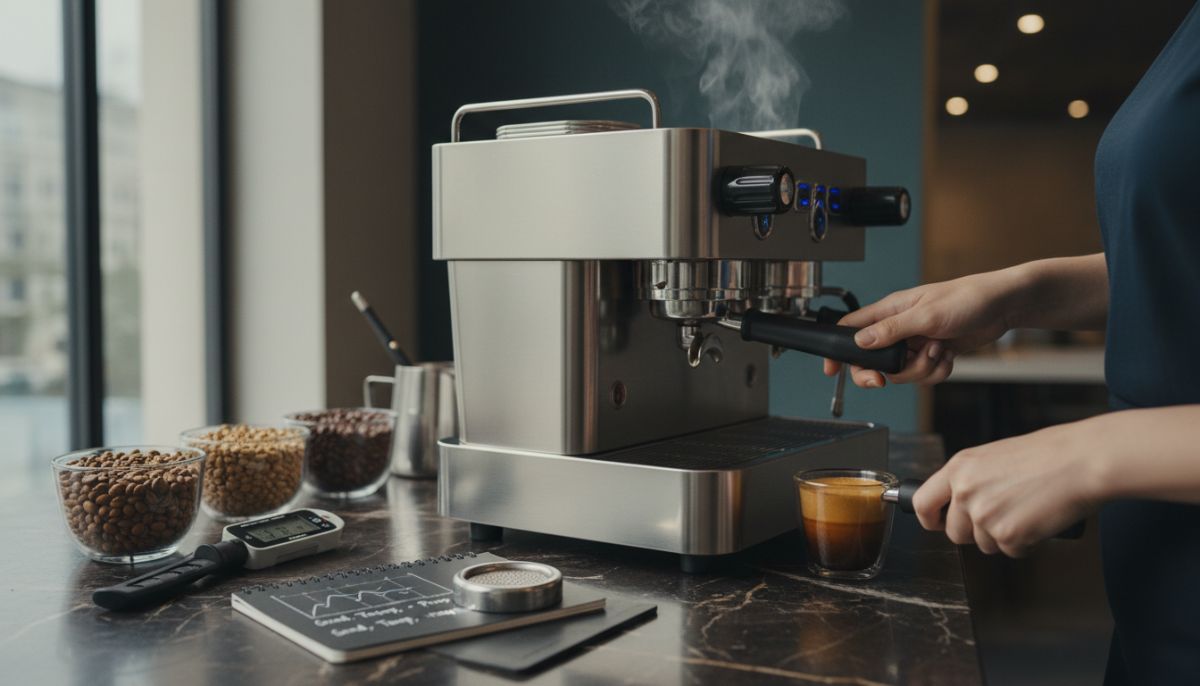
Brewing decaf espresso requires a different approach due to the unique structural changes caused by decaffeination processes. Learn how to adjust your grind, temperature, and puck prep for the perfect caffeine-free shot.
Key Takeaways
- Structural Fragility: Decaffeination processes make beans more porous and brittle, significantly increasing flow rate.
- Grind Finer: You will almost always need a finer grind setting for decaf compared to regular beans to build adequate pressure.
- Lower Temperature: Processed beans extract faster and burn easier; lowering brew temperature helps preserve sweetness.
- Precision Prep: WDT and careful tamping are non-negotiable to prevent channeling in low-density coffee pucks.
For years, the phrase "death before decaf" was the mantra of the specialty coffee world. But times have changed. With the rise of high-quality Sugarcane (Ethyl Acetate) and Swiss Water Process beans, decaf espresso is no longer an afterthought—it is a culinary delight in its own right. However, many home baristas find themselves frustrated when they switch bags. The shot runs like water, the crema dissipates instantly, or the flavor is distinctively ashy.
The problem isn’t the coffee; it is the physics. The process of removing caffeine fundamentally alters the cellular structure of the green coffee bean. To pull a syrupy, rich shot of decaf, you cannot simply use your standard full-caffeine recipe. You need to adjust your variables to account for a more fragile, porous bean.
Understanding the Physics of Decaf Beans
To brew better decaf, you must understand what happens before the beans reach your hopper. Whether using the Swiss Water method (soaking beans in green coffee extract) or the Sugarcane process (using a natural solvent), the goal is to extract a specific chemical compound: caffeine.
This extraction process is invasive. It opens up the cellular structure of the bean, making it more porous. Once roasted, decaf beans are significantly less dense and more brittle than their caffeinated counterparts. When you grind them, they shatter differently, often producing more "fines" (microscopic particles) while simultaneously offering less resistance to water flow.
This paradox—brittle beans creating fines yet flowing fast—is why understanding how to dial in your espresso ratios is even more critical with decaf. The water permeates the puck much faster because the cellulose structure has already been partially degraded.
The Grind: Go Finer, Then Go Finer Again
The most common issue with decaf espresso is a gusher—a shot that finishes in 15 seconds and tastes thin and sour. Because the beans are less dense, they provide less resistance to the 9 bars of pressure from your machine.
To counteract this, you almost invariably need to grind finer. If you are switching from a medium-roast Ethiopia to a decaf Colombia, expect to move your grind setting significantly toward the "fine" end of the spectrum. The goal is to artificially create the resistance that the bean structure lacks.
Managing Fines and Static
Decaf beans are notoriously static-prone. Because they are drier and more brittle, they create a mess. This static can cause retention issues in your grinder, where old coffee gets stuck and stales. Reading up on grinder retention is vital here. If you are single-dosing, we highly recommend using the Ross Droplet Technique (RDT)—adding a tiny drop of water to the beans before grinding—to mitigate this.
Dosing and Puck Prep
Because decaf beans are less dense, the same weight of coffee will take up more volume in your basket. If you usually dose 18 grams of regular coffee, you might find that 18 grams of decaf overflows your basket. However, because the structural integrity is lower, the puck compresses more during tamping.
We recommend sticking to your standard weight (e.g., 18g) if your basket allows it, or dosing down slightly to 17.5g if volume is an issue. However, the real secret lies in puck preparation.
Decaf is unforgiving when it comes to uneven water distribution. The water will find the path of least resistance rapidly, leading to severe channeling. Using a Weiss Distribution Technique (WDT) tool is arguably more important for decaf than regular coffee. The science of puck prep shows us that breaking up clumps and homogenizing the bed is the only way to ensure the water flows through the coffee, not just around it.
Temperature: Cool it Down
One of the distinct characteristics of processed decaf beans is that they brown faster during roasting. As a result, they often look darker than they taste. However, because their cellular structure is already compromised, they extract very easily.
High temperatures (202°F/94°C and above) can easily over-extract decaf, leading to bitter, ashy, or dry flavors. If you have a PID controller, try lowering your temperature to 195°F–198°F (90°C–92°C). If you are using a machine without a PID, mastering temperature surfing techniques becomes essential to ensure you aren’t scorching these delicate beans.
Flow Rate and Ratio Strategies
With caffeinated beans, we often aim for a 1:2 ratio in 25–30 seconds. With decaf, you might need to throw the timer out the window. Because decaf produces less crema (crema is largely CO2, and decaf beans have less trapped gas), the visual cues are different.
Decaf shots often look "thin" even when extracted perfectly. Do not be discouraged by a lack of tiger striping. Focus on taste. If the shot is running too fast despite a fine grind, you might be experiencing channeling. If you spot spraying or bald spots on a bottomless portafilter, you are dealing with channeling and uneven water flow, which requires revisiting your tamping technique.
The Ristretto Approach
Since decaf extracts so readily, you can often get away with a shorter ratio, closer to a Ristretto (1:1.5). This concentrates the body and mouthfeel, compensating for the natural thinness of the processed bean. It also minimizes the risk of extracting the harsh, woody flavors that come at the tail end of a decaf extraction.
Conclusion
Brewing decaf espresso is an exercise in gentleness. You are working with a bean that has already been through a lot. By grinding finer to increase resistance, lowering your water temperature to prevent burning, and being meticulous with your puck prep, you can produce a cup that rivals any full-caffeine shot. Don’t let the lack of caffeine fool you; the complexity is there, waiting for the right technique to unlock it.
Frequently Asked Questions
Decaffeinated beans are less dense and more porous than regular beans due to the processing method. This structure offers less resistance to water, causing the shot to run faster. You typically need to grind significantly finer to compensate.
Decaf beans generally extract faster and can taste ashy if brewed too hot. A lower temperature range of 195°F to 198°F (90°C–92°C) is often ideal to preserve sweetness and body.
Because decaf is less dense, the same weight takes up more volume. You may need to slightly lower your dose (e.g., from 18g to 17.5g) to fit it in the basket, though tamping will compress it significantly.
The decaffeination process removes some of the organic compounds and oils responsible for crema. Additionally, roasted decaf beans degassing faster and trap less CO2, resulting in a thinner layer of foam.