
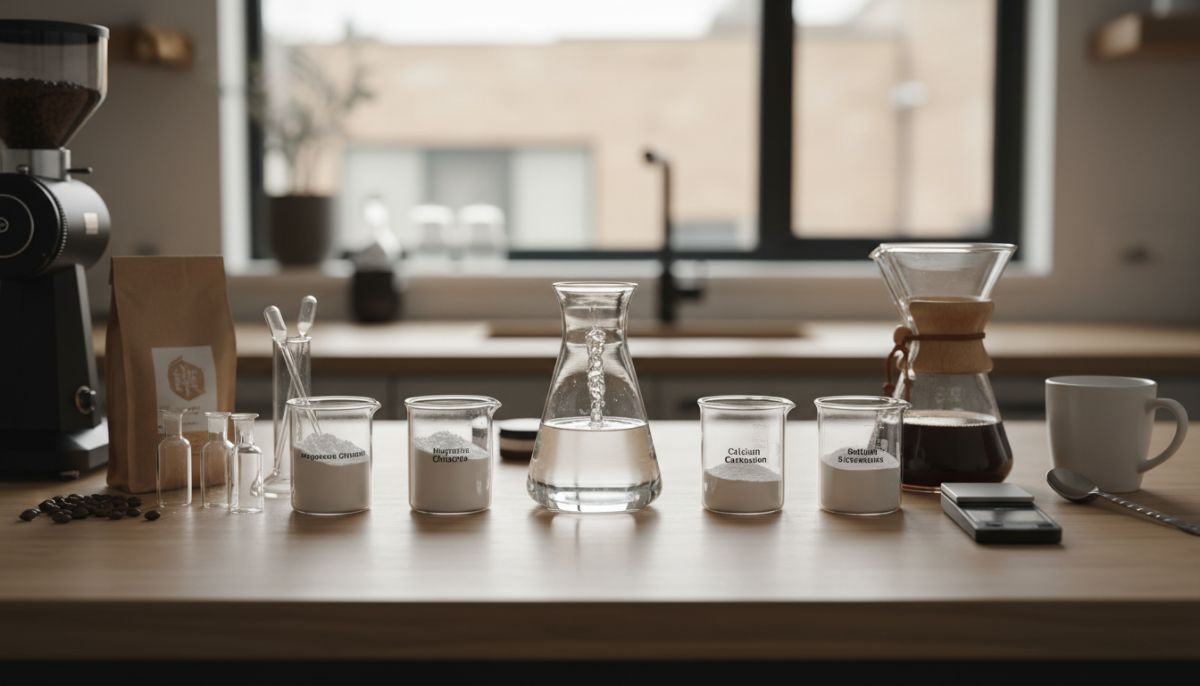
Stop brewing with tap water. Learn how to create custom water recipes using magnesium, calcium, and bicarbonate to unlock the true potential of your coffee beans.
Key Takeaways
- Water is 98% of Coffee: Even the best beans will taste flat or sour if your water chemistry is off.
- The Canvas Strategy: Always start with 0 TDS water (Distilled or RO) and remineralize it.
- Flavor Levers: Magnesium enhances fruitiness and acidity; Calcium adds body and creaminess; Bicarbonate buffers acidity to prevent sourness.
- Safety First: Avoid putting chlorides in espresso machines to prevent boiler corrosion.
- Cost Efficiency: DIY mineral concentrates cost pennies compared to pre-made sachets like Third Wave Water.
The Hidden Ingredient in Your Brew
You have invested in a precision grinder, fresh specialty beans, and perhaps a high-end espresso machine. Yet, your coffee lacks the vibrancy found in top-tier cafes. The culprit is almost certainly your water. Coffee is approximately 98% water (and up to 99% for filter coffee). Using tap water, which is often laden with chlorine, random minerals, and unpredictable buffer capacities, is akin to painting a masterpiece on a dirty canvas.
To achieve competition-level consistency—the kind seen at the World Brewers Cup—you must build your water from scratch. By starting with a generic base of distilled or Reverse Osmosis (RO) water and adding specific amounts of minerals, you gain total control over extraction. This guide simplifies the chemistry of SCA water standards into actionable recipes, allowing you to modulate acidity, sweetness, and body.
If you have been struggling with scale buildup, this approach is also the ultimate preventative measure. As discussed in our guide on water chemistry and scale, controlling your mineral content is vital for machine longevity.
The Holy Trinity of Coffee Water Chemistry
Before mixing, you must understand the three specific metrics that dictate flavor. You do not need a chemistry degree, but you do need to understand the function of each component.
1. General Hardness (GH): The Flavor Extractors
GH refers to the concentration of multivalent cations, primarily Magnesium (Mg) and Calcium (Ca). These minerals bond with the flavor compounds in coffee grounds and pull them into the water.
- Magnesium: Highly effective at extracting smaller organic molecules associated with fruitiness, brightness, and acidity. Modern “Nordic” roasts benefit heavily from high magnesium levels.
- Calcium: Bonds readily with heavier compounds that create mouthfeel, body, and creaminess. It balances the sharpness of magnesium.
2. Carbonate Hardness (KH) / Alkalinity: The Buffer
KH (often synonymous with Alkalinity in coffee contexts) measures the water’s ability to neutralize acid. It acts as the “Buffer.”
- Too Low KH: The coffee will taste sharp, sour, and thin.
- Too High KH: The buffer neutralizes the good acids (citric, malic), making the coffee taste flat, chalky, or dull.
3. Total Dissolved Solids (TDS)
This is the total weight of minerals in the solution, measured in parts per million (ppm). The Specialty Coffee Association (SCA) recommends a target TDS of 75-175 ppm. However, the composition of that TDS matters more than the total number.
Sourcing Your Minerals: The Shopping List
To create safe, food-grade water, purchase these specific additives. Do not use industrial chemicals.
- Magnesium Source: Epsom Salts (Magnesium Sulfate Heptahydrate – MgSO4·7H2O). Ensure it is unscented and food-grade (USP).
- Buffer Source: Baking Soda (Sodium Bicarbonate – NaHCO3). Standard Arm & Hammer is acceptable, provided it is pure baking soda, not powder.
- Optional Calcium Source: Calcium Citrate. Note: Calcium Chloride is popular for taste but is corrosive to metals. For espresso machines, stick to Calcium Citrate or rely on Magnesium for hardness.
- The Base: Distilled water or Zero Water filter output (0 ppm).
You will also need a precision scale capable of measuring 0.01g to ensure accuracy.
The Concentrate Method: Step-by-Step Guide
Trying to weigh 0.05g of powder for a single brew is prone to error. The professional method, popularized by Barista Hustle, involves creating “Concentrates.” You mix a large batch of mineral water, then add small drops of that concentrate to your brewing water.
Step 1: Create the “Buffer” Concentrate (Alkalinity)
This solution controls acidity. We use Sodium Bicarbonate (Baking Soda).
- Weigh 1.68g of Baking Soda.
- Add it to 1 Liter of distilled water.
- Shake until fully dissolved.
- Result: 1g of this liquid adds approx. 1 ppm alkalinity (as CaCO3) to 1L of water.
Step 2: Create the “Hardness” Concentrate (Magnesium)
This solution drives extraction. We use Epsom Salts.
- Weigh 2.45g of Epsom Salts.
- Add it to 1 Liter of distilled water.
- Shake until dissolved.
- Result: 1g of this liquid adds approx. 1 ppm hardness (as CaCO3) to 1L of water.
Competition-Ready Recipes
Now that you have your two bottles of concentrate (Buffer and Hardness), you can mix them into fresh distilled water to create specific profiles. The following recipes are for making 1 Liter of Brewing Water.
1. The SCA Standard (Balanced)
This profile mimics the official SCA specifications. It provides a neutral, balanced cup suitable for most medium roasts and standard cupping protocols.
- Buffer Concentrate: 40g
- Hardness Concentrate: 68g
- Distilled Water: 892g
- Profile: ~40 ppm Alkalinity / ~68 ppm Hardness.
2. The “Bright & Fruity” (Light Roast / Filter)
High magnesium pushes extraction of fruit notes, while lower alkalinity allows the acidity to shine. Perfect for washed Ethiopians or Geishas. This aligns with modern trends in processing methods.
- Buffer Concentrate: 25g
- Hardness Concentrate: 80g
- Distilled Water: 895g
- Profile: ~25 ppm Alkalinity / ~80 ppm Hardness.
3. The Espresso Profile (Machine Safe)
Espresso requires careful buffering to handle the intense acidity of concentrated extraction, but you must avoid scaling. This recipe keeps hardness moderate. If you are troubleshooting a shot that tastes sour, slightly increase the buffer.
- Buffer Concentrate: 50g
- Hardness Concentrate: 60g
- Distilled Water: 890g
- Profile: ~50 ppm Alkalinity / ~60 ppm Hardness.
4. The Rao / Perger Water
A classic recipe from the early days of scientific brewing, favoring high extraction yield.
- Buffer Concentrate: 50g
- Hardness Concentrate: 100g
- Distilled Water: 850g
- Profile: ~50 ppm Alkalinity / ~100 ppm Hardness.
Quick Mixing Cheat Sheet
Use this table to quickly mix different volumes of water without recalculating.
| Target Profile | Batch Size | Buffer Conc. (g) | Hardness Conc. (g) | Distilled Water (g) |
|---|---|---|---|---|
| SCA Standard | 1 Liter | 40 | 68 | 892 |
| SCA Standard | 1 Gallon (3.8L) | 152 | 258 | 3,375 |
| Bright (Filter) | 1 Liter | 25 | 80 | 895 |
| Espresso | 1 Liter | 50 | 60 | 890 |
| Espresso | 1 Gallon (3.8L) | 190 | 228 | 3,367 |
Advanced Sensory Troubleshooting
Even with a recipe, you may need to adjust based on your specific beans. Developing your coffee palate takes time, but water adjustment yields immediate results.
- Problem: Coffee tastes chalky, dull, or lacks acidity.
Diagnosis: Alkalinity (Buffer) is too high.
Fix: Reduce the Buffer concentrate by 10-20%. - Problem: Coffee is intensely sour, sharp, or hollow.
Diagnosis: Alkalinity is too low, or Hardness is too high relative to buffer.
Fix: Increase Buffer concentrate. - Problem: Coffee lacks body or feels “thin.”
Diagnosis: Total Hardness is too low.
Fix: Increase the Hardness concentrate. Note: Magnesium adds less body than Calcium. If you want a creamy texture, consider swapping 50% of your magnesium source for Calcium Citrate, though it dissolves poorly. - Problem: Bitter finish.
Diagnosis: High Magnesium can sometimes emphasize bitterness in dark roasts.
Fix: Reduce Hardness or switch to a simpler filtration method for dark roasts.
A Critical Warning on Chlorides
Many online recipes suggest using Calcium Chloride because it is highly soluble and tasty. Do not use chlorides in an espresso machine. Under the high heat and pressure of a boiler (especially stainless steel or copper), chloride ions destroy the protective oxide layer of the metal, leading to rapid pitting corrosion. This damage is irreversible.
For pour-over (kettle brewing), chlorides are safe as the water does not sit in a pressurized boiler. However, for simplicity and equipment safety, we recommend sticking to Sulfate (Epsom) and Bicarbonate recipes universally.
The Economics: DIY vs. Packets
Is the effort worth it? Let’s look at the numbers.
- Third Wave Water / Lotus Drops: Approx. $1.50 – $2.00 per gallon.
- DIY Minerals: A 1lb bag of Epsom Salt ($5) and a box of Baking Soda ($1) will make thousands of gallons of brew water. The cost is roughly $0.01 per gallon.
By spending ten minutes mixing concentrates, you save hundreds of dollars a year and gain infinite adjustability.
Conclusion
Water is the variable that separates the amateur from the expert. By remineralizing distilled water with simple magnesium and bicarbonate concentrates, you ensure that your extraction is consistent, your equipment is safe from scale, and your flavor profile is intentional. Start with the SCA Standard recipe, brew a control cup, and then tweak the hardness or buffer to suit your taste. You now have the power to engineer your perfect cup.
Frequently Asked Questions
No. Tap water contains unknown levels of minerals, chlorine, and contaminants. You must start with ’empty’ water (0 TDS) like distilled or Reverse Osmosis (RO) water to effectively control the final mineral profile.
Yes, provided you buy ‘USP’ (United States Pharmacopeia) or Food Grade Epsom Salt (Magnesium Sulfate). Do not use Epsom salts intended for bath soaking if they contain added scents or oils.
Sourness is often a sign of insufficient Alkalinity (Buffer). If your water lacks bicarbonate, it cannot neutralize the sharp acids in the coffee. Try increasing your Buffer concentrate ratio.
The ‘Espresso Profile’ recipe provided is designed to be non-scaling at normal operating temperatures. However, all mineral water has some scaling potential. Regular maintenance is still required, but this is much safer than tap water.
You must use Baking Soda (Sodium Bicarbonate). Baking Powder contains added acids (like cream of tartar) and cornstarch, which will ruin the flavor and chemistry of your coffee water. Do not interchange them.