Stop sacrificing your wrists for espresso. Learn the biomechanics of proper tamping, how to adjust your home setup for ergonomics, and why the ’30lb pressure’ rule is a myth.
Key Takeaways
- Neutral Wrist Position: Always maintain a straight line from forearm to knuckles to prevent nerve compression.
- Body Weight vs. Muscle Force: Use your body weight to lean into the tamp rather than pushing with your shoulder or arm muscles.
- Counter Height Matters: Standard kitchen counters are often too high for proper leverage; adjust your stance or station height.
- Gear Upgrades: Palm tampers and calibrated spring-loaded tampers significantly reduce strain compared to traditional handles.
- Ignore the 30lb Myth: Consistency and level tamping are far more important than heavy pressure.
The Hidden Danger of "Barista Wrist" at Home
Making espresso at home should be a ritual of pleasure, not a source of chronic pain. However, many home enthusiasts unknowingly mimic the high-volume movements of professional baristas without the benefit of ergonomically designed commercial bars. This leads to Repetitive Strain Injury (RSI), often manifesting as tendonitis, carpal tunnel syndrome, or general wrist fatigue.
The culprit is rarely the coffee itself, but rather the biomechanics of how we interact with the portafilter. When you repeatedly apply force through a collapsed or bent wrist, you compress the median nerve and strain the forearm extensors. By understanding the anatomy of a safe tamp, you can brew better espresso and protect your joints for the long haul.
The Biomechanics of Tamping: Neutrality is Key
The golden rule of ergonomic tamping is the Neutral Spine, Neutral Wrist principle. Your bones, not your muscles, should bear the load.
The "Doorknob" Grip vs. The "Flashlight" Grip
Most beginners naturally grab the tamper handle like a flashlight (fist clenched around the shaft, thumb on top). This forces the elbow outward and bends the wrist into ulnar deviation (angled toward the pinky) or extension (bent backward). This is the fastest route to injury.
The Correct Grip: The Doorknob Method
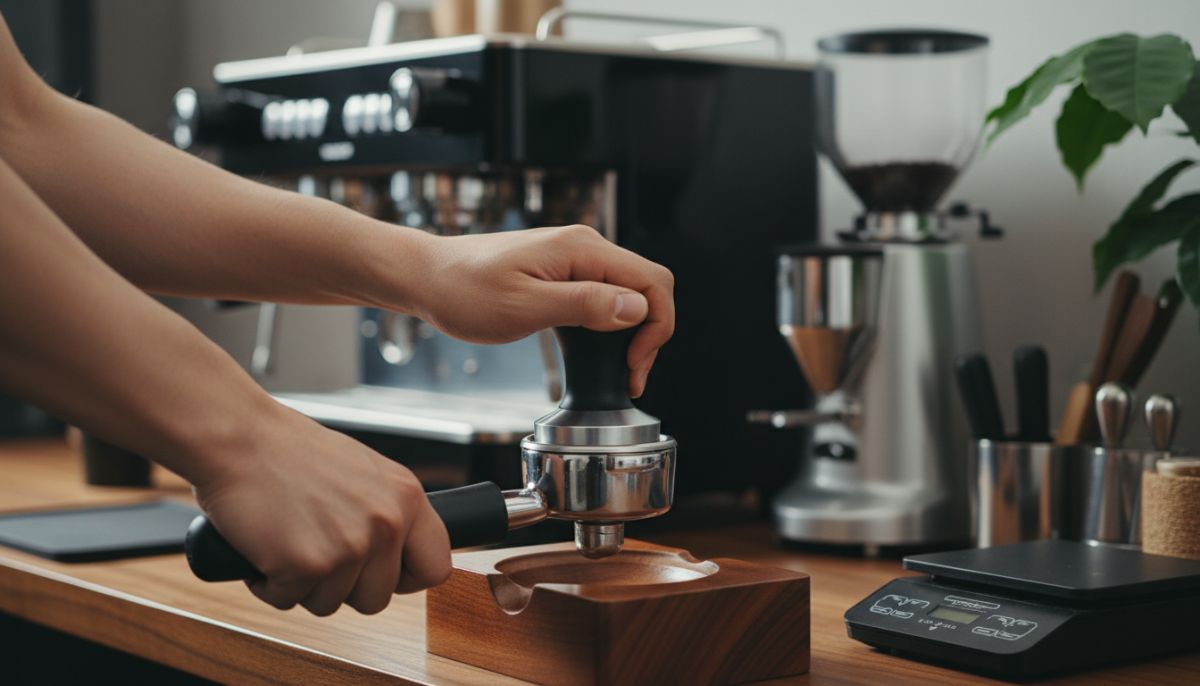
Approach the tamper as if you are turning a doorknob. Rest the base of the handle against the fleshy part of your palm (the thenar eminence). Your thumb and index finger should pinch the base of the tamper handle, providing stability. This grip keeps the wrist perfectly straight, aligning the radius and ulna bones directly over the puck.
The Kitchen Counter Conundrum: Height vs. Leverage
Commercial espresso bars are designed with specific working heights (usually 36-42 inches) relative to the barista's elbow. In a home kitchen, standard counters are 36 inches high. Once you add an espresso machine, the portafilter basket sits at roughly 40-44 inches.
For many home baristas, this places the tamping surface too high relative to their torso. If the portafilter is near chest height, you cannot use your body weight. You are forced to raise your elbow (Barista Elbow) and push using your rotator cuff and wrist muscles.
The Fix:
- Step Up: If you are shorter, use a stable step stool to get your hip bone above the level of the counter.
- Lower the Station: If possible, set up a dedicated coffee station on a lower cart or table (30-32 inches).
- The Perpendicular Stance: Stand perpendicular to the counter. Turn your hips toward the machine. This opens your chest and allows you to lean comfortably.
The Body Weight Lean: Physics Over Brute Force
You should never feel like you are "pushing" the tamper down. Instead, you are simply transferring your mass.
- Lock the Arm: With a neutral wrist grip, straighten your arm. Your elbow should be directly above your wrist, and your shoulder directly above your elbow.
- Engage the Core: Keep your back straight.
- Lean In: Shift your weight from your back foot to your front foot, allowing your upper body to fall forward onto the tamper. Gravity does the work.
This technique eliminates muscular strain and ensures the force is applied vertically, reducing the risk of channeling caused by uneven pressure.
Debunking the 30lb Pressure Myth
For decades, coffee training dictated a strict "30 pounds of pressure." Modern extraction theory has proven this unnecessary and potentially harmful. Once the coffee puck is fully compressed (removing air pockets), applying more force does not increase density; it only increases the strain on your body.
The Reality: You likely only need 10-15 pounds of pressure to fully compress the puck. Consistency and leveling are far more critical than force. If you are straining to hit an arbitrary pressure number, stop. A level tamp is the primary goal.
Ergonomic Gear: Tools to Save Your Joints
If you have existing wrist issues like arthritis or carpal tunnel, or simply want to prevent them, upgrading your tamper is the most effective change you can make.
1. Palm Tampers (Push Tampers)
These are handleless devices that sit flat against the palm. You push them down with an open hand, completely eliminating wrist extension. Many are adjustable depth, ensuring a perfectly level tamp every time without the need for skill or force. This is often the best solution for those with weak grip strength.
2. Calibrated and Spring-Loaded Tampers
Tools like the Normcore V4 or The Force Tamper provide force feedback. They click or release when the desired pressure is reached. This prevents over-tamping and reduces the mental and physical fatigue of guessing your pressure. When deciding between a leveler or just a good tamper, a high-quality calibrated tamper is often the superior ergonomic choice.
3. Automatic Tampers
For those with severe RSI or high-volume home setups, devices like the Puqpress automate the process entirely. You insert the portafilter, and the machine tamps for you. While expensive, they offer zero physical strain.
Alternative Workflows: The Low-Pressure Trend
Another way to reduce strain is to change your brewing style. The rise of the turbo shot utilizes coarser grinds and lower pressures (6 bars). Because the grind is coarser, the resistance during tamping is different, often requiring less compaction force to achieve the desired flow rate.
Additionally, ensuring proper puck prep with a WDT tool breaks up clumps before you tamp. This creates a fluffy, even bed of coffee that compresses easily, requiring less physical effort to level out.
Pre-Shift Warm-Up: Stretches for Baristas
Treat coffee making like the athletic activity it is. Perform these simple stretches before your morning routine:
- Prayer Stretch: Place palms together in front of your chest and slowly lower your hands until you feel a stretch in your forearms.
- Wrist Flexor Stretch: Extend one arm forward, palm up. Use the other hand to gently pull your fingers back toward you.
- Fist Rotations: Make soft fists and rotate your wrists in circles, 10 times clockwise and 10 times counter-clockwise.
Conclusion
Ergonomics is not just for office workers; it is essential for the longevity of any home barista. By adjusting your counter height, adopting the "doorknob" grip, and utilizing modern tools like palm tampers, you can eliminate wrist pain. Remember, the best espresso is the one you can make comfortably for the rest of your life.
Frequently Asked Questions
No. Modern extraction tests show that once the air is removed from the coffee puck (full compression), additional force does not improve extraction. 10-15lbs is usually sufficient. Consistency and levelness are more important than force.
A palm tamper (or push tamper) is typically best for arthritis. It eliminates the need to grip a handle and allows you to use your body weight through an open palm, keeping the wrist neutral.
Wrist pain often stems from tamping with a ‘collapsed’ wrist (bent backward or sideways) or working on a counter that is too high, forcing you to use shoulder muscles instead of body weight. This can lead to Repetitive Strain Injury (RSI).
Ideally, the top of the portafilter (when locked in or on a tamping mat) should be low enough that your elbow is directly above your wrist when your arm is straight. For most people, this is lower than a standard 36-inch kitchen counter.
Yes, indirectly. A WDT tool de-clumps the coffee and creates an even density, meaning the puck compresses more smoothly and requires less corrective force to get a level surface.