
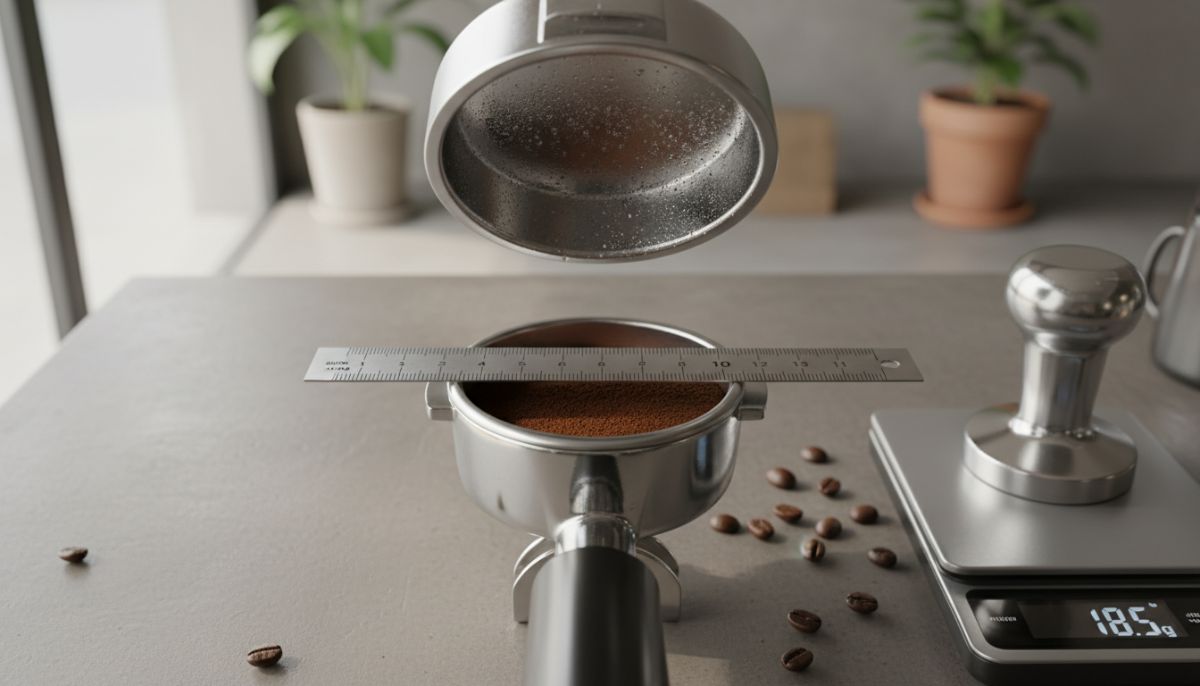
Headspace is the invisible variable in your espresso extraction. Learn exactly how much gap you need between your puck and shower screen to prevent channeling and ensure consistent shots.
Key Takeaways
- Headspace defined: It is the empty space between the top of your tamped coffee puck and the shower screen of your grouphead.
- The Goldilocks Zone: Too little space causes uneven extraction and channeling; too much can lead to messy, wet pucks and delayed pressure buildup.
- The Coin Test: A simple, cost-free method to determine if your current dose is appropriate for your specific basket.
- Variable adjustments: Changing your roast level or grind setting alters the volume of your dose, requiring you to re-evaluate your headspace.
You have bought the best beans, you have invested in a high-end grinder, and you are meticulous about your distribution. Yet, your shots are inconsistent. Sometimes they taste divine; other times, they are harsh and astringent. You might be ignoring the invisible variable of espresso brewing: Headspace.
While most home baristas obsess over grind size and yield, few pay enough attention to the vertical gap inside the portafilter. The amount of coffee you fit in your basket determines more than just the strength of the beverage; it dictates how water interacts with the coffee bed in those critical first seconds of extraction. If this gap is wrong, even the most expensive equipment cannot save your shot.
What Exactly is Espresso Headspace?
In simple terms, headspace is the clearance between the top of your tamped coffee puck and the dispersion screen (shower screen) of your espresso machine. This gap is crucial because coffee grounds are not static; they are reactive.
When hot water hits dry coffee, the grounds release gases (CO2) and absorb water, causing them to expand. This process is similar to what happens during a pour-over bloom. If you want to understand the mechanics of expansion better, our guide on blooming espresso and pre-infusion covers the science of wetting coffee grounds.
If there is zero headspace, the coffee has nowhere to go when it expands. If there is too much, the water behaves unpredictably before building pressure. Finding the sweet spot—typically between 1mm and 2mm—is essential for repeatable extractions.
The Dangers of Too Little Headspace
Many baristas inadvertently overfill their baskets, thinking that “more coffee equals more flavor.” While a higher dose does increase strength, overfilling the basket eliminates the necessary headspace. This causes a cascade of extraction failures.
1. The Puck Fracture
When you lock your portafilter into the grouphead, the shower screen should not touch the dry coffee. If the basket is overfilled, the shower screen presses into the puck, fracturing the carefully prepared surface. These fractures create paths of least resistance.
Water is lazy; it will always flow where it is easiest. Instead of saturating the puck evenly, the water rushes through these cracks. This is a classic cause of channeling. If you are struggling with spurting shots or uneven flow, you should review our guide on how to spot and fix uneven water flow. Often, the culprit is simply too much coffee in the basket.
2. Restricted Flow and Uneven Saturation
Even if the puck doesn’t fracture, a lack of headspace prevents the water from forming a uniform layer above the coffee before permeation begins. This leads to dry spots in the puck and over-extracted sections directly beneath the water jets of the shower screen. The result is a cup that tastes both sour and bitter simultaneously.
The Issues with Too Much Headspace
On the flip side, underfilling your basket creates a massive gap between the shower screen and the coffee. While this is generally less catastrophic than overfilling, it introduces its own set of annoyances.
1. The Soupy Puck
A large headspace leaves room for a significant amount of water to pool on top of the puck after the shot finishes. When the pressure is released (via the 3-way solenoid valve), this excess water creates a muddy, soupy mess. While a wet puck doesn’t necessarily mean the espresso tastes bad, it makes cleaning your knock box much more difficult.
2. Delayed Pressure Buildup
excessive headspace requires the pump to fill a larger void with water before pressure can build up against the coffee bed. This can alter the timing of your shot and change the flavor profile, often reducing body and texture.
The Coin Test: How to Measure Your Headspace
You do not need expensive calipers to measure this gap. The most effective diagnostic tool is likely in your pocket right now: a nickel (or a similar coin approx. 1.5mm to 2mm thick).
Step-by-Step Guide:
- Prep your puck: Grind, distribute, and tamp your dose as you normally would.
- Place the coin: Gently place the nickel in the center of the dry, tamped puck.
- Lock it in: Insert the portafilter into the machine and lock it tight. Do not turn on the water.
- Remove and inspect: Unlock the portafilter and carefully remove the coin.
Interpreting the Results:
- No Impression: If the coin left no mark on the coffee, or was barely pressed, you have plenty of headspace. You might even be able to increase your dose slightly.
- Slight Impression: If the coin was pressed slightly into the coffee but didn’t ruin the puck integrity, your headspace is likely perfect (around 2mm).
- Deep Impression / Stuck Coin: If the coin was smashed deep into the puck, or if the shower screen screw left an imprint on the coffee itself, you are overfilling. You need to reduce your dose.
Basket Geometry: Stock vs. Precision
Not all baskets are created equal. A “18g” basket from one manufacturer might hold 20g of a light roast but only 16g of a dark roast. This is where equipment choice becomes vital.
Precision baskets, like VST or IMS, are manufactured with strict tolerances and straight walls, which can significantly alter your required headspace compared to tapered stock baskets. If you are upgrading your gear, it is crucial to understand the differences. We dive deep into this topic in our comparison of stock vs. precision baskets.
Switching to a precision basket often requires a finer grind, which reduces the volume of the coffee. Consequently, you might need to *increase* your dose to maintain the correct headspace, or conversely, decrease it if the flow is too fast.
The Impact of Roast Level on Volume
One of the most common mistakes baristas make is keeping the same dose weight when switching beans. Dark roasts are less dense than light roasts. This means that 18 grams of a dark roast takes up significantly more physical space (volume) than 18 grams of a light roast.
If you dial in your headspace with a dense Ethiopian light roast, and then switch to a dark Italian blend using the same 18g weight, you will likely overfill the basket and choke the machine. When learning how to dial in espresso ratios, always remember that volume matters just as much as weight.
Puck Screens: The Headspace Eater
The recent trend of using puck screens adds another layer of complexity. These metal mesh screens sit on top of your puck to keep the grouphead clean and disperse water. However, they are typically 1.7mm thick.
If you start using a puck screen, you representatively reduce your headspace by nearly 2mm. To accommodate this, you must lower your coffee dose—usually by 1 to 2 grams. If you don’t, the screen will press into the shower screen, potentially damaging the gasket or bending the screen itself. For a full breakdown on whether these tools are worth the hassle, read our analysis on puck screens and flavor.
Conclusion
Headspace is not a fixed number; it is a relationship between your basket, your coffee’s density, and your machine’s design. Ignoring it leads to inconsistency, while mastering it unlocks a new level of control over your extraction.
Start with the coin test today. If you find you are overfilling, drop your dose by a gram and fine up your grind. You might be surprised at how much sweeter and more consistent your espresso becomes once the water has room to do its work.
Frequently Asked Questions
Ideally, you should aim for 1mm to 2mm of clearance between the top of the tamped puck and the shower screen. This allows the coffee to expand (bloom) without hitting the screen.
Too much headspace often leads to a ‘soupy’ or wet puck because water pools on top after the shot. It can also delay pressure buildup, potentially resulting in a shot with less body, though it is generally less harmful than too little headspace.
Yes. Finer grounds pack more tightly, taking up less volume for the same weight. Coarser grounds are fluffier and take up more volume. If you change your grind size significantly, you may need to adjust your dose to maintain correct headspace.
The coin test involves placing a nickel (approx. 1.9mm thick) on your tamped puck and locking the portafilter into the grouphead. If the coin leaves a slight impression without breaking the puck, your headspace is correct. If it presses deeply, you are overfilling.