
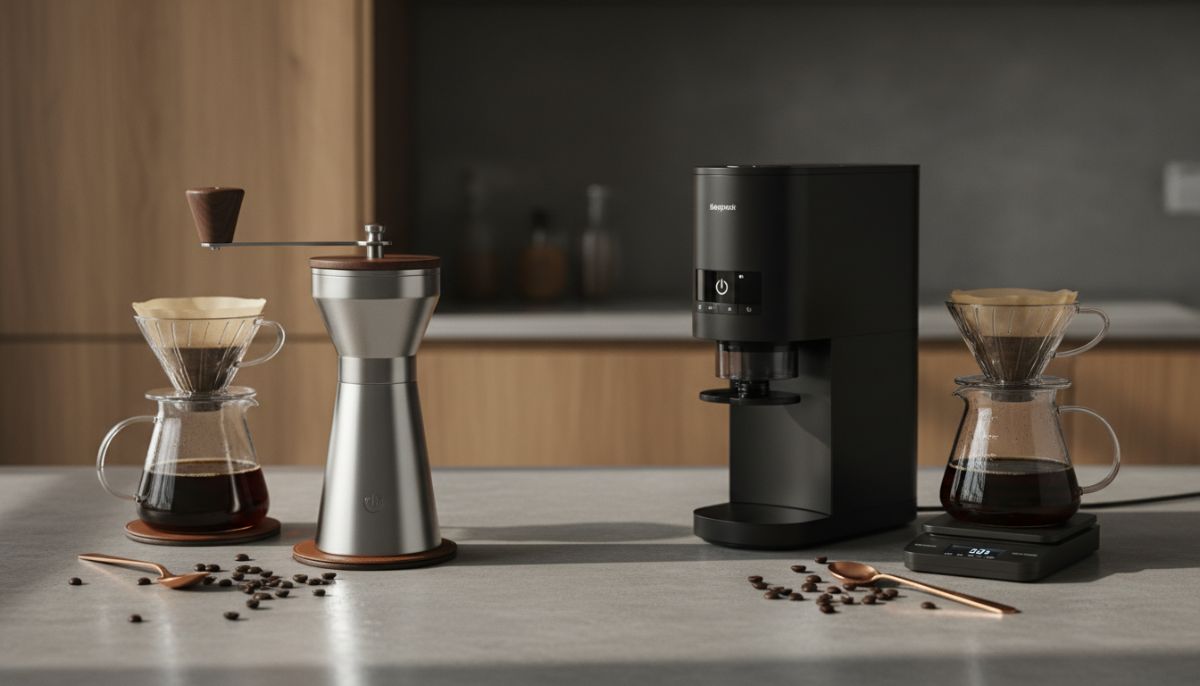
Is a premium manual grinder worth the effort? We compare high-end hand grinders against electric titans to see which offers better taste, value, and consistency.
Key Takeaways
- Price-to-Performance Ratio: Manual grinders generally offer superior grind consistency compared to electric grinders at the same price point.
- Workflow & Speed: Electric grinders win on convenience and speed, especially for espresso or brewing multiple cups.
- Sensory Experience: Hand grinding offers a tactile connection to the coffee but requires physical effort that isn’t for everyone.
- Retention: High-end hand grinders typically have near-zero retention, minimizing waste compared to many electric hoppers.
For years, the manual coffee grinder was seen as a travel companion or a budget compromise. It was the tool you used when you couldn’t afford a “real” grinder. That narrative has shifted dramatically.
Today, the market is flooded with precision-engineered, high-end hand grinders that command prices higher than many entry-level electric appliances. But does the increase in physical effort translate to a better cup of coffee?
If you are debating between a premium hand mill and a motorized countertop unit, you aren’t just choosing a tool. You are choosing a lifestyle and a specific approach to flavor. Let’s break down the battle between manual labor and electric convenience.
The Economics of the Grind
When you buy an electric grinder, a significant portion of your money pays for the motor, the electronics, the housing, and the regulatory certifications. When you buy a hand grinder, almost every dollar goes into the burr set and the alignment stability.
A $300 hand grinder often houses the same (or better) burr geometry as a $800 electric grinder. This gives manual grinders a massive edge in the price-to-performance ratio. If you are working with a tight budget but demand professional results, the manual route is often the smartest play.
This is particularly relevant for those just starting out. If you are looking to pair a grinder with one of the top 5 entry-level espresso machines under $500, a high-end hand grinder ensures you aren’t bottling-necking your extraction with inconsistent grounds.
Burr Geometry and Flavor Profiles
Most high-end hand grinders utilize large conical burrs. These burrs are excellent at producing a bimodal grind distribution, which adds texture and body to the cup. It creates a classic, rich espresso profile or a complex pour-over.
However, the electric market offers a wider variety of flat burr options. Flat burrs generally provide higher clarity and flavor separation, which is preferred by those who chase light roast, floral notes.
Understanding how grinder geometry changes your espresso flavor profile is crucial before making a purchase. If you crave clarity above all else, an electric flat-burr grinder might still be the king. But for body and sweetness, a premium conical hand grinder is a formidable contender.
The Workflow Factor: Ritual vs. Convenience
This is where the divide is sharpest. Grinding 18 grams of beans for espresso by hand takes anywhere from 30 to 60 seconds, depending on the bean density and the grinder’s gearing.
For one person, this is a zen-like moment of anticipation. For a host trying to serve four lattes during a dinner party, it is a nightmare.
The Tactile Experience
There is a rising trend in coffee that values the manual process. Just as we have seen with the rise of manual lever machines, using a hand grinder connects you physically to the bean. You can feel the resistance change as the beans shatter, giving you tactile feedback on the roast level and freshness.
The Morning Rush
Conversely, if your morning routine involves getting out the door in ten minutes, an electric grinder is superior. The ability to push a button and walk away to prep your portafilter cannot be understated.
Noise Pollution and Kitchen Atmosphere
Espresso preparation can be loud. Between the vibratory pump of the machine and the high-RPM whine of an electric grinder, your morning coffee ritual can wake up the whole house.
High-end hand grinders are whisper quiet. The only sound is the crunch of beans. If you are obsessed with how to quiet your coffee bar, swapping a motorized grinder for a manual one is the most effective step you can take.
Retention and Waste
Retention refers to the coffee grounds that get stuck inside the grinder after the cycle is finished. Many electric grinders, especially older designs with chutes, can retain 1 to 3 grams of coffee. This means your first shot of the morning might contain stale grounds from yesterday.
Premium hand grinders are designed for “single dosing” and typically have zero retention. You put 18 grams in, and you get 18 grams out.
This precision is vital when you are learning how to dial in espresso ratios and yield. If your output weight fluctuates because of grinder retention, it becomes impossible to troubleshoot your shot effectively.
Portability and Durability
You cannot take your heavy electric grinder camping, but a hand grinder fits in a backpack. Furthermore, there are fewer points of failure. No capacitors to blow, no motors to burn out.
A well-made stainless steel hand grinder is an heirloom piece. With simple cleaning, it will last a lifetime. Speaking of maintenance, because they disassemble easily without tools, keeping them clean is straightforward, ensuring you don’t have rancid oils affecting the freshness of your beans.
Conclusion: Which One Should You Buy?
The decision ultimately comes down to what you value more: the quality of the grind per dollar spent, or the efficiency of your workflow.
Choose a High-End Hand Grinder If:
- You want top-tier espresso quality on a budget.
- You value silence and have a small kitchen footprint.
- You typically brew for only one or two people.
- You enjoy the ritual and tactile nature of brewing.
Choose an Electric Grinder If:
- You frequently serve multiple guests.
- You prefer light roasts and crave the clarity of flat burrs.
- You view coffee making as a necessity rather than a hobby.
- Physical resistance or repetitive motion is an issue for you.
Whichever route you choose, remember that the grinder is more important than the machine. Invest in the best burrs you can afford, and your palate will thank you.
Frequently Asked Questions
Yes, high-end hand grinders are specifically designed with precision burrs and fine adjustment mechanisms that can easily achieve and maintain the fine grind required for espresso.
Depending on the bean hardness and the grinder’s burr size, grinding a standard 18g dose for espresso usually takes between 30 to 60 seconds with a premium grinder.
Generally, yes. Because you aren’t paying for a motor or electronics, more of the manufacturing cost goes into the burr quality and alignment, often outperforming electric grinders that cost twice as much.
Yes, but it requires more physical effort. Light roasts are denser than dark roasts, so turning the crank can be difficult, though the grind quality remains excellent.