
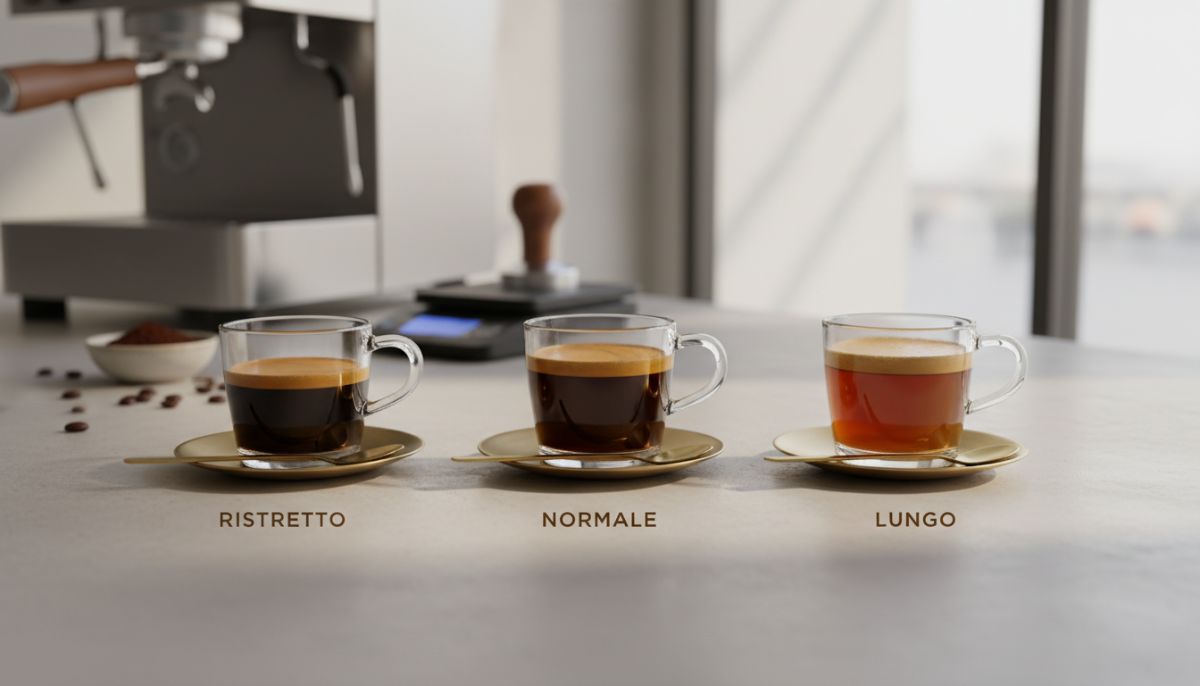
Master the art of the brew ratio. Learn the critical differences between Ristretto, Normale, and Lungo espresso shots and how to use them to unlock distinct flavor profiles in your coffee.
Key Takeaways
- It is all about the Ratio: The difference between these drinks is defined by the ratio of dry coffee dose to liquid espresso yield.
- Ristretto (1:1 to 1:1.5): Offers a thick body and intense flavor, often minimizing bitterness but sacrificing clarity.
- Normale (1:1.5 to 1:2.5): The standard espresso shot, providing the best balance between body, sweetness, and acidity.
- Lungo (1:2.5 to 1:4): A —long— shot that increases clarity and extraction yield, ideal for lighter roasts.
Walk into a traditional Italian bar, and the menu might seem simple. But dive into the world of specialty coffee, and you are suddenly faced with a spectrum of choices. It is not just about —espresso.— It is about how that espresso is pulled.
The terms Ristretto, Normale, and Lungo describe three distinct points on the espresso ratio spectrum. While they all use the same machine and often the same portafilter, the resulting cups are worlds apart in flavor, texture, and intensity. Understanding these ratios is the fastest way to level up your home barista skills and rescue a bag of beans that just does not taste right at a standard setting.
Here is your guide to mastering the extraction spectrum.
The Foundation: Understanding Brew Ratio
Before distinguishing the drinks, we must define the metric: Brew Ratio. In modern espresso, we do not measure by volume (fluid ounces or milliliters) because crema volume can be deceptive. We measure by weight.
A brew ratio is the relationship between the dose (ground coffee in) and the yield (liquid espresso out). To achieve consistency, you need a workflow that prioritizes precision, preferably using smart scales to track your output.
- Input: 18 grams of ground coffee.
- Output: 36 grams of liquid espresso.
- Ratio: 1:2.
This ratio dictates the concentration and extraction level of your shot. Changing the ratio changes the flavor profile entirely.
Ristretto: The —Restricted— Shot
Ratio: 1:1 to 1:1.5
Flavor Profile: Syrupy, intense, low acid, high body.
In Italian, Ristretto translates to —restricted.— Historically, baristas would physically restrict the lever of the machine, or simply stop the pump early. Today, it means stopping the shot when the output weight is roughly equal to the input weight.
Why Pull a Ristretto?
Because you cut the shot short, you leave behind the water that flows at the end of the extraction. This tail end of the shot usually contains more bitter compounds and caffeine. By restricting the water, you get a cup that is incredibly viscous and rich.
However, Ristrettos can be tricky. Because there is less water to dissolve the coffee solids, you risk underextraction. This can lead to sourness. If you are experiencing this, you may need to check our guide on troubleshooting sour espresso to find the balance. Ristrettos work beautifully with darker, chocolatey roasts where you want to minimize bitterness.
Normale: The Gold Standard
Ratio: 1:1.5 to 1:2.5
Flavor Profile: Balanced, sweet, clear.
The Normale is what most of us simply call —espresso.— If you walk into a specialty cafe and order a double shot, you are likely getting a 1:2 ratio (e.g., 18g in, 36g out).
The Reference Point
The Normale is the starting line for any new bag of beans. It provides enough water to extract the sugars and acids properly without diluting the body too much. When you are learning how to dial in espresso ratios, you should almost always aim for a 1:2 ratio first, then adjust based on taste.
This ratio suits the widest variety of beans, from medium-roast blends to single-origin chocolates. It balances the tactical sensation (mouthfeel) with flavor clarity.
Lungo: The —Long— Shot
Ratio: 1:2.5 to 1:4
Flavor Profile: High clarity, thinner body, complex notes.
Lungo means —long.— To make a Lungo, you let the water run through the puck for longer, resulting in a larger beverage volume. Note: This is not an Americano. An Americano is espresso diluted with hot water. A Lungo is all brewed coffee.
When to Go Long
Why would you want to water down your espresso? You aren’t. You are extracting more. Light roasted coffees are dense and difficult to extract. They hold onto their flavors tightly.
If you pull a light roast at a 1:2 ratio, it might taste salty or sour. By pushing more water through the puck (going to 1:3), you extract more soluble compounds, unlocking floral and fruity notes that would otherwise be lost. For those interested in the chemistry, this relates to increasing your extraction yield vs. TDS.
Keep in mind that as you push more water through, the puck degrades. To avoid channeling during these longer shots, ensuring you have the right gear, such as high-quality precision baskets, helps maintain puck integrity.
Comparing the Trinity
To visualize the difference, imagine you have a bag of Ethiopian Yirgacheffe (light roast) and a bag of Brazilian Dark Roast.
- The Dark Roast: Pulling this as a Lungo might make it taste like ash, bitter and dry. Pulling it as a Ristretto (1:1.2) will turn it into a liquid dessert—thick dark chocolate and caramel.
- The Light Roast: Pulling this as a Ristretto will likely make your face pucker from sour acidity. Pulling it as a Lungo (1:3) will open up the jasmine and lemon notes, sacrificing some body for incredible flavor clarity.
Equipment Considerations
While you can pull these shots on any machine, your grinder plays a massive role. Ristrettos often require a finer grind to slow the flow, while Lungos might require a slightly coarser setting to prevent the shot from running for 60 seconds.
Furthermore, the geometry of your grinder burrs affects how these ratios taste. Generally, flat burrs excel at the clarity required for delicious Lungos, while conical burrs provide the texture that makes Ristrettos shine.
Conclusion: Taste is the Final Metric
The numbers 1:1, 1:2, and 1:3 are guideposts, not laws. The —Espresso Ratio Spectrum— is a tool for you to navigate flavor. If your coffee is too sour, try moving toward a Lungo (longer ratio). If it is too bitter or watery, move toward a Ristretto (shorter ratio).
Don’t just press the button and hope for the best. Grab your scale, weigh your output, and taste the difference intentional brewing makes.
Frequently Asked Questions
No. A Lungo is brewed by running more water through the coffee puck, extracting more flavor compounds. An Americano is a standard espresso shot diluted with hot water after brewing. Lungos have a distinct, often more bitter flavor profile compared to the smoother Americano.
Generally, no. While a Ristretto is more concentrated (higher caffeine per milliliter), the total volume is smaller. A Lungo typically extracts the most caffeine from the beans because the water is in contact with the coffee for longer.
Ristrettos (1:1) are often preferred for lattes and cappuccinos because their intense, syrupy body can cut through the richness of the milk better than a watery Lungo.
Ideally, yes. For a Ristretto, you may need to grind finer to restrict the flow. For a Lungo, you might grind slightly coarser to prevent the shot from taking too long and becoming overly bitter. However, you can also achieve these ratios just by stopping the pump earlier or later using the same grind setting.