
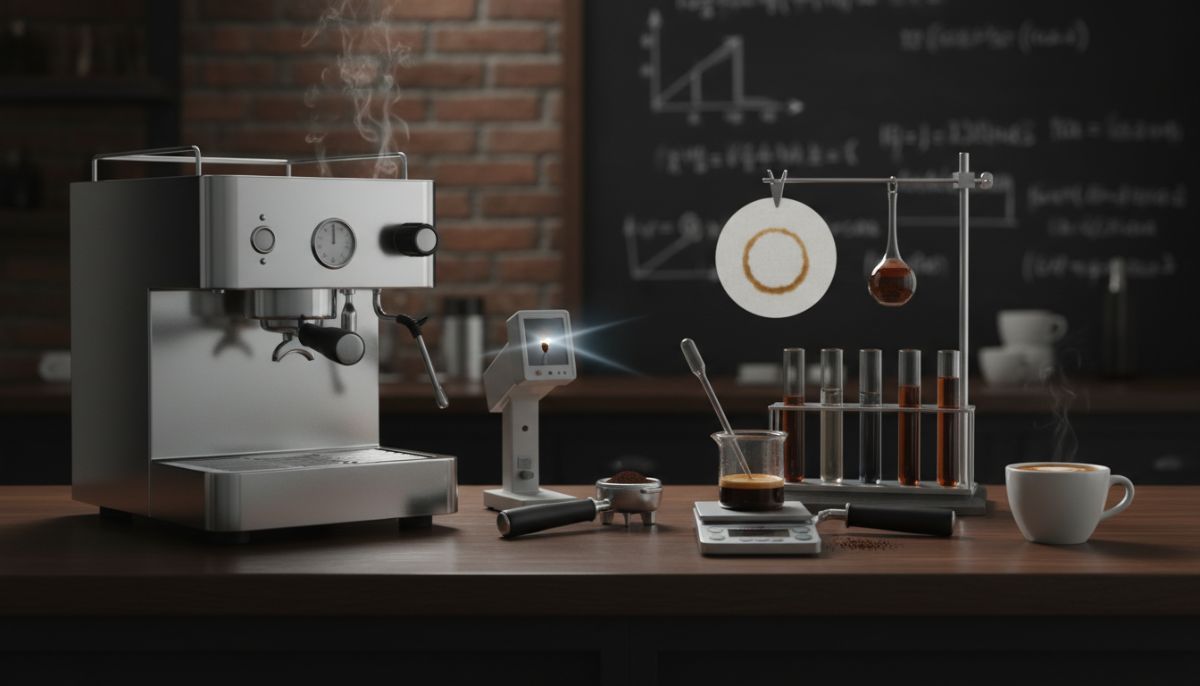
Move beyond guesswork. Learn how Total Dissolved Solids (TDS) and Extraction Yield define the strength and flavor of your coffee, and how to use them to brew consistently better espresso.
Key Takeaways
- TDS (Total Dissolved Solids) measures the concentration or "strength" of your coffee.
- Extraction Yield measures how much of the dry coffee mass was dissolved into the water.
- The Golden Cup Standard generally suggests an extraction yield between 18% and 22%.
- While data provides a baseline, taste remains the ultimate judge of quality.
For decades, making espresso was considered a dark art. Baristas relied on intuition, smell, and the color of the crema to judge a shot. While these sensory cues are still vital, the modern coffee renaissance has introduced a layer of scientific precision that allows us to quantify "good" coffee.
Enter TDS and Extraction Yield.
If you have ever brewed a cup that tasted overwhelmingly strong yet sour, or weak but bitter, you have experienced the interplay of these two concepts. Understanding the math behind the brew doesn't remove the romance from coffee; it gives you the roadmap to replicate your best shots every single morning.
What is TDS? (The Strength)
TDS stands for Total Dissolved Solids. In the context of coffee, it represents the percentage of the beverage that is actually coffee compounds (solubles) versus the percentage that is pure water.
Think of TDS as the "texture" or "weight" of the drink. A high TDS means the liquid is dense and concentrated. A low TDS means it is watery.
- Filter Coffee: typically has a TDS of 1.15% to 1.35%. This means the drink is roughly 98.7% water.
- Espresso: typically ranges from 8% to 12% TDS. This means it is significantly more concentrated.
However, strength is not the same as quality. You can have a very strong cup of coffee (High TDS) that tastes terrible because it was under-extracted. To understand flavor quality, we need to look at the second half of the equation.
What is Extraction Yield? (The Flavor)
Extraction Yield refers to the percentage of the dry coffee grounds that dissolved into the water. Coffee beans are cellulose structures holding soluble compounds like fats, acids, sugars, and carbohydrates. Roughly 30% of a coffee bean is soluble in water, but you don't want to dissolve all of it.
Why? Because the compounds dissolve in a specific order:
- Acids and Fats: Dissolve first (Sour/Fruity).
- Sugars: Dissolve second (Sweet/Balanced).
- Plant Fibers/Bitter compounds: Dissolve last (Dry/Bitter).
The goal is to stop brewing at the "sweet spot"—usually generally accepted as an Extraction Yield between 18% and 22%. If you extract less than 18%, the coffee is often sour and grassy (under-extracted). If you extract more than 22%, it becomes astringent and bitter (over-extracted).
To achieve high, even extractions, many home baristas upgrade their equipment. For example, using precision baskets like VST or IMS allows for finer grinding and higher flows without clogging, which significantly boosts yield.
The Relationship Between TDS and Yield
This is where many home baristas get confused. Strength (TDS) and Extraction Yield are related, but they can move independently depending on the ratio of water used.
The formula connecting them is:
Extraction Yield % = TDS % x (Beverage Weight / Dose Weight)
Let’s look at two scenarios using an 18g dose of coffee:
Scenario A: The Ristretto (High TDS, Low Yield)
You pull a short 1:1 ratio shot (18g out). The liquid is thick and syrupy (High TDS), but because you used so little water, you didn't wash enough flavor out of the grounds. The Extraction Yield might be low (e.g., 15%), resulting in a sour, intense flavor bomb.
Scenario B: The Lungo (Low TDS, High Yield)
You pull a long 1:3 ratio shot (54g out). The liquid is thinner (Low TDS), but the extra water washed out more compounds. Your Extraction Yield might be high (e.g., 23%), potentially tasting bitter and hollow.
Mastering this balance is the core of dialing in. For a deep dive on manipulating these variables, read our guide on how to dial in espresso ratios and yield.
Tools of the Trade: The Refractometer
You cannot see TDS; you must measure it. The standard tool for this is a coffee refractometer. This device shines light through a sample of coffee and measures how much the light bends (refraction). The more solids in the water, the more the light bends.
Is a refractometer necessary for home espresso? No. But it is an incredible diagnostic tool. If your espresso tastes bad, a refractometer tells you why.
For accurate readings, precision is key elsewhere in your workflow. You cannot calculate yield if you don’t know your exact input and output weights. This makes reliable smart scales an absolute necessity for data-driven brewing.
Common Extraction Problems
Sometimes, the numbers look right, but the coffee tastes wrong. You might have a theoretically perfect 20% extraction, but the cup tastes both sour and bitter. This is usually due to uneven extraction or channeling.
Channeling occurs when water finds the path of least resistance through the puck, over-extracting that specific path (bitter) while leaving the rest of the puck under-extracted (sour). In this case, your "average" reading is 20%, but your palate detects the flaws.
To fix this, you must address puck preparation or machine issues before worrying about TDS. Learn how to diagnose these flow issues in our article on channeling 101.
Furthermore, your grinder plays a massive role here. A grinder that produces too many "fines" (tiny dust-like particles) alongside "boulders" (large chunks) will make a high, even extraction yield impossible. This is often the central argument in the flat vs. conical burrs debate, where flat burrs are often praised for higher clarity and extraction potential.
Using TDS to Troubleshoot
Here is a simple workflow to use TDS for improving your coffee:
- Taste First: Always rely on your palate. If it tastes good, stop.
- Measure: If the shot is off, check the TDS and calculate the yield.
- Analyze:
- Low Yield (<18%) & Sour: Grind finer or increase brew ratio (more water).
- High Yield (>22%) & Bitter: Grind coarser or decrease brew ratio (less water).
- Correct Yield but Bad Taste: Check for channeling or dirty equipment.
Remember that even your cleaning routine impacts flavor clarity. Old coffee oils can skew the taste, masking the true extraction profile. Ensure your machine isn’t the problem by following a strict espresso machine cleaning manifesto.
Conclusion
TDS and Extraction Yield are not the goals of coffee brewing; they are the compass. They help you navigate the vast ocean of variables to find your destination: a delicious cup of coffee.
By understanding that TDS is strength and Yield is flavor, you can stop guessing and start manipulating your espresso to suit your exact preference.
Frequently Asked Questions
The ideal TDS for espresso typically ranges between 8% and 12%. However, this depends heavily on the style of espresso (e.g., ristretto vs. lungo) and personal preference.
No, a refractometer is not required. It is a diagnostic tool that helps quantify consistency and troubleshoot issues, but your palate is the most important tool for judging quality.
The formula is: Extraction Yield % = TDS % x (Beverage Weight / Dry Coffee Dose). You need a scale and a refractometer to calculate this accurately.
This is often caused by channeling. Even if the ‘average’ yield is high, channeling causes some parts of the puck to be over-extracted (bitter) and others under-extracted (sour), confusing the palate.