
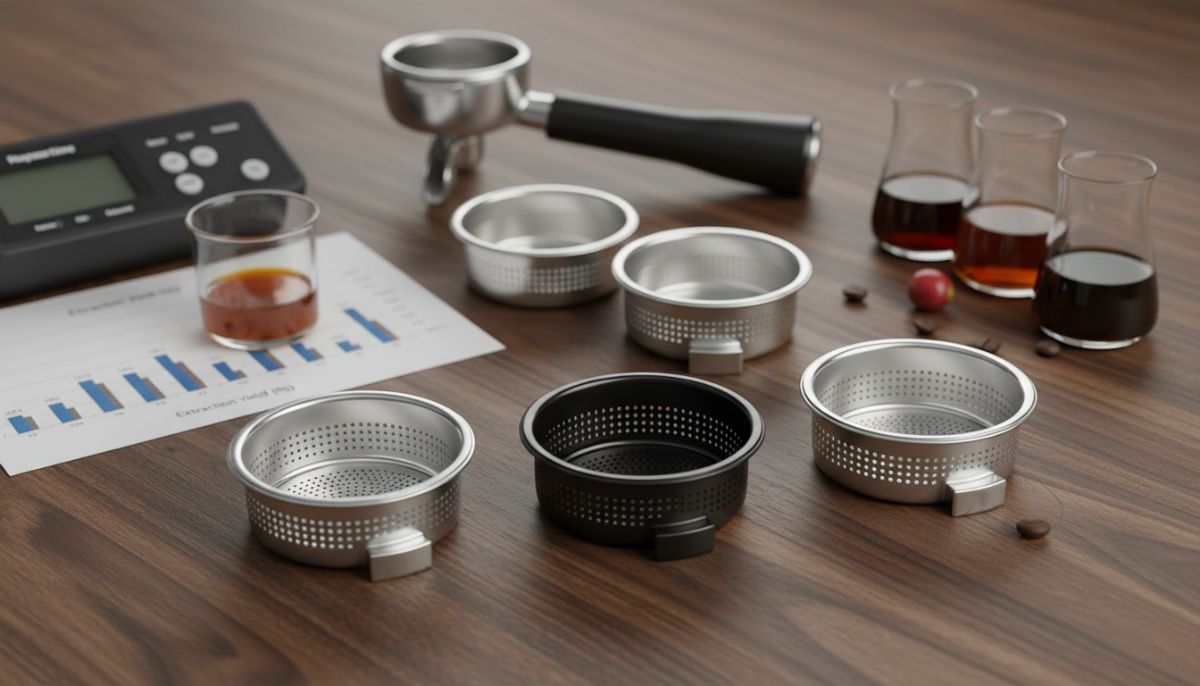
A data-driven comparison of Weber, Wafo, and Sworksdesign vs. VST and IMS. We analyze extraction yields, taste profiles, and value to determine if the $200 upgrade is worth it.
Key Takeaways
- The Flow Paradigm: Next-gen baskets (Weber Unibasket, Wafo, Sworksdesign) offer significantly higher flow rates than VST or IMS, requiring a much finer grind setting.
- Flavor Trade-off: Expect a measurable increase in Extraction Yield (EY) and clarity, but a noticeable reduction in mouthfeel and texture.
- Gear Compatibility: These baskets often require high-end grinders capable of ultra-fine, uniform particle distribution. Entry-level grinders may stall or produce excessive fines.
- The Verdict: For light roast enthusiasts chasing maximum clarity, the investment is justifiable. For traditional espresso lovers, VST remains the gold standard for balance.
The New Frontier of Espresso Extraction
For over a decade, upgrading from a stock basket to a precision filter from VST Inc. or IMS Filtri was the single most effective upgrade a home barista could make. These baskets introduced tighter manufacturing tolerances and punch-pressed holes that standardized flow. However, a new category of “High Extraction” (HE) baskets has emerged, promising to push the boundaries of soluble yield even further.
Brands like Weber Workshops, Wafo, and Sworksdesign have moved beyond traditional punch-pressing. Using laser cutting and billet stainless steel construction, these manufacturers created baskets with holes extending to the very edge of the floor, boasting open area percentages far exceeding standard precision baskets. But with prices ranging from $180 to $200, the question remains: is the performance gap real, or is this just expensive jewelry for your portafilter?
Technical Deep Dive: Punched vs. Laser-Cut Geometry
To understand the performance difference, we must look at the manufacturing physics.
Standard Precision (VST / IMS)
Traditional precision baskets are manufactured by punching holes into a sheet of steel. This process limits the hole density and proximity to the basket’s edge due to structural integrity concerns. Consequently, a “dead zone” exists around the perimeter of the puck where water flows slower, potentially leading to uneven extraction.
Next-Gen High Extraction (Weber / Wafo / Sworks)
Next-gen baskets utilize laser drilling or chemical etching on rigid billet AISI 304 Stainless Steel. This allows for:
- Edge-to-Edge Holes: Eliminating the outer ring dead zone.
- Straight Walled Profiles: Increasing the effective puck diameter (often fully 58.5mm straight down).
- Structural Rigidity: Unlike stamped baskets which flex under 9 bars of pressure, billet baskets remain rigid, preventing the bottom from bowing and distorting the flow path.
If you are still using a stock basket, read our guide on Stock vs. Precision Baskets to understand why upgrading to at least a VST is mandatory before considering these high-end options.
The Grind: Can Your Grinder Handle It?
The most immediate shock when switching to a Weber Unibasket or Wafo Spirit is the flow rate. These baskets offer almost zero resistance compared to a VST. The resistance must come entirely from the coffee puck.
This necessitates grinding significantly finer—often 10 to 20 microns finer than your standard espresso dial-in. This shift exposes the limitations of mid-range grinders. If you use a conical burr grinder like the Niche Zero, you may find that grinding this fine increases the production of “fines” (dust), which can clog the precision holes and lead to astringency. Flat burr grinders with high uniformity (like the DF64 with SSP burrs or a Lagom P64) tend to perform better here.
Furthermore, because the grind is so fine, puck preparation becomes unforgiving. Any inconsistency in distribution will cause immediate, visible spraying. We strongly recommend mastering your puck screen workflow, as a screen helps disperse water evenly and prevents the turbulent force of the grouphead water from disturbing the delicate puck surface.
Data Analysis: Extraction Yield and Taste Profiles
We conducted a comparative analysis using a standardized light roast Ethiopian coffee, an EG-1 grinder, and a Decent DE1 to track flow data.
1. Extraction Yield (EY)
- VST 18g Basket: Averaged 20.5% EY.
- Weber Unibasket: Averaged 22.1% EY.
The numbers validate the claims: HE baskets allow you to extract more soluble material from the same dose. However, numbers don’t drink coffee; people do.
2. Blind Taste Test Results
In a blind A/B/C test comparing IMS Nanotech, VST, and Sworksdesign Billet, three Q-graders noted distinct differences:
- Clarity: The HE baskets consistently scored higher on flavor separation. Notes of jasmine and bergamot were piercingly clear.
- Body/Texture: This is where the trade-off occurs. The HE shots were described as “tea-like” and “thin.” The VST shots retained a syrupy mouthfeel that many traditional espresso drinkers prefer.
- Acidity: HE baskets accentuate acidity. If you enjoy modern, Nordic-style light roasts, this is a benefit. For medium-dark roasts, it can be overwhelming.
For those struggling with sour shots on standard equipment, review our guide on troubleshooting underextraction before blaming the basket.
The Problem of “Side Channeling”
A unique issue with rigid, straight-walled HE baskets is side channeling (bypass). Because the basket walls do not taper and the metal is perfectly rigid, the coffee puck may shrink slightly during extraction, detaching from the walls. Water, taking the path of least resistance, races down the sides rather than through the coffee.
The Fix:
Using a paper filter at the bottom of the basket is a common solution, but it changes the texture further. A more effective method is ensuring perfect tamp technique. Issues with leveling can be fatal here. If you are experiencing uneven flow, refer to our Channeling 101 guide to diagnose if it is a prep issue or a gear issue.
Durability and Maintenance
VST/IMS: Extremely durable. If you drop them, they might dent, but they are cheap to replace ($30–$35).
Next-Gen Baskets: The structural integrity of the billet steel is high, but the laser-cut holes are fragile. Clogging is a significant user pain point. Over time, oils and micro-fines can become impacted in the thousands of microscopic holes. Unlike VST baskets which can be scrubbed vigorously, HE baskets often require ultrasonic cleaning baths to restore flow performance after a few months of heavy use.
Cost-Benefit Analysis: Is it Worth $200?
To determine ROI, you must identify your coffee profile.
Who Should Buy Next-Gen Baskets?
- The Light Roast Purist: You drink exclusively light roasts and chase high EY percentages.
- The Profiling Expert: You use a flow-profiling machine (Decent, Slayer, Lelit Bianca) and want to experiment with turbo shots or low-pressure extractions.
- The Gear Maximizer: Your grinder cost more than $1,500, and you want to remove the last bottleneck in your workflow.
Who Should Stick to VST/IMS?
- The Traditionalist: You enjoy medium to dark roasts and value body and crema over flavor separation.
- The Texture Lover: You drink cappuccinos or cortados. The nuance gained by an HE basket is often lost in milk.
- The Budget Conscious: A $200 basket offers diminishing returns. Investing that money into better burrs—see our guide on flat vs. conical burrs—will yield a far greater improvement in flavor.
Final Verdict
Next-generation high-extraction baskets are not a scam; they are highly specialized tools that do exactly what they claim—increase flow and extraction. However, they are not “better” in a universal sense. They shift the profile toward clarity at the expense of body.
If your goal is to mute the acidity of a dark roast, these baskets will ruin your shot. If your goal is to unlock the hidden florals in a washed Geisha, they are the key you have been looking for.
Frequently Asked Questions
Yes, standard 58mm tampers are often too loose for these baskets. Because next-gen baskets have straight walls and measure 58.5mm or slightly wider, a precision 58.5mm tamper is required to prevent an unsealed ring of coffee at the edges, which causes severe channeling.
Yes, but be careful. Standard E61 machines often have a slow pressure ramp-up, which is good, but if your machine is set to a static 9 bars, the fast flow of these baskets might result in 15-20 second shots. You will need to grind much finer to compensate, or lower your pump pressure to 6 bars if possible.
This is a common complaint known as loss of texture. The high-flow geometry reduces the hydraulic resistance that creates the syrupy ‘crema’ and body in traditional espresso. To fix this, try increasing your dose slightly or using a paper filter on top to slow the flow, but accept that these baskets prioritize clarity over body.
Do not use needles or pins, as you can damage the precision geometry. The best method is soaking the basket in a hot solution of espresso detergent (like Cafiza) for 20 minutes, followed by an ultrasonic cleaner cycle if available. Rinse thoroughly with high-pressure water.
It is not recommended. Dark roasts are highly soluble and brittle. Using a high-extraction basket will likely over-extract the bitter compounds and ash notes, resulting in a harsh, astringent shot. Stick to IMS or standard baskets for dark roasts.