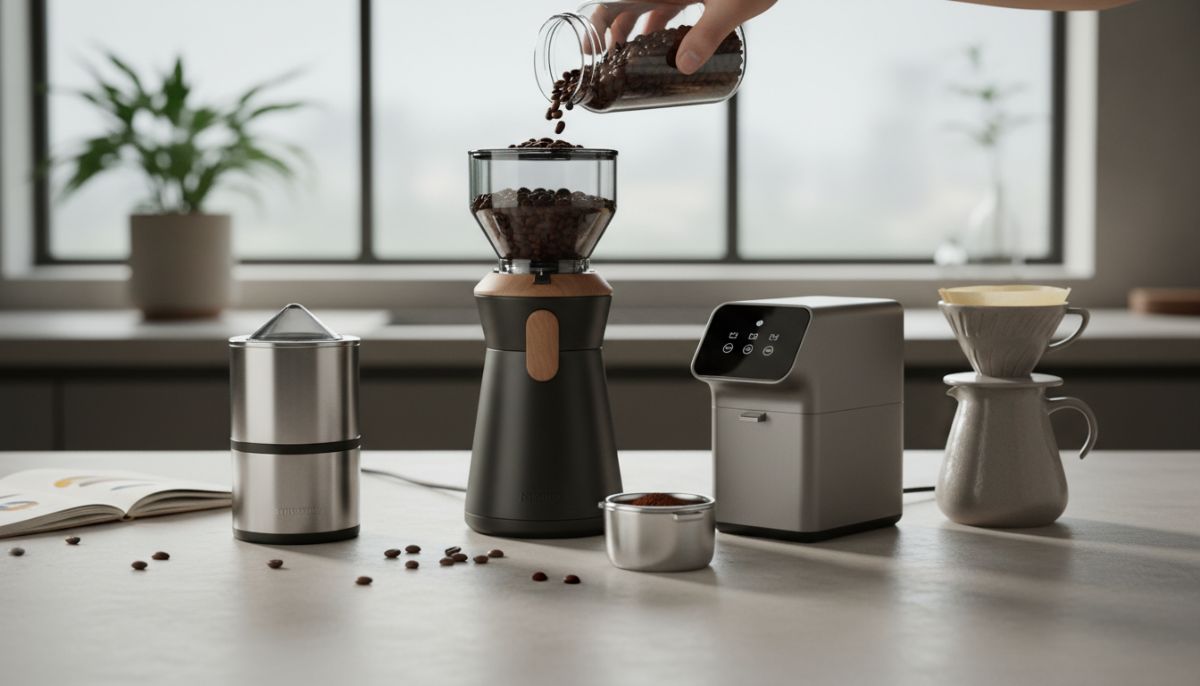
Discover the best electric coffee grinders under $300. We analyze burr quality, consistency, and features to help you brew café-quality coffee on a budget.
Key Takeaways
- Budget doesn’t mean bad coffee: You can achieve excellent filter coffee and passable espresso with the right sub-$300 grinder.
- Prioritize the Burrs: Focus on steel burr sets over fancy digital displays or aesthetics.
- Know the Trade-offs: Lower-priced electric grinders often sacrifice build quality (plastic vs. metal) and noise reduction for grind consistency.
- Workflow Hacks: Simple techniques like RDT and shim alignment can make a budget grinder perform like a mid-range titan.
There is an old adage in the specialty coffee world: “Date your espresso machine, but marry your grinder.” While it is tempting to blow your entire budget on a shiny chrome espresso machine, the truth is that the grinder does the heavy lifting. It is the gatekeeper of flavor, determining whether your morning cup tastes like sweet nectar or bitter ash.
For many years, the sub-$300 price bracket was a wasteland of false promises and blade grinders disguised as burr grinders. Fortunately, times have changed. Manufacturers have realized that home baristas want performance without taking out a second mortgage. Today, finding a capable electric grinder under $300 is not only possible; it is arguably the most competitive segment of the market.
Whether you are brewing pour-over or dialing in your first espresso shots, this guide will help you navigate the budget-friendly landscape to find a machine that offers genuine value.
The Reality of the $300 Price Point
Before diving into specific features, it is crucial to manage expectations. At this price point, you are generally looking at entry-level equipment. These machines are designed for home use, typically handling one or two coffees a day rather than the high-volume throughput of a commercial bar.
To keep costs down, manufacturers often use plastic casings and lighter motors. However, the smartest brands put the money where it counts: the burr set. When shopping in this tier, you should look for a machine that prioritizes internal geometry over external beauty.
Burr Geometry: The Engine of Flavor
The most critical component of any grinder is the burr set. In the under-$300 category, you will predominantly find conical burrs, though some flat burr options are beginning to appear.
Conical burrs are excellent for this price range because they are generally quieter and require lower motor torque to operate efficiently. They tend to produce a bimodal grind distribution—meaning two distinct peak particle sizes—which can add texture and body to your coffee. However, for those seeking high clarity and flavor separation, flat burrs are often the gold standard.
Understanding how these shapes impact your cup is vital. To dive deeper into the differences, read our guide on flat vs. conical burrs and how they change flavor profiles. Generally, if you enjoy traditional, chocolatey espresso, conical burrs in this price range will serve you well.
Stepped vs. Stepless Adjustment
One of the biggest compromises in budget grinders is the adjustment mechanism. Most grinders under $300 utilize a “stepped” adjustment system. This means the grind setting clicks into place at pre-determined intervals.
For filter coffee (French Press, V60, Chemex), stepped adjustments are perfectly fine. However, for espresso, they can be frustrating. You might find that setting 4 is too fine (choking the machine) while setting 5 is too coarse (gushing out). This is where the debate between stepless vs. stepped grinders becomes relevant. While true stepless adjustment is rare in this bracket, some newer models offer “micro-steps” that bridge the gap, allowing for the precision required for modern espresso.
The “Jack of All Trades” Dilemma
Can one grinder really do it all? Many machines in the $200–$300 range claim to grind for everything from coarse French Press to fine Turkish coffee. While technically true, switching back and forth can be problematic.
Retention Issues
Budget grinders often have higher retention—meaning ground coffee gets stuck inside the chute and burr chamber. If you switch from a coarse pour-over setting to a fine espresso setting, you might purge several grams of stale coffee into your next shot. Understanding grinder retention is key to minimizing waste. If you plan to brew multiple methods, you may need to commit to a rigorous cleaning schedule or accept some cross-contamination of grind sizes.
Workflow Hacks to Elevate Budget Gear
The secret to making a $250 grinder perform like a $600 grinder often lies in your workflow. Because these grinders lack the anti-static technology and precision tolerances of high-end models, you need to compensate with technique.
1. The RDT Method
Cheaper grinders are notorious for static cling, especially with plastic catch cups. Chaff sticks to everything, and grounds fly across the counter. The solution is simple: The Ross Droplet Technique (RDT). Adding a tiny droplet of moisture to your beans before grinding can eliminate this mess. Learn more about the RDT method for banishing static.
2. Shim Alignment
Factory alignment on budget grinders is rarely perfect. If your burrs aren’t parallel, you will get an uneven grind, leading to channeling and sour/bitter flavors. Enthusiasts often “shim” their burrs using thin pieces of foil to ensure they are perfectly aligned. It requires patience, but our guide on burr alignment 101 can help you get the best possible uniformity out of an affordable machine.
The Alternative: Going Manual
If your budget is strictly capped at $300 and your priority is purely taste quality—specifically for espresso—you face a difficult choice. Electric motors cost money. Electronics cost money. If you remove those costs, every dollar can go into the burrs and stabilization.
A $250 premium hand grinder often outperforms a $250 electric grinder in terms of particle distribution and cup clarity. If you are willing to put in the elbow grease, you might find superior value in a manual option. We break down this comparison in detail in our article on high-end hand grinders vs. electric models. However, if convenience is king and you need to grind for multiple people in the morning, electric is still the way to go.
Top Features to Look For
When scanning the market for your sub-$300 grinder, keep this checklist in mind:
- Serviceability: Can you easily remove the top burr for cleaning?
- Manufacturer Support: Does the brand sell replacement parts? (Baratza is legendary for this).
- Low RPM: Cheaper high-speed motors can heat up the coffee. Look for gear-reduction motors that grind slower and cooler.
- Single-Dosing Capability: Can you put in 18g of beans and get 18g out?
Conclusion
Finding a value-packed electric grinder under $300 is no longer a pipe dream. By focusing on burr quality over bells and whistles, and by utilizing smart workflow techniques like RDT and alignment shimming, you can produce excellent coffee at home.
Whether you choose a reliable workhorse like the Baratza Encore ESP, a stylish Fellow Opus, or a classic Eureka Mignon entry model, the key is understanding the limitations of the machine and working with them. Invest in the best grinder you can afford, keep it clean, and your palate will thank you.
Frequently Asked Questions
Yes, but with caveats. Newer models like the Baratza Encore ESP or Fellow Opus are designed specifically to bridge the gap between filter and espresso. They can grind fine enough, though you may lack the micro-adjustability (stepless adjustment) found on more expensive grinders, making dialing in shots slightly more challenging.
With proper maintenance, a reputable sub-$300 grinder can last 5 to 10 years. The burrs will eventually dull and need replacement, and plastic gears may wear out, but brands that offer replacement parts allow you to repair rather than replace the unit.
If your only metric is grind quality and flavor clarity, a $200-$300 hand grinder usually outperforms an electric grinder of the same price because you aren’t paying for a motor or electronics. However, electric grinders offer significantly better workflow and convenience, especially for multiple cups.
Generally, yes. Budget grinders often have larger grind chambers and discharge chutes where coffee can get stuck. Using a bellows or the ‘single dosing’ method can help mitigate this retention.