
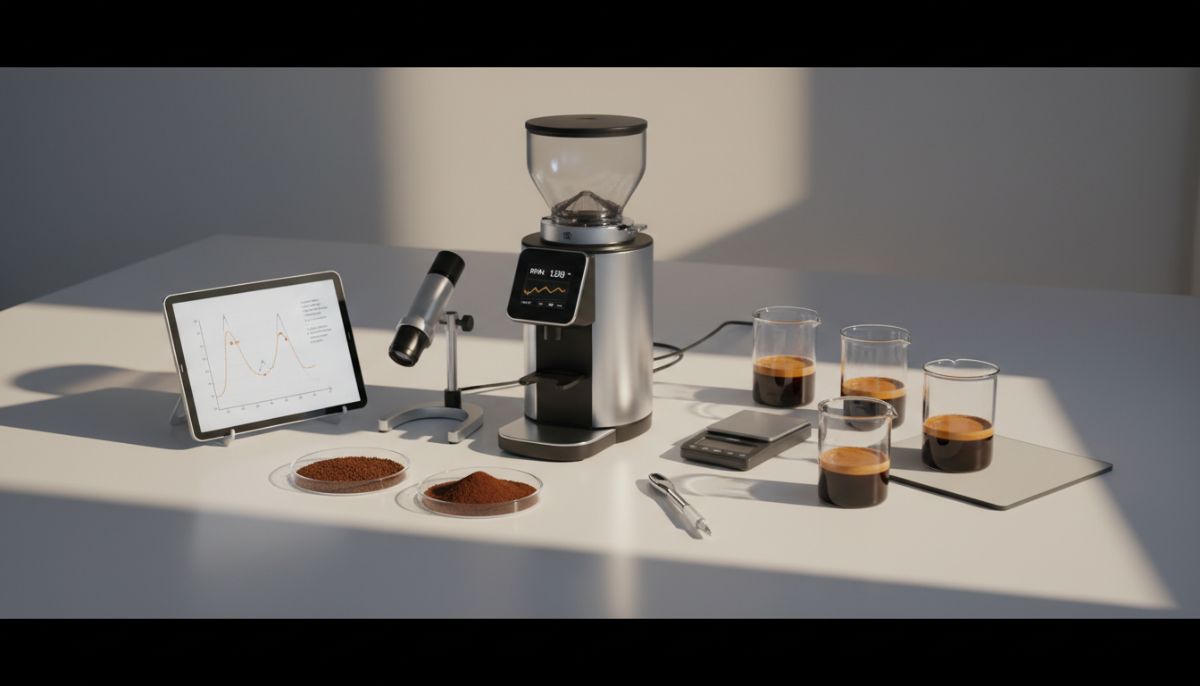
Does changing your grinder’s RPM actually affect espresso flavor? We dive into the science of variable speed grinding, particle distribution, and how to profile your RPM for the perfect shot.
Key Takeaways
- Speed impacts fines: Generally, higher RPMs create more fines (tiny coffee particles), while lower RPMs produce a more uniform grind size.
- Flavor vs. Texture: High RPM tends to increase body and blending of flavors; low RPM enhances clarity and distinct flavor notes.
- Shot time correlation: Changing your RPM often requires adjusting your grind size setting to maintain the same shot time due to changes in flow resistance.
- Static management: Lower speeds can reduce static buildup, though grind retention varies based on the specific grinder design.
The New Frontier of Espresso Control
For decades, home baristas obsessed over pressure. We bought machines with PID controllers for temperature stability. We mastered flow control paddles. But until recently, the grinder was a constant.
You turned it on, the burrs spun at a fixed speed, and coffee came out. That is changing rapidly.
The latest generation of high-end grinders has introduced variable RPM (Revolutions Per Minute) as a standard feature. This allows you to control how fast the burrs spin while crushing the beans. But is this just another expensive feature to inflate specifications, or does it genuinely change what is in your cup?
The short answer is yes. RPM profiling is the next step in precision brewing.
The Physics of Grinding: Why Speed Matters
To understand why speed changes taste, we have to look at what happens inside the grinding chamber. It isn’t just about cutting beans; it is about how the beans are fed into the burrs.
The Feeding Rate and Popcorn Effect
At high speeds, centrifugal force pushes beans into the burrs aggressively. The beans are crushed quickly and violently. This leads to more collisions between coffee particles.
At lower speeds, the beans feed into the burrs more gently. This is often compared to the difference between high-end hand grinders vs. electric grinders. Hand grinders naturally operate at a much lower RPM (around 60-120 RPM) compared to electric motors (often 1000+ RPM).
Particle Distribution: Fines vs. Boulders
The Holy Grail of grinding is usually considered “unimodal distribution”—where the vast majority of particles are the exact same size. However, no grinder is perfect. Every grinder produces two things alongside the target grind size:
- Boulders: Chunks that are too large.
- Fines: Microscopic dust-like particles.
Fines are the critical variable here. Fines restrict water flow and provide the “glue” that holds an espresso puck together. They contribute significantly to texture and body.
High RPM typically generates more fines due to the increased shattering and particle-on-particle friction. Low RPM usually generates fewer fines, resulting in a more unimodal distribution. This shift in particle geometry directly impacts how water extracts flavor from your coffee.
High RPM vs. Low RPM: The Taste Test
So, how does physics translate to flavor? If you have a variable speed grinder, here is what you can generally expect when experimenting.
The Case for High RPM (1000+ RPM)
Grinding fast mimics the profile of traditional commercial grinders found in Italian cafes. The increase in fines creates higher resistance in the puck.
The result in the cup:
- Heavier Body: The fines migrate to the bottom of the basket and create a thick barrier, resulting in a syrupy texture.
- Blended Flavors: High RPM is excellent for traditional “comfort” espressos (chocolate, nuts, caramel). It blends acidities together, making the shot more cohesive.
- Higher Extraction Yield: Because fines have a massive surface area, they extract instantly. This can push extraction numbers higher, but risks bitterness if not managed.
The Case for Low RPM (300-600 RPM)
Slowing the motor down changes the game. With fewer fines clogging the puck, water flows more freely through the coffee bed.
The result in the cup:
- High Clarity: This is the choice for modern, light-roast espresso. You can taste the separation between fruit notes and floral aromatics.
- Thinner Body: With fewer fines to emulsify, the mouthfeel may be lighter or more tea-like.
- Lower Sweetness Perception: Sometimes, the lack of body can be perceived as a lack of sweetness, though the flavor definition is sharper.
Ideally, you want to match your RPM to your bean choice. This concept is similar to flat vs. conical burrs, where geometry dictates the flavor profile. RPM gives you a way to tweak that profile without buying a new grinder.
Workflow Issues: Static and Retention
Taste isn’t the only factor. Your grinder’s speed changes your workflow, particularly regarding mess and waste.
The Static Monster
High-speed grinding creates significant static electricity. The friction generates a charge that causes coffee grounds to cling to the chute, the doser cup, and your portafilter. This can result in a messy counter and inconsistent dosing weights.
If you prefer high RPMs for the texture they provide, you almost certainly need to use the RDT method (Ross Droplet Technique). A single spray of water can neutralize the charge.
Retention and Exchange
Does speed affect how much coffee stays stuck inside the grinder? Yes. Low RPM grinding often has less velocity to push the grounds out of the chute, potentially increasing retention in certain grinder designs.
However, because low RPM generates less static, the grounds may not stick as stubbornly to the internal walls. Understanding grinder retention is crucial here; you don’t want yesterday’s stale grounds mixing with your low-RPM profilng experiment.
How to Dial in RPM
If you bought a grinder with variable speed, don’t just leave it on the middle setting. Follow this protocol to see the difference.
1. Establish a Baseline
Start with a medium roast. Set your grinder to a standard speed (e.g., 1000 RPM). Dial in your espresso so you get a standard 1:2 ratio in 28 seconds. Taste it and take notes.
2. The Low RPM Test
Drop the speed to the lowest setting (e.g., 500 RPM). Do not change the grind size yet.
Pull a shot. You will likely notice the shot runs faster. This is because there are fewer fines providing resistance. Taste this shot. It might be sour (underextracted). Now, adjust your grind setting finer until you are back to that 28-second shot time.
Compare the taste to your baseline. You should notice increased acidity and clarity.
3. The High RPM Test
Crank the speed to the max. The shot will likely choke or run very slowly due to excessive fines. You will need to adjust your grind setting coarser to get back to the 28-second mark.
This process of adjusting grind size to compensate for RPM changes is essential. It is similar to the patience required when dialing in espresso ratios.
Does RPM Affect Heat?
A common myth is that high-speed grinders “burn” the coffee. In a commercial environment where a grinder runs non-stop for an hour, heat buildup is a real concern. This can alter the chemical structure of the oils before brewing.
For the home barista making one or two shots, heat transfer from friction is negligible regardless of RPM. The grounds aren’t in the chamber long enough to cook. If you are worried about temperature variables, focus on your pressure profiling or water temp, not the grinder heat.
Conclusion
Variable RPM is a powerful tool for the home barista who wants to squeeze every ounce of potential out of their beans. It allows you to transform a single grinder into a versatile machine capable of handling both dark, syrupy roasts (High RPM) and delicate, light roasts (Low RPM).
While it adds another variable to manage, the control it offers is undeniable. Start with the extremes to train your palate, and find the speed that suits your taste.
Frequently Asked Questions
Yes. Generally, lowering the RPM produces fewer fines, which decreases resistance. You will typically need to adjust your grind setting finer to maintain the same shot time.
Often, yes. High RPM creates more fines, which contributes to a thicker body and richer texture. This complements the traditional chocolate and caramel notes found in darker roasts.
Yes. Low RPM produces a more uniform grind with fewer fines. This highlights clarity and acidity, which helps separate the complex fruit and floral notes in light roasts.
Yes. Higher speeds create more friction and static electricity, causing grounds to stick to the chute. Lower speeds generally result in less static buildup.