
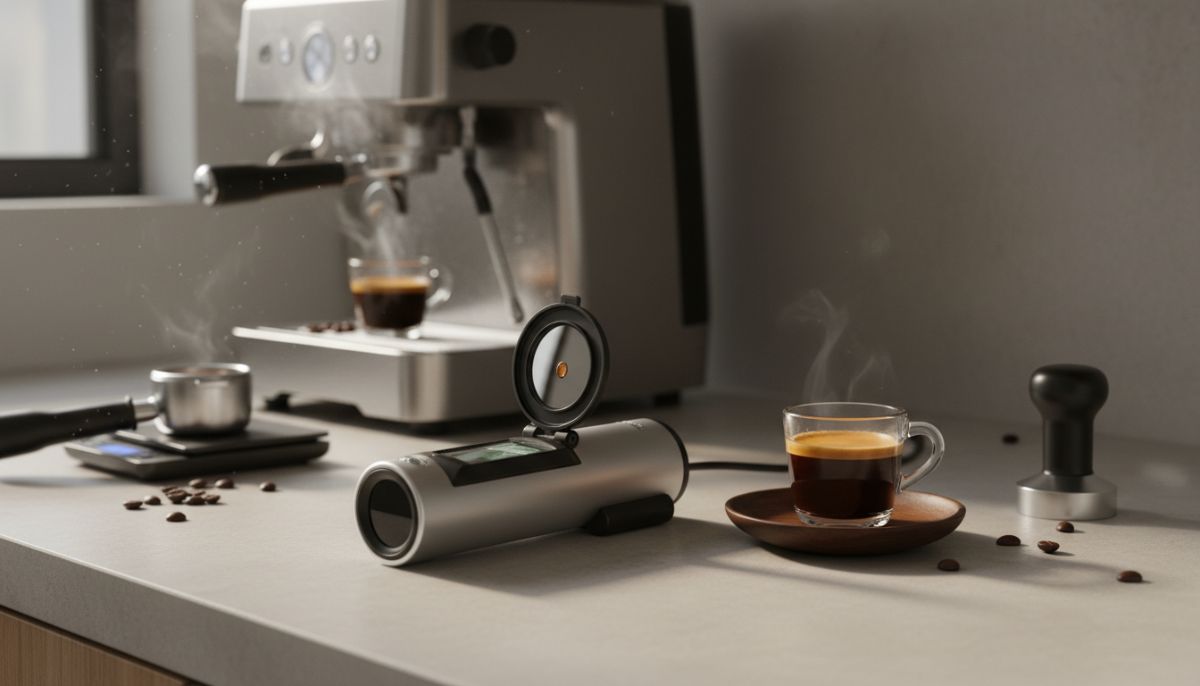
Is a coffee refractometer the ultimate tool for espresso perfection or just an overpriced gadget? We break down the costs, the science of TDS, and whether measuring extraction yield belongs in your home workflow.
Key Takeaways
- Objectivity vs. Subjectivity: Refractometers provide hard data (TDS) to back up your taste buds, helping you replicate ‘God Shots’ consistently.
- The Cost Barrier: High-quality sensors like VST are expensive, often costing as much as an entry-level grinder, though cheaper alternatives are entering the market.
- Workflow Impact: Using a refractometer adds time and steps to your routine; it requires strict sampling protocols and filtration to be accurate.
- Target Audience: They are essential for roasters and experimenters but likely overkill for the casual home barista who prioritizes convenience.
In the pursuit of the perfect espresso, the rabbit hole runs deep. You start with a machine, then a grinder, and soon you find yourself obsessing over WDT tools, precision baskets, and water chemistry. But there is one tool that sits at the very edge of the “prosumer” cliff, separating the hobbyist from the data scientist: the coffee refractometer.
For years, this device was the exclusive domain of commercial labs and elite coffee shops. Today, with the rise of affordable tech, it is finding its way onto kitchen counters. But does measuring the refractive index of your morning brew actually make it taste better? Or is it just another expensive way to complicate a ritual that should be about enjoyment?
Let’s strip away the marketing hype and look at the hard data. Here is everything you need to know about coffee refractometers and whether they are worth your investment.
Demystifying the Magic Box: What is a Refractometer?
At its core, a refractometer is a scientific instrument used to measure the bending of light as it passes through a liquid. In the context of coffee, it measures the concentration of Total Dissolved Solids (TDS). When you brew coffee, water acts as a solvent, extracting compounds from the ground beans. The refractometer tells you exactly what percentage of your espresso is actual coffee solids versus water.
However, a raw TDS reading is only half the story. To make that number useful, it must be calculated against the weight of the dose and the weight of the final beverage to determine the Extraction Yield (EY). This percentage tells you how much of the dry coffee bean mass ended up in your cup.
Generally, the industry standard for a balanced cup sits between an 18% and 22% extraction yield. Below 18%, coffee often tastes sour and grassy. Above 22%, it tends to become bitter and astringent. For a deep dive into the math behind this, check out our guide on the science behind the perfect cup.
The Argument for Data-Driven Brewing
Why would a home barista spend hundreds of dollars on a device that doesn’t actually make coffee? The answer lies in consistency and diagnosis. Taste is subjective; numbers are not. We have all experienced days where our palate is off, perhaps due to what we ate for breakfast or simple fatigue.
1. Objective Troubleshooting
Imagine you pull a shot that tastes terrible. Is it sour because it is underextracted, or is it sour because of a defect in the roast? Without data, you are guessing. If a refractometer shows a low extraction yield (e.g., 15%), you know physically that you haven’t taken enough from the coffee. You can then adjust your grind finer or increase your yield.
If the numbers indicate you are well within the 20% range but the shot still tastes bad, the issue might be the beans themselves or channeling. This distinction is crucial for effective troubleshooting. For more on fixing specific flavor flaws, read our article on troubleshooting underextraction.
2. Dialing in New Beans Faster
When you switch coffee bags, the process of dialing in espresso can be wasteful. You might pull five or six sink shots before finding the sweet spot. With a refractometer, you can take a reading of the first shot. If the extraction is significantly low, you can make a drastic change to your grind size immediately, rather than making small, tentative adjustments. This saves coffee and time in the long run.
3. verifying Equipment Performance
Are your expensive expensive grinder upgrades actually delivering better particle distribution? A refractometer can help verify this. Better grinders generally allow you to push extraction yields higher without introducing bitterness. If you upgrade your gear but your extraction ceiling remains the same, you know something else in your workflow—like your puck prep—is the bottleneck.
The Reality of the Workflow
While the data is alluring, obtaining it is not as simple as sticking a probe into your cup. Refractometry requires a rigorous, almost clinical workflow to be accurate. If you are rushing to get to work in the morning, this is not the tool for you.
The Sampling Protocol
To get an accurate reading, the sample must be filtered. Coffee contains suspended solids (fines) and oils that block light and distort the refractive index. You need to use specific syringe filters to clarify a few drops of coffee before placing them on the lens. If you skip this step, your readings can be wildly inaccurate.
Temperature Sensitivity
Refraction changes with temperature. While most modern devices have Automatic Temperature Compensation (ATC), placing boiling hot liquid on a room-temperature glass lens can still cause drift. You often need to wait for the sample to cool slightly, further delaying your consumption of the beverage.
The Clean-Up
Between every reading, the lens must be cleaned with alcohol and a microfiber cloth to ensure zero contamination from the previous sample or water residue. It is a far cry from the simplicity of just knocking out a puck. If you struggle with keeping your station tidy, you might want to review our guide on managing coffee waste before adding more clutter to your bar.
The Cost Analysis: VST vs. The Rest
For a long time, VST was the only name in the game. Their refractometers are the industry standard, used by coffee champions and large roasters. However, they come with a hefty price tag, often exceeding $700. For the average home user, that price is hard to justify.
Recently, competitors like Atago and DiFluid have entered the market with devices at a fraction of the cost. The DiFluid R2, for example, brings smart connectivity and decent accuracy to a much more accessible price point. While early iterations of budget refractometers suffered from accuracy issues, the gap is closing.
However, you must ask yourself: What else could I buy for this money? For the price of a VST, you could buy a high-end grinder or even one of the top entry-level espresso machines. If your grinder is inconsistent, a refractometer will only document your inconsistency; it won’t fix it.
The Importance of Puck Prep
It is vital to understand that a refractometer assumes the sample you test is representative of the whole extraction. If you suffer from channeling, where water rushes through a crack in the puck, your extraction will be uneven. One part of the puck might be over-extracted, and another dry.
If you have not mastered your puck preparation, a refractometer will give you confusing data. Before investing in a sensor, invest in a WDT tool and learn how to fix uneven water flow. If you cannot get water to flow through the coffee evenly, knowing the TDS is academic at best and misleading at worst.
Who Should Buy One?
The Home Roaster: If you roast your own beans, a refractometer is invaluable. It helps you understand how your roast profile affects solubility. You can track how development time changes the extraction potential of the bean.
The Experimenter: If you enjoy playing with modern techniques like turbo shots or pressure profiling, a refractometer helps you quantify the results. It confirms whether that 15-second shot actually extracted properly or just tasted weak.
The Gear Enthusiast: If you have already maxed out your grinder, machine, and accessories, and you simply love the science of coffee, this is the final frontier.
Who Should Avoid It?
If you rely on dark roasts and traditional ratios, or if you drink mostly milk-based drinks, a refractometer offers diminishing returns. The nuances of extraction yield are often masked by milk. Furthermore, if you are still learning the basics of dialing in by taste, relying on numbers can stunt your sensory development. You might find yourself chasing a number (like 20% EY) even if the coffee tastes better at 18%.
Conclusion
A coffee refractometer is a powerful diagnostic tool, but it is not a magic wand. It requires a commitment to a slow, methodical workflow and a solid understanding of coffee chemistry. For the vast majority of home baristas, the investment is better spent on a superior grinder or high-quality beans.
However, for those who demand absolute precision and want to peel back the layers of what is happening inside the portafilter, it offers a level of insight that taste alone cannot provide. Ultimately, the best tool you own is your palate—use the data to train it, not replace it.
Frequently Asked Questions
For espresso, a typical TDS reading ranges between 8% and 12%. However, this depends heavily on your brew ratio. The more important number is usually the Extraction Yield, which should ideally fall between 18% and 22%.
Technically yes, but it is not recommended for accuracy. Brix refractometers are designed for sugar (sucrose) and interpret coffee solids differently. You would need a conversion factor, and even then, the precision is usually insufficient for fine-tuning espresso.
Yes. Coffee contains suspended solids and oils that scatter light and distort the refractive index reading. For a scientifically accurate reading, using a syringe filter is necessary.
No. While higher extraction usually means you are getting more out of the bean, pushing it too far causes over-extraction, leading to bitterness and astringency. The goal is the highest yield that still tastes sweet and balanced.