
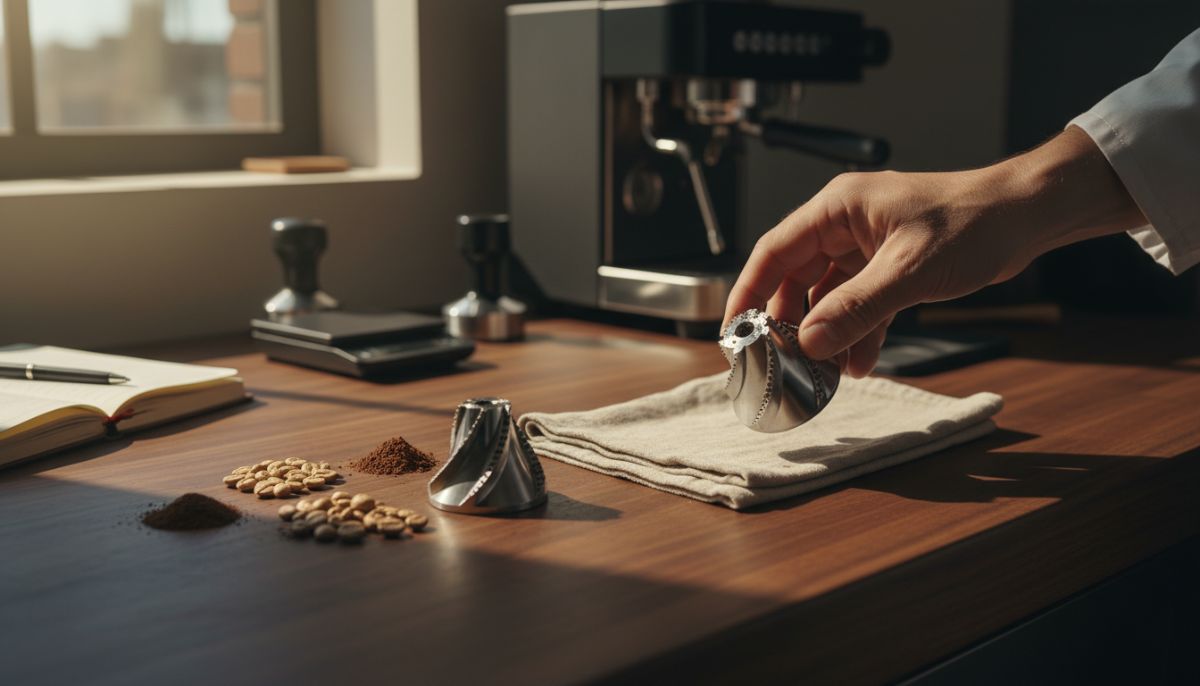
Is seasoning your coffee grinder burrs really necessary? We dive into the science of breaking in new burrs, how it affects espresso consistency, and the best methods to get the job done.
Key Takeaways
- Consistency is King: Seasoning removes microscopic imperfections from manufacturing, leading to more stable grind particle sizes.
- Time vs. Waste: You can season naturally over months of use or accelerate the process with sacrificial beans.
- Taste Impact: Unseasoned burrs often produce erratic extraction times and wandering grind settings, frustrating your dial-in process.
- Coating Matters: Titanium and Red Speed coated burrs generally require significantly longer break-in periods than standard steel.
You have just unboxed a brand-new, high-end grinder. You plug it in, pour in your finest single-origin beans, and pull a shot. It runs fast. You adjust finer. Now it chokes. You adjust slightly coarser, and it sprays everywhere. Is the grinder broken? Is the machine acting up?
Likely, neither. You are simply experiencing the erratic behavior of unseasoned burrs. In the world of specialty coffee, the concept of "seasoning"—or breaking in—your grinder burrs is often debated. Is it a myth perpetuated by obsessives, or is it a critical step for cafe-quality espresso? Let’s separate the science from the folklore.
What Exactly is Burr Seasoning?
When grinder burrs are machined at the factory, the cutting teeth are incredibly sharp. While this sounds ideal, the manufacturing process leaves behind microscopic rough edges, tiny metal artifacts, and an overly aggressive friction coefficient. These imperfections prevent the coffee beans from sliding and cutting uniformly.
Seasoning is essentially the process of dulling these razor-sharp edges just enough to smooth out the cutting action. Over time, coffee oils coat the metal, and the friction of grinding beans polishes the teeth. This results in a more unimodal particle distribution (more consistent grind size) and reduces the amount of fines (dust) that can clog your portafilter.
For a deeper dive into how different geometries react to this process, read our guide on flat vs. conical burrs. The geometry dictates how quickly the burrs settle, but the need for seasoning remains universal.
The Symptoms of “Raw” Burrs
How do you know if your burrs are the culprit? New, unseasoned grinders often display specific behaviors that can drive a home barista crazy:
- Wandering Zero Point: You dial in your shot perfectly in the morning, but by the afternoon, the same setting produces a completely different flow rate.
- Clumping and Static: Rougher metal surfaces create more friction and static electricity, leading to messy retention. While you can combat this with tricks, as seen in our article on the RDT method, the root cause is often new steel.
- Inconsistent Extraction: If your puck prep is perfect but your shots still taste sour or channel, your grinder might be producing too many boulders and fines simultaneously. This inconsistency makes it incredibly hard to dial in espresso ratios effectively.
Myth or Essential? The Verdict
It is not a myth, but the urgency might be exaggerated depending on your equipment. For a standard home user, seasoning happens naturally over the first few months of use. However, until that break-in period is over, you will waste more coffee trying to chase a moving target.
If you value precision and want your grinder to perform at its peak immediately, active seasoning is an essential step. This is especially true if you are trying to minimize waste. Ironically, unseasoned burrs often lead to high retention, trapping stale coffee inside the chamber. Learn more about how this affects flavor in our post on grinder retention.
Coated vs. Uncoated Burrs
Not all burrs are created equal. Standard stainless steel burrs might only need 5 to 10 pounds of coffee to settle. However, modern high-end burrs often come with advanced coatings (like Titanium Nitride or Red Speed) to increase durability. These coatings are harder and smoother, meaning they can take significantly longer—sometimes up to 20-30 pounds of coffee—to fully break in.
How to Season Your Burrs
There are two main schools of thought on how to tackle this process.
1. The Organic Method (Patience)
Just use the grinder. Accept that your first few kilograms of coffee will result in slightly inconsistent shots. You will need to adjust your grind setting more frequently. This is the most cost-effective method if you aren’t in a rush.
2. The Rapid Method (Sacrificial Beans)
If you want peak performance on day one, buy a few bulk bags of the cheapest, darkest roast whole bean coffee you can find. Do not use flavored coffee (the chemical oils stick to the burrs) or rocks/rice (this destroys the grinder).
- Set the grinder to a medium-coarse setting.
- Run the coffee through in batches to avoid overheating the motor.
- Discard the grounds (or use them for compost).
- Clean the grinder thoroughly afterwards to remove old oils.
While doing this, it is the perfect time to ensure your alignment is spot on. Seasoning won’t fix a misalignment issue. Check out our tutorial on burr alignment and shimming to ensure your geometry is parallel before you start running pounds of coffee through it.
Conclusion
Seasoning your burrs is a tangible, physical process that improves the consistency and taste of your espresso. While you don’t have to grind 20 pounds of coffee the day you buy your machine, understanding that your grinder will evolve over its first few months saves you from frustration. Treat your new gear with patience, keep your maintenance routine solid, and eventually, your burrs will settle into the sweet spot.
Frequently Asked Questions
It depends on the burr material. Standard steel burrs usually take 5-10 lbs of coffee. Coated burrs (TiN, SSP) can take 10-30 lbs before the grind setting stabilizes.
No! Instant rice (specifically branded grinder cleaners) is safe for cleaning, but raw rice is too hard and can damage the motor or dull the burrs. Always use roasted coffee beans for seasoning.
Yes. Seasoned burrs produce a more uniform particle size (unimodal distribution), which leads to clearer flavors, higher sweetness, and less astringency compared to the muddy extractions of new burrs.
The process is the same, though flat burrs generally show a more dramatic improvement in particle distribution after seasoning compared to conical burrs.