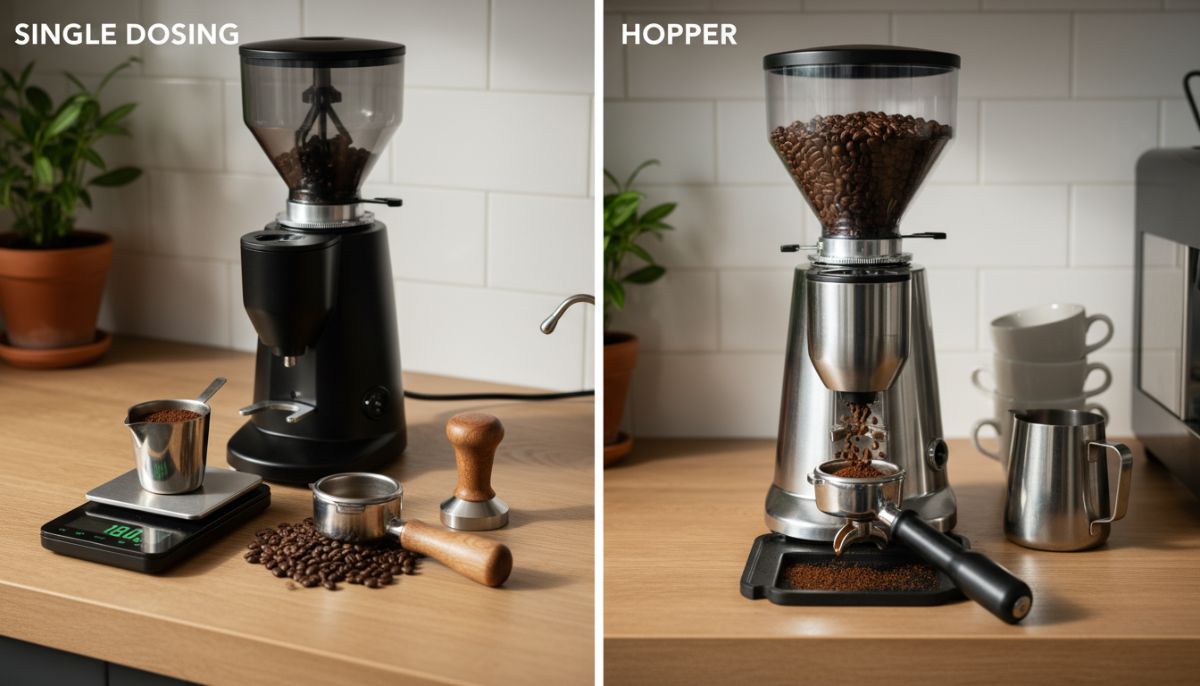
Torn between the precision of single dosing and the convenience of a hopper? We break down the pros, cons, and hidden mechanics of each grinder workflow to help you choose the best setup for your home cafe.
Key Takeaways
- Freshness Factor: Single dosing maximizes bean freshness by keeping coffee in airtight storage until the moment of grinding.
- Workflow Speed: Hopper-based grinding is significantly faster for back-to-back shots but requires purging old grounds.
- Flexibility: Single dosing allows you to switch between bean origins or decaf instantly without waste.
- Consistency: Understanding retention is critical for both methods to ensure your extraction parameters remain stable.
Introduction
Walk into a bustling commercial café, and you will see large hoppers filled with pounds of glistening coffee beans. Walk into the kitchen of a dedicated home barista, and you might see a sleek machine with a tiny bellows on top, empty and waiting.
This visual difference represents the great divide in modern home espresso: Single Dosing vs. Hopper Grinding.
Choosing a grinder is often more critical than choosing the espresso machine itself. However, the decision isn’t just about burr size or motor power; it is about workflow. How you interact with your coffee beans every morning dictates the quality of your cup and the enjoyment of your routine.
Are you looking for the speed and convenience of a “fill it and forget it” system? Or are you chasing the ultimate flavor clarity that comes with weighing every dose? Let’s dive deep into the mechanics of both methods to see which one belongs on your countertop.
The Traditional Hopper Workflow
How It Works
The hopper workflow is the standard for a reason. You fill a reservoir (the hopper) with a large quantity of beans—usually 250g to 1kg. The weight of the beans provides downward pressure, feeding coffee into the burrs as you grind based on a timer.
The Benefits: Speed and Consistency
The primary advantage here is efficiency. If you often make three or four lattes in a row for family members or guests, a hopper is superior. You simply place the portafilter in the cradle, press a button, and wait for the timed dose.
Many budget-friendly electric grinders utilize this system because it is user-friendly and familiar. It mimics the cafe experience where speed is money.
The Drawbacks: The Stale Coffee Problem
The downside of a hopper is twofold: oxidation and retention. Beans left in a semi-transparent plastic hopper are exposed to light and air, accelerating the staling process. Furthermore, the “exchange”—the amount of ground coffee left in the chute from the previous day—can be significant.
To get fresh coffee, you often have to “purge” (grind and discard) a few grams of coffee before your first shot. Over a year, this waste adds up significantly.
The Single Dosing Revolution
How It Works
Single dosing involves weighing a specific amount of beans (e.g., 18.0 grams) for exactly one shot. You load only those beans into the grinder, grind until the chamber is empty, and brew.
The Benefits: Precision and Versatility
Single dosing is the darling of the enthusiast community. Because the hopper is empty, you can switch from a light roast Ethiopian to a dark roast sumatra, or even to decaf, instantly. There is no need to purge old beans to get to the new ones.
This workflow forces you to be intimate with your recipe. It aligns perfectly with the principles of dialing in your espresso, as you eliminate variables. You know exactly what went in, so you know exactly what should come out.
The Drawbacks: The “Faff” Factor
The main criticism of single dosing is the extra steps involved. You must weigh the beans every single time. Many single-dose grinders also require the use of a bellows (a puffer tool) to blow out the last few grounds, adding another step to the routine.
Deep Dive: The Retention Issue
The battle between these two workflows often comes down to one technical concept: retention. This refers to the coffee grounds that get stuck inside the grinder’s chamber and chute after the motor stops.
In a hopper grinder, this retained coffee sits there until the next time you grind. If you grind 24 hours later, the first 2-5 grams of your “fresh” grind is actually yesterday’s stale coffee. This mixing of old and new grounds is the enemy of flavor clarity.
Single dose grinders are engineered to have “zero retention” (or very close to it). They use tilted bodies, straight chutes, and air blowers to ensure that if you put 18g in, you get 18g out. To truly understand why this matters for your wallet and your palate, read our guide on the concept of grinder retention.
Workflow Enhancements
Regardless of which path you choose, there are techniques to improve your results. However, single dosing often requires a bit more “puck prep” to ensure perfect flow.
The RDT Method
Because single dose grinders often grind until the chamber is completely empty, static electricity can build up, causing grounds to cling to the exit chute. This is where the Ross Droplet Technique comes in.
By adding a tiny drop of water to the beans before grinding, you eliminate static. While this is less common in hopper grinding (you don’t want wet beans sitting in a hopper), it is an essential step for the single doser. Learn more about the Ross Droplet Technique (RDT) to keep your station clean.
Flavor Profiles and Freshness
Does the workflow change the taste? Indirectly, yes.
By storing your beans in airtight containers or vacuum-sealed bags and only opening them to weigh a dose, you preserve the volatile aromatics of the coffee. Hopper beans degrade faster.
If you buy expensive, specialty coffee, you want to preserve the specific tasting notes—be it blueberry or jasmine. Paying attention to your roast dates and freshness is futile if you leave the beans in a hopper for a week.
Conversely, if you prefer darker, traditional roasts that are more forgiving, the slight oxidation that occurs in a hopper might not bother you as much as it would a lover of light roasts.
Which Grinder Geometry Fits?
It is worth noting that while you can single dose on almost any grinder, some are designed for it. Large flat burrs are often preferred for single dosing because they offer high clarity, which highlights the freshness of the workflow.
Conical burrs are often found in hopper grinders due to their ability to handle a load of beans smoothly. Understanding how grinder geometry changes flavor can help you decide if the hardware matches your desired workflow.
The Verdict: Who is Each For?
Choose the Hopper Workflow If:
- Convenience is King: You want coffee with the push of a button, especially early in the morning.
- High Volume: You frequently entertain guests or have multiple coffee drinkers in the house.
- Consistent Bean Choice: You buy one bag of beans at a time and drink it until it’s gone.
Choose Single Dosing If:
- Flavor is King: You want the absolute maximum potential from your beans.
- Variety Seeker: You like to switch between different roasts or decaf throughout the day.
- Waste Averse: You hate the idea of purging (wasting) expensive coffee every morning.
Conclusion
Ultimately, the battle of “Single Dosing vs. Hopper” isn’t about which is objectively better; it is about which friction you are willing to accept. Do you accept the friction of weighing beans every time for the sake of quality? Or do you accept the friction of purging waste for the sake of speed?
Assess your morning routine honestly. If you enjoy the ritual of preparation, single dosing is a rewarding journey. If you just need caffeine to function, the hopper remains the undefeated champion of convenience.
Frequently Asked Questions
Yes, but it is not ideal. Standard grinders are designed to have the weight of beans pushing down on the burrs (pop-corning effect). Without this weight, the grind consistency can suffer unless the grinder is modified or designed for single dosing.
Yes. Coffee beans are porous and absorb moisture and odors while losing aromatics. Beans left in a non-airtight hopper for several days will stale significantly faster than those kept in a sealed container.
Purging is the act of grinding a small amount of coffee (usually 2-5 grams) and discarding it before brewing. This pushes out stale grounds retained in the chute from the previous session to ensure your shot uses fresh coffee.
Not necessarily. While some high-end single dose grinders are expensive, the workflow actually saves money over time by eliminating the waste associated with purging stale coffee.