
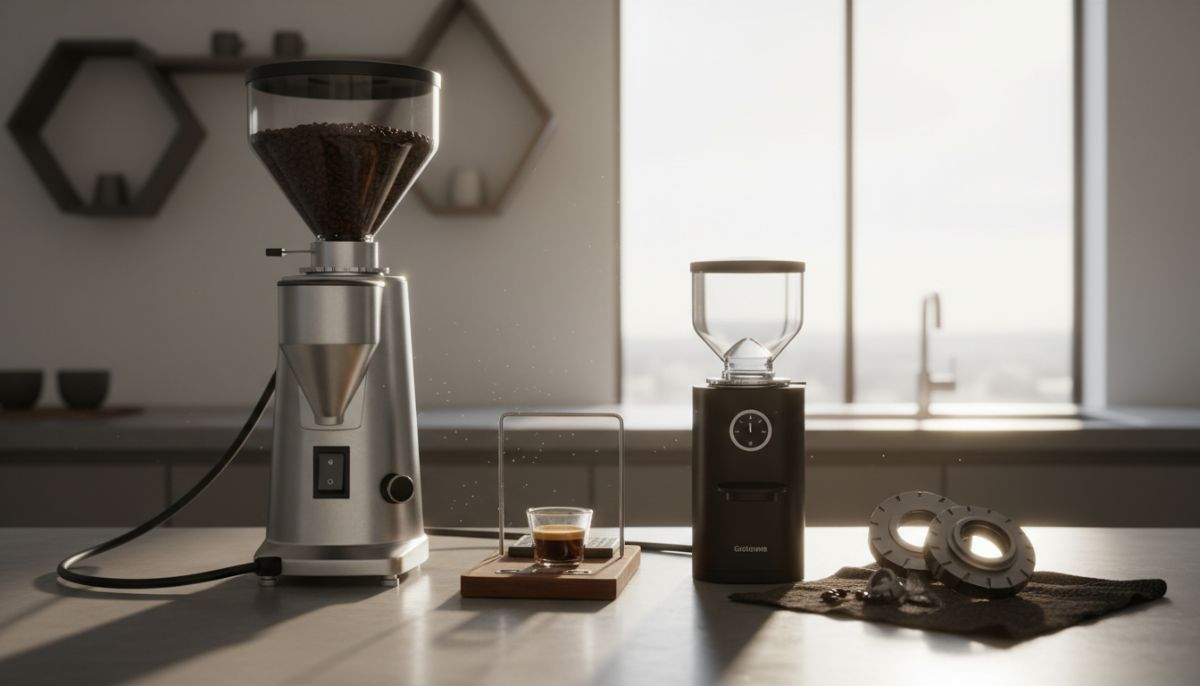
Are massive 83mm or 98mm burrs worth the investment for home espresso? We analyze the Titan grinder trend, weighing flavor clarity against retention, size, and diminishing returns.
Key Takeaways
- Burr Surface Area: Larger burrs generally provide more uniform particle distribution and faster grinding speeds.
- Flavor Clarity: Titan class grinders (75mm+) often excel at separating complex flavor notes compared to smaller counterparts.
- The Retention Trade-off: Commercial-sized grinders can retain significant amounts of coffee, making them tricky for single-dosing without modification.
- Diminishing Returns: For many home baristas, the jump from 64mm to 98mm offers a subtler improvement than upgrading from an entry-level grinder.
Walk into any high-end specialty coffee shop, and you will see them: the monoliths. These massive grinders, housing burrs the size of saucers, dominate the counter. For years, the home espresso community has looked at these commercial beasts with envy, sparking a trend known as the “Titan Grinder” movement.
The logic seems sound. If the best cafes use massive burrs to make delicious espresso, shouldn’t you do the same at home? However, bringing commercial equipment into a residential kitchen isn’t always a straightforward upgrade. It involves trade-offs in space, workflow, and wallet.
Is bigger always better? Or have we reached a point where precision engineering in smaller packages rivals the giants?
Defining the Titan Class
What exactly makes a grinder a “Titan”? While there is no strict industry definition, the term generally refers to grinders designed for heavy commercial duty cycles. They typically feature flat burrs of 75mm and above, or conical burrs of 68mm and above.
These machines are built to grind pounds of coffee per hour without overheating. But in a home setting, where you might pull two shots a morning, that duty cycle is irrelevant. So, why do enthusiasts buy them? It comes down to what happens inside the burr chamber.
The Argument for Size: Why Geometry Matters
The primary argument for large burrs is particle distribution. In theory, a larger cutting surface allows for a more gradual reduction of the coffee bean. This creates a longer grind path, which can result in a more unimodal distribution—meaning the particles are more uniform in size.
Flavor Separation and Clarity
Uniform particles extract at the same rate. When you have fewer “fines” (dust-like particles) and fewer “boulders” (large chunks), you reduce the risk of simultaneous over-extraction and under-extraction. The result in the cup is often described as high clarity. You can taste distinct notes of blueberry, jasmine, or chocolate rather than a muddied generic “coffee” flavor.
However, the profile changes depending on the shape. If you are debating between massive flats or huge conicals, you should understand how grinder geometry changes your flavor profile. Large flat burrs tend to highlight acidity and clarity, while large conicals often emphasize texture and body.
Speed and Heat Transfer
Titan grinders are incredibly fast. A 98mm grinder can chew through an 18-gram dose in under three seconds. Because the grind time is so short, there is very little heat transfer from the motor or friction to the beans. Cooler grounds preserve the volatile aromatics that make espresso smell divine.
The Hidden Enemy: Retention
Here is the catch. Commercial grinders are designed to have a hopper full of beans sitting on top. They rely on the weight of the beans to push coffee through. When you use them at home, specifically for single-dosing, you encounter the issue of retention.
Large grind chambers have huge cavernous spaces where coffee grounds can get stuck. If a grinder retains 3 grams of coffee, and you grind 18 grams, a significant portion of your shot might be stale grounds from yesterday. This is the hidden enemy of fresh espresso.
To combat this, manufacturers have started releasing “single-dose” versions of Titan grinders, often using bellows to puff air through the chamber. Without these modifications, a standard commercial grinder can be wasteful and frustrating for the home user.
Alignment: The Great Equalizer
A massive burr set is useless if it isn’t spinning perfectly true. If the top and bottom burrs aren’t parallel, one side of the coffee bed will be coarse while the other is fine. This leads to severe channeling.
Interestingly, a perfectly aligned 64mm grinder will often outperform a poorly aligned 83mm grinder. The precision of the manufacturing is just as important as the sheer size of the steel. Before dropping thousands on a Titan, ensure you are comfortable with maintenance. You might need to learn how to shim your grinder for perfection to get the value out of your investment.
Workflow and Usability
Beyond the taste, there is the user experience. Titan grinders are loud, heavy, and tall. Many won’t fit under standard kitchen cabinets. Furthermore, the powerful motors can generate significant static electricity, causing grounds to cling to the chute.
To manage this, many home baristas utilize the Ross Droplet Technique. By adding a tiny spray of moisture to the beans, you can mitigate the static. This is essential for large burrs. If you aren’t familiar with this workflow hack, read up on the RDT method to banish static.
You also need to consider adjustment mechanisms. Titan grinders used for espresso must offer infinite adjustability. If you are locked into rigid clicks, you won’t be able to dial in your shot perfectly. This is where the battle of stepless vs. stepped grinders becomes critical. Ensure your Titan choice has a worm gear or micrometric adjustment collar.
The Law of Diminishing Returns
So, is it worth it? The jump from a blade grinder to a decent conical burr grinder is massive. The jump from an entry-level burr grinder to a pro-sumer 64mm flat burr grinder is significant.
However, the jump from a premium 64mm grinder to a 98mm Titan grinder is subtle. We are talking about the last 5-10% of potential flavor quality. For a palate that is still developing, or for those who prefer dark roasts with milk, this difference might be imperceptible.
If you are limited on space or budget, do not feel like you cannot make god-tier espresso without a Titan. In fact, many modern high-end hand grinders offer grind consistency that rivals electric giants at a fraction of the cost, simply because you are paying for the burr stability, not a massive motor.
Conclusion
Bigger is better, but only with caveats. Titan grinders offer superior particle distribution, speed, and flavor separation. They are the pinnacle of espresso tech. However, they demand more counter space, strict alignment checks, and often struggle with retention unless specifically designed for single-dosing.
If you chase light roast espressos and want to taste every nuance of the origin, a Titan grinder is the ultimate tool. For the daily driver who wants a hassle-free morning latte, a high-quality 64mm grinder is likely the “sweet spot” of value and performance.
Frequently Asked Questions
While definitions vary, a Titan grinder typically features flat burrs of 75mm or larger, or conical burrs of 68mm or larger, powered by a high-torque commercial motor.
Generally, yes. Larger burrs create a more uniform particle size distribution, which leads to higher clarity and better flavor separation. However, the difference is most noticeable with light to medium roasts.
Not necessarily. Dark roasts prioritize body and chocolatey notes over clarity. A standard high-quality conical grinder often suits dark roasts perfectly well, making a Titan grinder an unnecessary expense for this style.
You can, but retention is a major issue. Unless the grinder is modified with a bellows system or specifically designed for single dosing (like the Lagom P100 or Monolith), you may waste several grams of coffee per session.