
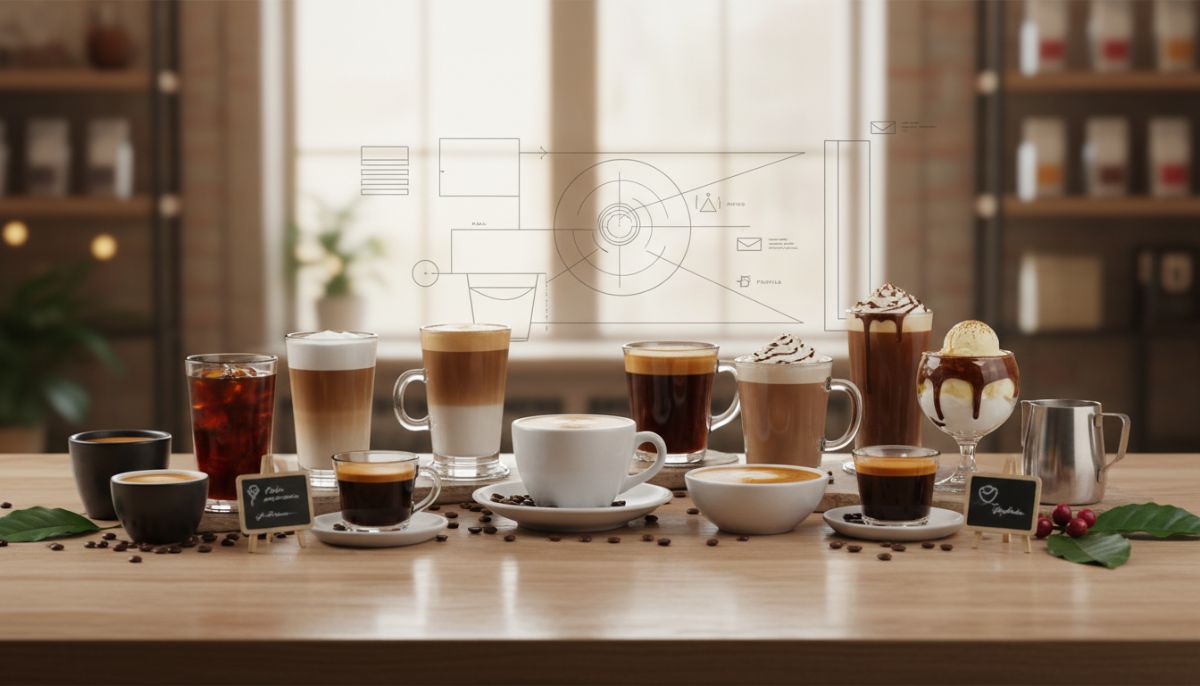
Confused by the coffee menu? From the ratio-perfect Cortado to the foam-heavy Cappuccino, we break down the top 10 types of coffee, flavor profiles, and caffeine content in this comprehensive guide.
Key Takeaways
- Beans vs. Drinks: Understand the difference between the plant species (Arabica vs. Robusta) and the brewing recipe (Latte vs. Macchiato).
- The Golden Ratios: The texture and taste of your drink depend entirely on the ratio of espresso to steamed milk and foam.
- Roast Matters: A dark roast suits milk-based drinks like Lattes, while light roasts shine in black coffee or Pour-overs.
- Caffeine Control: An espresso shot generally contains less caffeine than a full cup of drip coffee, though it is more concentrated by volume.
Walking into a modern cafe can feel like entering a chemistry lab. Between the Italian nomenclature and the precise variations in milk texture, knowing exactly what to order is a skill in itself. This guide moves beyond generic descriptions to provide an elite breakdown of the most popular coffee types, focusing on the specific ratios, extraction methods, and flavor profiles that define them.
The Critical Distinction: Beans vs. Drinks
Before analyzing the menu, it is vital to distinguish between the raw ingredient and the final beverage. Search queries often conflate the two, but they are distinct entities.
Types of Coffee Beans
- Arabica (Coffea arabica): Accounts for roughly 60-70% of global coffee production. It is grown at higher altitudes and is prized for its complex acidity and sweetness. If you are learning how to identify flavor notes, start here.
- Robusta (Coffea canephora): Grown at lower altitudes, Robusta is hardier, more bitter, and contains nearly double the caffeine of Arabica. It is often used in Italian espresso blends to generate a thicker crema.
- Liberica & Excelsa: Rare varieties (less than 2% of the market) known for unique, fruity, and tart profiles, often found in Southeast Asia.
Top 10 Types of Coffee Drinks
Most cafe menus are built around a single foundation: the espresso shot. Understanding the espresso ratio and yield is key to understanding the rest of these beverages.
1. Espresso (Short Black)
Pronunciation: Ess-press-oh
The foundation of modern coffee culture. Espresso is not a bean type, but a brewing method where pressurized hot water is forced through finely-ground coffee.
- The Ratio: 1:2 (e.g., 18g ground coffee yields 36g liquid espresso).
- Flavor Profile: Intense, rich, and full-bodied. Characterized by a top layer of golden foam known as “crema.”
- Caffeine: ~63mg per shot.
- Best For: Purists who want to taste the raw character of the bean without dilution.
- Pro Tip: If you find it too bitter, you may be experiencing extraction issues. See our guide on how to fix over-extracted espresso.
2. Americano
Pronunciation: Ah-meh-ri-kah-noh
Originating from WWII American soldiers rationing their espresso, this drink dilutes the intensity of espresso with hot water, mimicking the strength of drip coffee but preserving the espresso’s flavor notes.
- The Ratio: 1 part espresso to 2-4 parts hot water.
- Structure: Espresso is poured first, followed by hot water. This often dissolves the crema.
- Flavor Profile: Smoother than espresso, less acidic than drip coffee.
- Regional Variant: The Long Black (popular in Australia/NZ) reverses the order: water first, espresso extracted on top to preserve the crema.
3. Macchiato (Caffè Macchiato)
Pronunciation: Mock-e-ah-toe
In Italian, macchiato means “marked” or “stained.” This is an espresso shot marked with a tiny dollop of foam.
- The Ratio: 90% espresso, 10% milk foam.
- Flavor Profile: Intense coffee hit with just enough dairy to cut the sharpest acidity.
- Best For: Those who want an espresso with a slightly softer texture but no volume.
- Warning: Do not confuse this with the caramel-syrup-laden “Latte Macchiatos” found in large commercial chains.
4. Cortado
Pronunciation: Cor-tah-doh
Hailing from Spain, the Cortado cuts the acidity of espresso with warm milk. It is smaller and stronger than a flat white.
- The Ratio: Strictly 1:1 (Equal parts espresso and steamed milk).
- Texture: Little to no foam. The milk is steamed to be silky, not frothy.
- Flavor Profile: Balanced. You taste the coffee and milk equally.
- Best For: The sophisticated drinker who wants to reduce acidity without diluting the caffeine kick.
5. Flat White
Pronunciation: Flat White
An export from the Australian/New Zealand coffee scene, the Flat White is often confused with a Latte. The difference lies in the volume and the texture of the milk.
- The Ratio: 1 part espresso to 4 parts steamed milk.
- Texture: Characterized by varying layers of “microfoam” (very fine bubbles). It should have a glossy, velvety consistency.
- Flavor Profile: Milky but coffee-forward. Stronger than a latte.
- Comparison: For a deep dive, read our analysis on Flat White vs. Cortado vs. Cappuccino.
6. Cappuccino
Pronunciation: Kap-oo-chee-noh
The breakfast classic. A traditional cappuccino is defined by texture and distinct layers.
- The Ratio: The “Rule of Thirds” (1/3 Espresso, 1/3 Steamed Milk, 1/3 Thick Foam).
- Texture: Airy and light. The foam should be thick enough to support a dusting of cocoa powder.
- Calorie Estimate: ~110-150 calories (depending on milk choice).
- Best Time to Drink: Traditionally consumed only in the morning in Italy to aid digestion.
7. Caffè Latte
Pronunciation: Lah-tay
The most popular entry-point for coffee drinkers. It is a milk-heavy drink that masks bitterness effectively.
- The Ratio: 1 part espresso to 5-6 parts steamed milk, topped with a thin layer of foam.
- Flavor Profile: Sweet, creamy, and mild. The espresso is a background note.
- Best For: Beginners, or those who enjoy flavoring syrups.
- Texture Guide: Requires mastering wet vs. dry microfoam to get that liquid-paint texture for latte art.
8. Mocha (Caffè Mocha)
Pronunciation: Moh-kuh
Essentially a latte with chocolate added. It bridges the gap between hot chocolate and coffee.
- The Ratio: 1 part espresso, 1 part chocolate syrup/powder, 4 parts steamed milk.
- Flavor Profile: Sweet and dessert-like.
- Best For: Those who dislike the taste of coffee but want the caffeine boost.
9. Cold Brew & Nitro
Pronunciation: Cold Broo
Unlike iced coffee (which is hot coffee cooled down), Cold Brew is steeped with cool water for 12-24 hours.
- The Method: Full immersion brewing over a long period.
- Flavor Profile: Extremely smooth, low acidity, and naturally sweet. The cold water does not extract the acidic compounds found in hot coffee.
- Nitro Cold Brew: Cold brew infused with nitrogen gas, creating a cascading texture similar to Guinness beer.
- Caffeine Content: Very High (often served as a concentrate).
10. Pour-Over (Drip / Filter)
Pronunciation: Por-oh-ver
The manual method preferred by specialty coffee enthusiasts to highlight single-origin beans.
- The Ratio: Generally 1:16 (1g coffee to 16g water).
- Flavor Profile: Clean, tea-like, and delicate. This method highlights floral and fruity notes that espresso often masks.
- Equipment: V60, Chemex, or Kalita Wave.
- Freshness: Crucial for this method. Always check coffee roast dates before brewing.
Choosing the Right Roast Level
Your choice of drink should influence your choice of bean roast.
- Light Roast: High acidity, fruit-forward. Best for Pour-over, Drip, and Black Americanos.
- Medium Roast: Balanced sweetness and body. Versatile for Espresso and basic milk drinks.
- Dark Roast: Low acidity, bitter-sweet, chocolatey. Best for milk-heavy drinks (Latte, Cappuccino) where the coffee needs to cut through the dairy.
Summary: Which Coffee Fits Your Lifestyle?
- High Energy / Quick Consumption: Espresso or Macchiato.
- Morning Ritual / Breakfast: Cappuccino or Cortado.
- Comfort / Sweetness: Latte or Mocha.
- Flavor Exploration: Pour-Over (Black).
- Summer Heat: Nitro Cold Brew.
Frequently Asked Questions
In terms of caffeine concentration per ounce, Espresso is the strongest. However, because a Ristretto uses less water for the same dose of beans, it is more concentrated. In terms of total caffeine per serving, a Cold Brew or a large Drip Coffee often contains more caffeine than a single shot of espresso.
The main difference is the milk-to-coffee ratio and texture. A Flat White is smaller (typically 6oz) with a higher proportion of coffee and a very thin layer of microfoam. A Latte is larger (8-10oz), milkier, and has a thicker layer of foam.
A Caffè Mocha is the best option for beginners, as the chocolate masks the bitterness. Alternatively, a Caffè Latte provides a very milky, mild flavor. For black coffee, try Cold Brew, which has naturally low acidity and bitterness.
Technically, no. Light roast beans retain slightly more caffeine than dark roasts because roasting burns off some caffeine. However, the difference is negligible per cup. The volume of coffee you use (by weight) matters more than the roast level.
A Red Eye is a cup of normal drip coffee with a shot of espresso added to it. It is designed for maximum caffeine intake.