
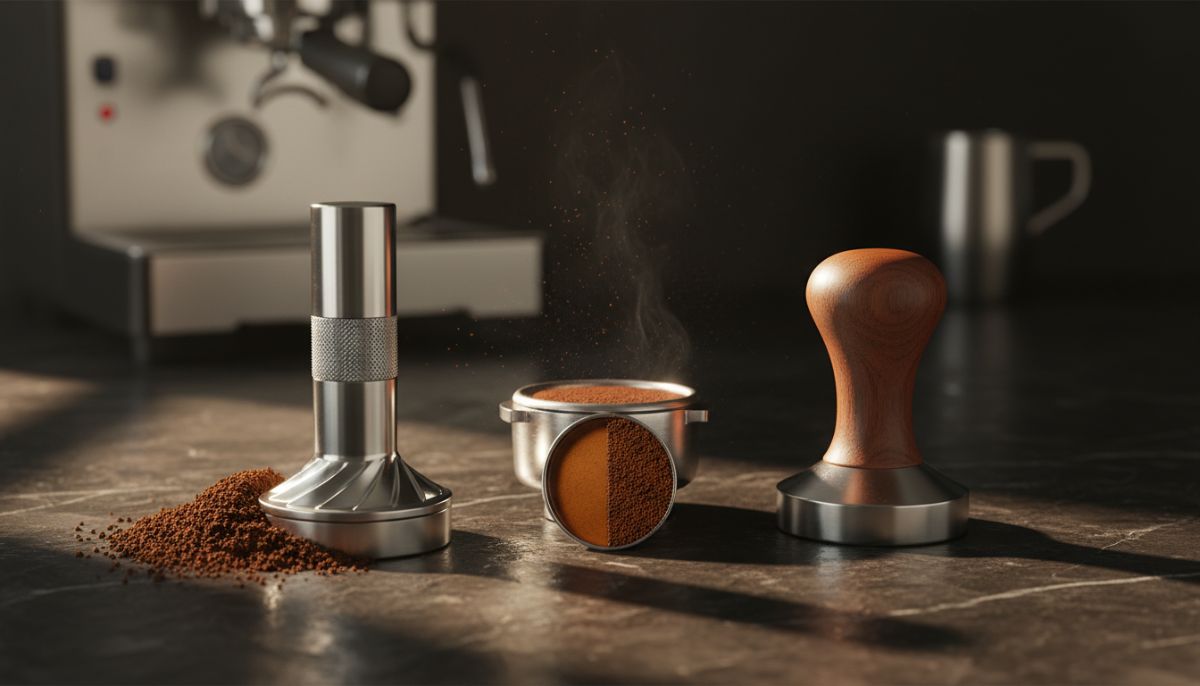
Are spinning wedge distributors just eye candy for Instagram, or do they scientifically improve espresso extraction? We break down the data on levelers versus tampers and the optimal puck prep workflow.
Key Takeaways
- Surface vs. Depth: Spinning levelers (wedge distributors) flatten the surface effectively but fail to redistribute coffee grounds deep in the basket compared to the WDT method.
- The Compression Trap: Using a leveler without tamping often results in "uneven compression," where the top layer is hard, but the bottom remains loose, causing channeling.
- Consistency Data: While levelers can improve shot-to-shot timing variance for beginners, they do not consistently yield higher extraction rates than proper vertical tamping.
- The Verdict: A leveler is a grooming tool, not a substitute for the vertical force of a tamper.
Scroll through any coffee enthusiast’s social media feed, and you will inevitably see it: the mesmerizing spin. A shiny, machined metal tool descends onto a portafilter, whirls around three or four times, and reveals a perfectly polished, flat puck surface. It looks satisfying. It looks professional. But does it actually make your coffee taste better?
For years, the "OCD" style wedge distributor was hailed as the ultimate fix for channeling. The promise was simple: spin the tool, and you get a perfectly level bed of coffee every time. However, as we have started measuring results with refractometers and using naked portafilters to diagnose flow, the narrative has shifted.
Are spinning levelers indispensable tools for consistency, or are they simply compressing uneven grounds into a pretty package? Let’s dive into the physics of puck preparation.
The Mechanics: What Wedge Distributors Actually Do
To understand the debate, we have to look at what is happening inside the basket. A tamper applies vertical force—usually between 15 to 30 pounds—to compress the coffee grounds into a solid cake. This removes air pockets and creates resistance, which is necessary for the pressurized water to extract oils and solids.
A spinning leveler works differently. It uses angled wedges (fans) to push coffee grounds laterally across the surface. As you spin it, the tool creates a flat plane. Most models have an adjustable depth, allowing you to control how far down the tool reaches.
Did You Know?
The concept of "polishing" the puck isn’t new, but the spinning leveler gained massive popularity largely due to the World Barista Championship. Competitors needed a way to ensure their tamps were perfectly level to avoid judges deducting points for slanted baskets.
The Myth of "Replacing" the Tamper
One of the biggest misconceptions in home espresso is that a leveler can replace a tamper. This is a dangerous habit if you are chasing high extraction yields.
If you set your distributor deep enough to compress the coffee fully, you run into a physics problem. The tool compresses the coffee it touches first—the top layer—much harder than the coffee at the bottom. The friction of the grounds prevents the force from traveling all the way down effectively when applied in a twisting motion compared to a direct vertical press.
The result? A puck that is dense at the top and loose at the bottom. When 9 bars of water pressure hit this structure, the water easily saturates the loose bottom layer but struggles to get through the cap. This frequently leads to visible channeling or the puck breaking apart mid-shot.
The "Donut Extraction" Phenomenon
Improper use of wedge distributors is a leading cause of "donut extractions," where coffee flows from the outer edges of the basket first, leaving a dead spot in the center. This happens because the spinning motion drives grounds toward the outer walls of the basket, increasing density at the perimeter if the depth isn’t set perfectly. Ironically, the tool meant to fix distribution often creates a density variance that didn’t exist before.
Data Breakdown: Spinning vs. Tamping vs. WDT
We shouldn’t just rely on theory. Let’s look at how these tools perform when we measure Extraction Yield (EY) and Total Dissolved Solids (TDS). For a deeper dive on these metrics, check out our guide on Understanding TDS and Extraction Yield.
| Puck Prep Method | Avg. Extraction Yield | Consistency (Std Dev) | Observation |
|---|---|---|---|
| Tamper Only | 19.5% | High Variance | Prone to slope/human error. |
| Leveler Only (No Tamp) | 18.2% | Medium Variance | Underextracted; low density. |
| Leveler + Tamper | 20.1% | Good Consistency | Flat surface helps the tamp. |
| WDT + Leveler + Tamper | 20.8% | High Consistency | Best visual pour, but slow workflow. |
| WDT + Tamper | 21.2% | Best Consistency | Highest EY; deep clumps removed. |
The data suggests that WDT + Tamper actually outperforms the inclusion of a leveler in terms of raw extraction yield. Why? Because the needles of a WDT tool break up deep clumps that the wedge distributor merely glides over. When you spin a leveler over a clump, you are often just pushing the clump down, not breaking it apart.
The Pros and Cons
Does this mean you should throw your distributor in the trash? Not necessarily. They serve a specific purpose, especially for those struggling to get a perfectly level tamp manually.
Wedge Distributor Pros
- Auto-Leveling: Creates a perfectly flat surface, ensuring your subsequent tamp is not crooked.
- Cleanliness: Keeps grounds inside the basket better than messy finger-leveling.
- Repeatability: Sets a fixed headspace distance if the depth is locked.
Wedge Distributor Cons
- False Density: Can compress the top layer while leaving air pockets below.
- Fines Migration: The spinning motion may migrate "fines" (tiny coffee particles) to the bottom, potentially clogging the basket holes.
- Cost: High-end distributors are expensive compared to a simple WDT tool.
The Optimal Workflow: Do You Need Both?
If you want the absolute best espresso, science points toward the Weiss Distribution Technique (WDT) as the non-negotiable step. Using thin needles to fluff the grounds ensures consistent density from top to bottom. If you use WDT, a spinning leveler becomes largely redundant, serving only to smooth the top for aesthetics.
However, if you struggle with tamping level—meaning your coffee bed is often slanted—a leveler is a fantastic crutch. It ensures that when you do bring your tamper down, it is hitting a flat surface. This can be particularly helpful if you aren’t using a spring-loaded leveling tamper.
The Recommendation:
1. Grind into your dosing cup or portafilter.
2. WDT to break deep clumps and fluffy the grounds.
3. Tap the portafilter once on the counter to collapse large voids.
4. Tamp firmly. (You can skip the spinning leveler here without losing quality, provided your tamp is straight).
Conclusion
Spinning levelers are not the magic bullet for consistency that marketing campaigns suggest. They are grooming tools, not distribution tools. While they make the puck look immaculate, they cannot fix deep density issues within the coffee bed. For true consistency, focus on deep distribution with WDT and ensure your tamping pressure is vertical and uniform. If you love the ritual of the spin, keep doing it—just make sure you aren’t skipping the tamp.
Frequently Asked Questions
Generally, no. A leveler creates a flat surface but does not compress the puck with enough vertical force to remove all air pockets. Using only a leveler often leads to channeling and underextraction.
The tool should be set deep enough to smooth the surface and slightly compress the grounds, but not so deep that it bottoms out against the basket rim before compressing the coffee. It should leave enough room for a final tamp.
Yes. A spinning leveler only affects the top layer of the coffee. WDT (Weiss Distribution Technique) distributes the grounds throughout the entire depth of the basket, which is more effective for preventing channeling.
Channeling often occurs because the distributor compacted uneven grounds rather than fixing them. If the grounds underneath the surface are clumpy or less dense, water will find a path of least resistance regardless of how flat the top looks.
The scientific consensus for the highest consistency is: Grind -> WDT -> Vertical Tap -> Tamp. You can insert a leveler step before tamping if you struggle to tamp level, but it is not strictly necessary.