
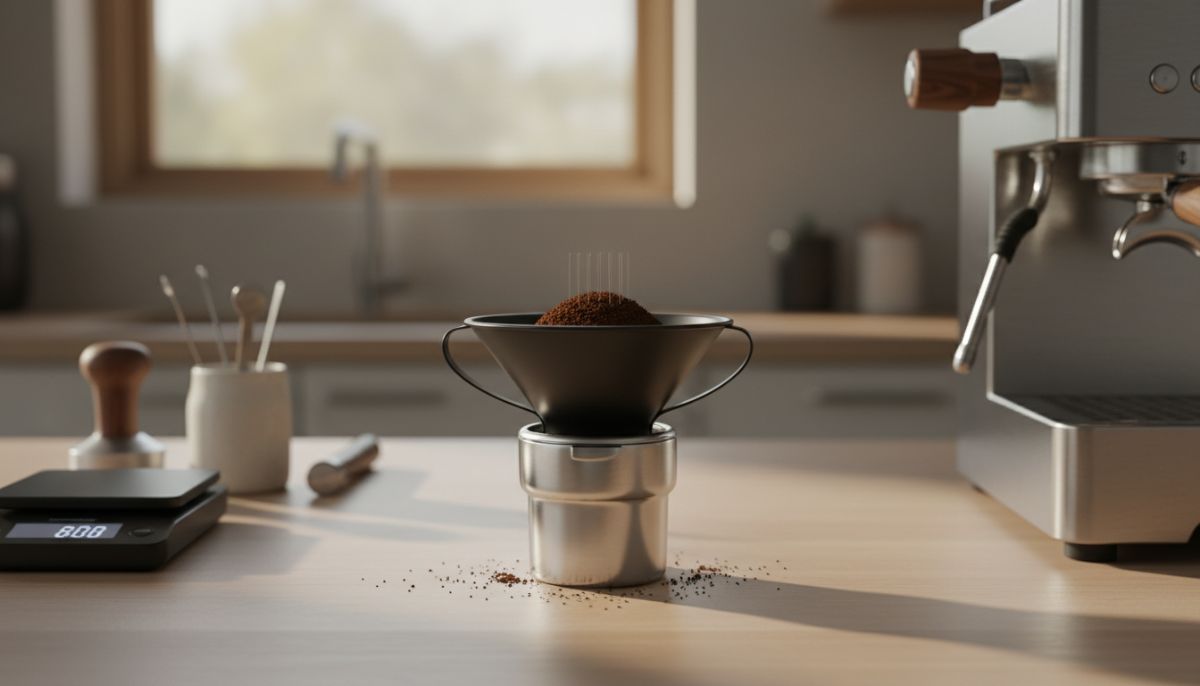
Tired of coffee grounds covering your countertop? Discover how a simple dosing funnel can revolutionize your espresso puck prep, enable aggressive WDT, and save you money on wasted beans.
Key Takeaways
- Eliminate Mess: Dosing funnels act as a barrier, keeping 100% of your coffee grounds inside the basket and off your countertop.
- Enable Advanced Puck Prep: They are virtually mandatory for the Weiss Distribution Technique (WDT), allowing for deep stirring without spillage.
- Improve Consistency: By preventing ground loss, you ensure that the exact weight of coffee you weighed is what actually makes it into the extraction.
- Cost Efficiency: Reducing waste means more espresso shots per bag of expensive specialty beans.
Introduction: The Battle Against Countertop Confetti
If you have ever tried to grind 18 grams of fluffy espresso grounds into a standard portafilter basket, you know the struggle. The moment the mound rises above the rim, gravity takes over. A slight bump, a static cling, or a gust of air, and your precious coffee dust is scattered across your drip tray and countertop. We often joke about “countertop confetti,” but for the serious home barista, this mess represents more than just a cleaning chore—it represents inconsistency.
In the pursuit of the perfect shot, we invest in high-end grinders and precision machines. Yet, the humble dosing funnel is often an afterthought. This simple ring of metal is arguably one of the most impactful workflow upgrades you can make for under $30. It bridges the gap between grinding and tamping, ensuring that your station remains pristine and your dose remains precise.
What Exactly is a Dosing Funnel?
A dosing funnel (also known as a dosing ring or collar) is an accessory designed to sit on top of your portafilter basket. It extends the height of the basket walls, creating a wide mouth that catches grounds falling from the grinder and holds them securely during puck preparation. They come in various sizes—most commonly 58mm for commercial machines and 54mm for brands like Breville—and are typically made from aluminum or stainless steel.
While early versions were simple plastic funnels, the market has evolved. Modern elite dosing funnels often feature integrated magnets that snap securely onto the basket, preventing the funnel from rattling or falling off during the grinding or distribution process.
The WDT Revolution: Why Funnels Are No Longer Optional
The rise of the Weiss Distribution Technique (WDT) has transformed the dosing funnel from a luxury into a necessity. WDT involves using thin needles to stir the coffee grounds inside the basket to break up clumps and homogenize density.
However, effective WDT requires vigorous stirring, often starting from the very bottom of the basket. Without a funnel, this motion would inevitably push grounds over the edge. If you are reading up on the science of puck prep and the WDT tool, you will quickly realize that a funnel is the WDT tool’s best friend. It allows you to stir aggressively to declump the entire bed of coffee without spilling a single particle.
Consistency: The Hidden Benefit of Cleanliness
Many home baristas focus on the mess, but the real benefit of a dosing funnel is consistency. Espresso is a game of variables. If you weigh out 18.0 grams of beans but spill 0.5 grams during the grinding or distribution phase, your input ratio has changed. This alters the flow rate and the final taste of your shot.
For those utilizing single dosing workflows, where retention is kept to a minimum, losing grounds to the countertop defeats the purpose of weighing your beans. By ensuring that 100% of the grinds stay in the basket, you maintain the integrity of your brew ratio. This precision is critical when you are learning how to dial in espresso ratios. If your dose fluctuates due to spillage, you will find yourself chasing your tail trying to adjust grind settings for a problem that is actually related to dose weight.
Dosing Funnel vs. Dosing Cup: Which Workflow Wins?
There is an ongoing debate in the community regarding the best transfer method: grinding directly into the portafilter with a funnel versus grinding into a cup and flipping it.
- Dosing Funnels: Best for direct grinding. You place the funnel on the portafilter, rest it on the forks, and grind. It creates a seamless “one-touch” workflow that minimizes static mess.
- Dosing Cups: These allow you to shake the grounds to declump them before transferring. However, the transfer itself can sometimes be messy without a funnel to guide the coffee in.
For a deeper dive into this comparison, check out our analysis on dosing cups vs. direct grinding. Many baristas actually use both: they grind into a cup, flip it into a portafilter equipped with a funnel, and then WDT. This hybrid approach offers the best of both worlds.
Selecting the Right Funnel
1. Magnet Strength
Not all funnels are created equal. Look for a funnel with strong, embedded magnets. Weak magnets will slide around when you tap the portafilter on the counter to settle the grounds. A secure fit is vital for one-handed operation.
2. Profile and Height
If you grind directly into the portafilter, you need to ensure the funnel isn’t too tall to fit between your portafilter forks and the grinder chute. Conversely, if the funnel is too shallow, you risk grounds overflowing if your grinder produces very fluffy coffee.
3. Inner Rim Design
Some cheaper funnels sit inside the basket rim rather than on top of it. Avoid these if possible. An inner lip creates a gap between the coffee puck and the basket wall, leading to a ring of low density that causes channeling. Always choose a funnel that sits on top of the basket rim or has a design that doesn’t disturb the puck’s edge. This helps avoid the issues discussed in our guide on Channeling 101.
The Waste-Free Workflow
Here is how to integrate a dosing funnel into an elite espresso routine:
- Weigh and RDT: Weigh your beans. Use the RDT method (Ross Droplet Technique) to reduce static, which helps the grounds fall vertically rather than flying sideways.
- Attach Funnel: Snap the magnetic funnel onto your portafilter.
- Grind: Grind your coffee directly into the basket.
- WDT: Use your distribution tool to stir the grounds thoroughly. Don’t be afraid to reach the edges; the funnel will catch everything.
- Vertical Tap: Give the portafilter a firm vertical tap on the counter to collapse the air pockets. This lowers the coffee bed below the rim of the basket.
- Remove and Tamp: Carefully lift the funnel. If you tapped correctly, the grounds should be settled enough that removing the funnel doesn’t cause a spill. Proceed to tamp.
Maintenance and Station Hygiene
Using a funnel significantly reduces the frequency of deep cleaning required for your coffee station. Coffee oils and fines that end up on your counter can go rancid and smell over time. By containing the mess, you are adhering to the principles of our cleaning manifesto, keeping your workspace sanitary and professional.
Conclusion
The dosing funnel is the unsung hero of the modern espresso bar. It is a small piece of metal that solves big problems: waste, inconsistency, and mess. Whether you are using a $300 entry-level setup or a $5,000 titan gear loadout, a dosing funnel is one of the few accessories that provides universal value. By integrating one into your workflow, you stop fighting against gravity and start focusing on what matters most: extraction and flavor.
Ready to upgrade your puck prep further? Consider looking into puck screens, another affordable accessory that pairs perfectly with a dosing funnel for the ultimate clean workflow.
Frequently Asked Questions
While not strictly mandatory, it is highly recommended. Even without WDT, grinding fluffy espresso requires containment to prevent spills. It saves coffee and keeps your counter clean.
Generally, no. Most standard tampers are the same diameter as the basket, meaning they won’t fit through the funnel’s opening if the funnel sits on the rim. You usually need to tap the portafilter to settle the grounds, remove the funnel, and then tamp. However, some specific precision tampers are designed to work with specific funnels.
You need to match the millimeter size of your machine’s portafilter. The most common commercial size is 58mm (E61 machines, Gaggia, Rancilio). Breville machines typically use 54mm. Always check your machine’s specifications before buying.
Yes, magnetic funnels are superior because they stay locked onto the portafilter during inversion or tapping. Non-magnetic funnels can easily slide off, potentially causing the very spill you are trying to avoid.