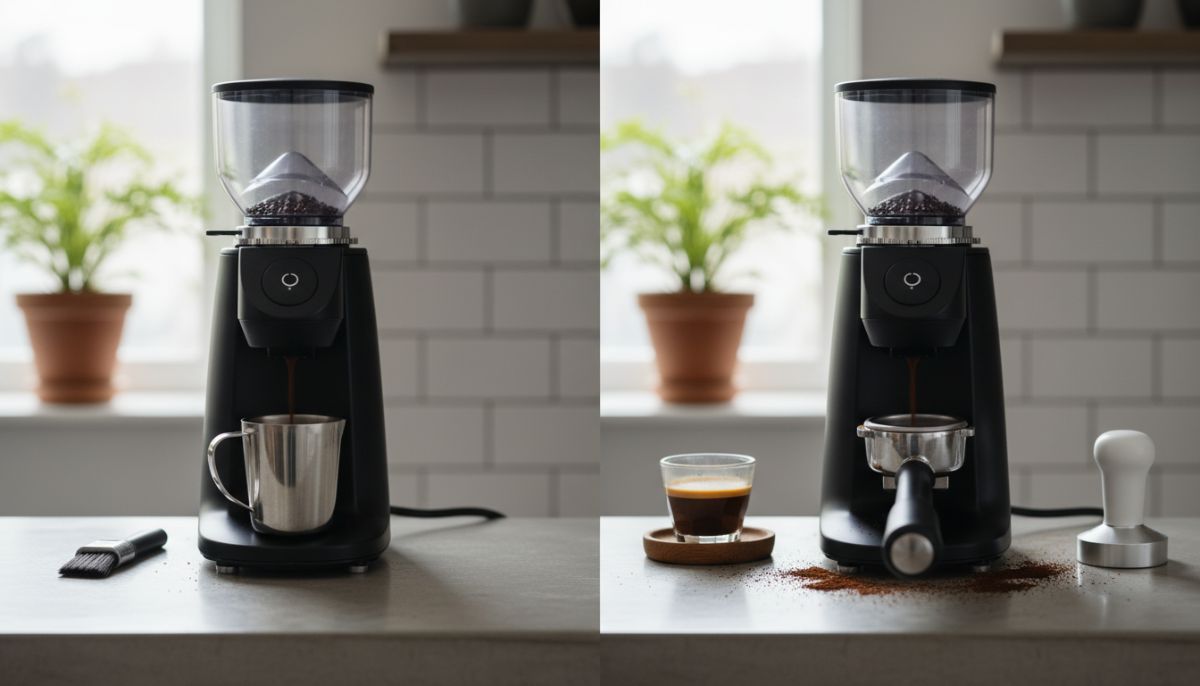
Tired of coffee grounds covering your counter? We compare dosing cups against direct grinding to determine which workflow offers the best balance of cleanliness, speed, and espresso consistency.
Key Takeaways
- Cleanliness: Dosing cups significantly reduce countertop mess by containing static-charged grounds closer to the grinder chute.
- Workflow: Direct grinding is faster and requires fewer steps, making it ideal for high-volume settings or rushed mornings.
- Consistency: Using a dosing cup allows for vigorous shaking, which can break up clumps and normalize density before the puck prep phase.
- Equipment: The choice often depends on your grinder’s retention and whether you utilize a single-dosing or hopper-based system.
There is a silent struggle that happens in home coffee bars every morning. It isn’t about the roast level or the water temperature; it is about the rogue coffee grounds that seem to coat every surface the moment the grinder turns on. As home espresso enthusiasts refine their setups, a debate has emerged regarding the most hygienic and efficient way to move coffee from the grinder to the portafilter: the dedicated dosing cup versus the traditional direct grind.
For decades, commercial cafes have ground directly into the portafilter for the sake of speed. However, as the single dosing workflow gains popularity among home baristas, the humble dosing cup has become a staple accessory. But is it just another shiny tool to clutter your station, or is it the secret to a spotless countertop? Let’s break down the mechanics, the mess, and the methodology of both approaches.
Direct Grinding: The Traditionalist’s Route
Direct grinding involves resting the portafilter on the grinder’s forks (or holding it manually) and allowing the grounds to fall directly into the basket. This is the standard operation for almost all commercial grinders and many home hopper-based grinders.
The Pros of Direct Grinding
The primary advantage here is efficiency. You eliminate the middleman. There is no transfer step, which means there is one less vessel to clean and one less movement in your workflow. For those who just want their caffeine fix without a ritual, this is the path of least resistance. It allows you to grind, tamp, and brew in rapid succession.
The Cons: Static and Spillage
The downside of direct grinding is almost always the mess. As coffee beans are pulverized, friction generates static electricity. This static causes the grounds to cling to the chute and, inevitably, spray sideways rather than falling straight down. Even with a dosing funnel, fine particles often drift onto the counter/drip tray.
Furthermore, mound management becomes an issue. If your grinder produces a fluffy mountain of coffee, it can spill over the edges of the basket before you even have a chance to distribute it. To combat this, many baristas utilize the RDT method (Ross Droplet Technique), adding a drop of water to the beans to reduce static, though this is harder to do with a full hopper.
The Dosing Cup: A Modern Workflow Essential
A dosing cup is a small vessel, usually stainless steel or ceramic, designed to catch the grounds from the grinder. You then invert the cup over your portafilter to transfer the coffee. This method has surged in popularity alongside the rise of zero-retention grinders.
Why Cleanliness is King
The dosing cup brings the capture vessel significantly closer to the grinder’s discharge chute. By reducing the distance the coffee has to fall, you minimize the chance of drafts or static scattering the grounds. Once the coffee is in the cup, it is contained. You can walk it over to your station without leaving a trail of “fines” behind you. For those obsessed with managing coffee waste and hygiene, the dosing cup is a game-changer.
Impact on Extraction and Consistency
Beyond cleanliness, the dosing cup offers a hidden benefit: redistribution. When coffee falls into a dosing cup, it layers. By placing the portafilter on top of the cup and shaking them together (often called the “blind shaker” effect), you effectively break up clumps and homogenize the particle distribution before the coffee ever hits the basket.
This shaking action can reduce channeling, though it does not replace the need for careful puck prep. Many users find that transferring from a cup creates a neater pile in the basket, making it easier to use a WDT tool. If you are curious about the mechanics of distribution, check out our deep dive on the science of puck prep and WDT tools.
Comparing the Mess: The Static Factor
If you own a grinder prone to high retention or static cling, direct grinding can be a nightmare. The coffee shoots out, sticks to the metal forks, and eventually falls onto the bench. This is often referred to as “retention exchange,” where old stale grounds eventually dislodge into your fresh cup.
A dosing cup allows you to tap the chute and catch those last few grams that get stuck. This helps in understanding your grinder’s retention, ensuring that if you put 18 grams in, you get 18 grams out into a vessel you can easily weigh. Weighing a heavy portafilter on a small scale can be cumbersome; weighing a light dosing cup is effortless.
Workflow Efficiency: Is the Extra Step Worth It?
Critics of the dosing cup argue that it adds unnecessary time to the routine. You have to grind, transfer, shake, remove the cup, and then prep. In a busy commercial setting, those seconds add up. However, in a home environment, the time “lost” using a dosing cup is often regained by not having to wipe down the counter after every shot.
Additionally, using a dosing cup facilitates a smoother workflow for those using bottomless portafilters. Since naked portafilters don’t always sit flat on a table or grinder fork, filling them via a dosing cup while they rest in a tamping station can be more stable.
Which Method Suits Your Station?
Choose Direct Grinding If:
- You use a hopper-based grinder and pull multiple shots back-to-back.
- Speed is your top priority.
- You have a grinder with excellent anti-static features and a focused chute design.
- You don’t mind a quick wipe-down of the counter once a day.
Choose a Dosing Cup If:
- You single dose your beans and want to ensure zero waste.
- Your grinder creates a lot of static or messy spray.
- You want to break up clumps via shaking before tamping.
- You have limited counter space and can’t afford to have grounds spreading everywhere.
- You use precision tools and want to weigh your output accurately before it hits the basket.
Conclusion
Ultimately, the choice between dosing cups and direct grinding comes down to your tolerance for mess versus your desire for speed. For the purist home barista who treats every shot as a ritual, the dosing cup offers a cleaner, more controlled environment that can slightly improve consistency through redistribution. For the pragmatist who needs espresso now, direct grinding remains the king of speed.
Whichever method you choose, remember that the goal is the same: a delicious, balanced shot of espresso. If you find your current workflow is leaving your station gritty, give a dosing cup a try—it might just be the small upgrade that saves your sanity during the morning rush.
Frequently Asked Questions
It can indirectly improve taste. Shaking the grounds in a dosing cup helps break up clumps and distributes particle sizes more evenly (homogenization), which can lead to a more even extraction and reduce channeling.
It is still recommended. While a dosing cup catches the mess, the Ross Droplet Technique (RDT) reduces the static that causes coffee to stick to the inside of the dosing cup itself, ensuring all your grounds make it into the portafilter.
Yes, you can. While dosing cups are associated with single dosing, you can place a cup under a hopper grinder’s chute, grind your desired amount by time or weight, and then transfer it. This keeps the station cleaner than direct grinding.
Stainless steel is the most popular due to durability and ease of cleaning. However, ceramic or glass cups with special coatings are becoming popular to further reduce static cling.