
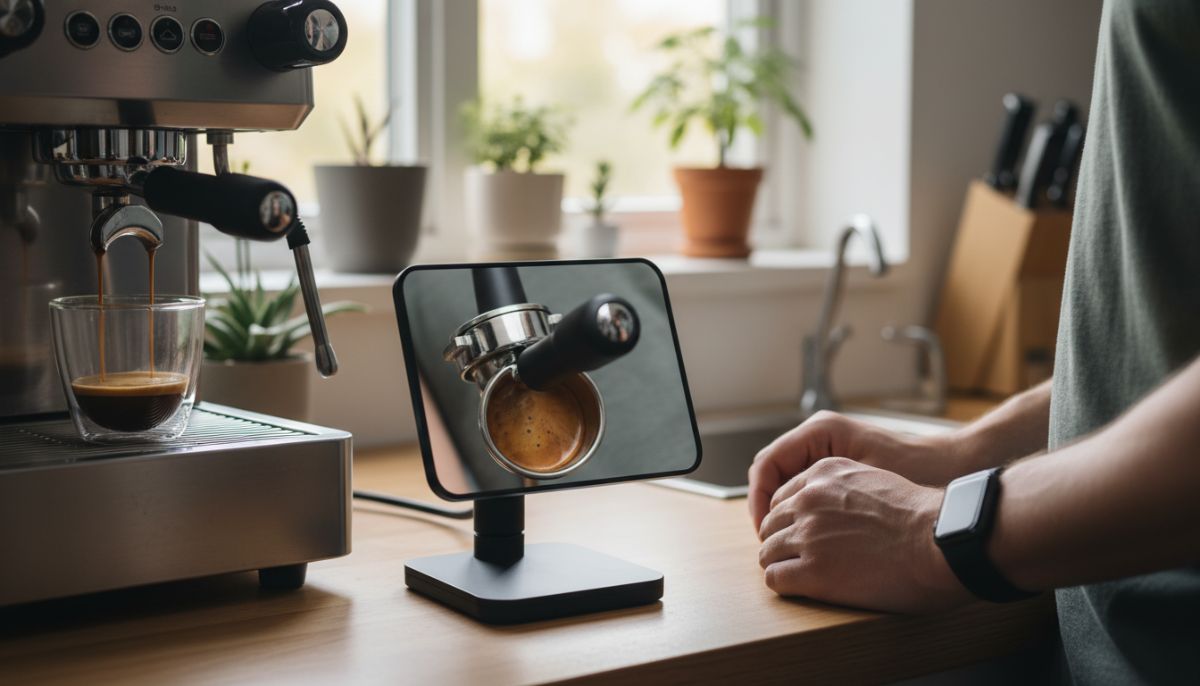
Tired of the ‘barista crouch’? Discover how an espresso shot mirror can save your posture and improve your extraction diagnostics by providing a clear view of your bottomless portafilter.
Key Takeaways
- Ergonomics First: Shot mirrors eliminate the need to crouch or bend to view your extraction, saving your back and neck during the morning routine.
- Diagnostic Power: They provide a real-time reflection of flow rate, channeling, and tiger striping, allowing for immediate feedback on your puck prep.
- Workflow Integration: Modern mirrors are magnetic or weighted, fitting seamlessly into compact espresso stations without adding clutter.
- Aesthetic Appeal: Beyond function, mirrors enhance the visual experience of brewing, making it easier to film and share your coffee journey.
There is a specific posture known well to home baristas. It involves a deep squat, a tilted head, and a strained neck, all performed while staring intently at the underside of a brew group. We do this because we are obsessed with the perfect extraction. We want to see the cones form, the colors change, and the streams unite. However, this gymnastic routine is hardly the relaxing start to the morning most of us desire.
Enter the espresso shot mirror. Once considered a luxury or a mere aesthetic prop for social media videos, the shot mirror has established itself as a critical piece of hardware for the serious home barista. It bridges the gap between comfort and precision, allowing you to monitor your shot mechanics without the physical contortion.
The Ergonomics of Brewing
The layout of a typical espresso machine places the group head roughly at chest or stomach height for the average person standing at a counter. To see the bottom of a portafilter, you physically have to get your eyes below the counter line. Over time, this repetitive motion can lead to strain.
A shot mirror sits on your drip tray or attaches to the machine’s body, angled upward to reflect the bottom of the basket directly to your standing eye line. It turns a physical chore into a passive observation. By improving your posture, you can focus more on the variables that matter—time, yield, and flow—rather than how quickly your knees are tiring.
Diagnostics: Why Visual Feedback Matters
You might ask, "Why do I need to see the bottom of the basket anyway? Can’t I just taste the coffee?" While taste is the ultimate arbiter of quality, visual cues are your early warning system. They tell you why a shot tastes the way it does before you even take a sip.
Identifying Channeling
The most common defect in espresso preparation is channeling, where water finds a path of least resistance through the coffee puck. This leads to weak, sour, or astringent flavors. When using a spouted portafilter, channeling is often hidden. However, when you pair a shot mirror with a naked basket, you can spot these issues instantly.
If you see spurts of coffee spraying sideways onto your mirror, or bald spots on the filter basket where no coffee is flowing, you know your distribution was uneven. This visual feedback loop is essential for mastering bottomless portafilters as a diagnostic tool. Without the mirror, you might miss the tiny spray that indicates a micro-channel.
Monitoring Flow Evenness
A perfect shot should start as droplets on the outside of the basket, moving inward to form a single, syrupy stream. If your mirror shows the flow favoring one side, or starting significantly earlier on the left than the right, your tamp might be unlevel. Seeing this allows you to correct your technique for the next shot. For those struggling with uneven flow, learning how to spot and fix channeling is the next logical step in your barista education.
Types of Shot Mirrors
Not all mirrors are created equal. Depending on your machine’s chassis and your available counter space, you will want to choose the right form factor.
Magnetic Mirrors
These are popular for machines with steel drip trays or front panels. They attach via a strong magnet and usually feature a ball-and-socket joint. This allows for infinite adjustability. They are excellent for keeping the drip tray clear for your scale.
Weighted Base Mirrors
If your machine has a plastic drip tray or non-magnetic housing, a weighted base mirror is the solution. These sit directly on the drip tray. They are stable and portable, but they do take up a small footprint, which can be tricky if you are using large scales.
Inset/Grouphead Mirrors
Some high-end machines or custom modifications allow for mirrors to be mounted directly to the E61 group or the chassis frame. These offer the cleanest look but are often machine-specific.
Integrating the Mirror into Your Workflow
Using a shot mirror is not just about staring at the pretty colors; it is about active management of the extraction. Here is how it fits into a professional workflow.
1. Puck Preparation
Before you even lock in the portafilter, the mirror is waiting. You grind, you distribute, and you tamp. Because you know the mirror will reveal any flaws, you are likely to be more diligent with your puck prep. This is where tools like the WDT come into play. Understanding the science of puck prep and WDT tools ensures that what you see in the mirror is a beautiful, cohesive cone rather than a chaotic mess.
2. The Extraction Phase
As the pump engages, glance at the mirror. You are looking for the “pre-infusion sweat”—the first beads of coffee. Are they appearing evenly? If you see a delay, you can sometimes save the shot by manipulating flow control if your machine has it.
Simultaneously, you should be watching your scale. The mirror gives you qualitative data (how it looks), while the scale gives you quantitative data (how much it weighs). Combining these inputs is the secret to consistency. If you aren’t yet weighing your shots, check out our guide on whether you need smart scales for flow rate tracking.
3. The Cleanup
One downside of the shot mirror is that it sits in the splash zone. If you have a bad channel, your mirror will get covered in espresso. However, this is actually a benefit. It forces you to maintain a clean station. A quick wipe with a microfiber cloth after every shot keeps your gear sparkling.
If you find your mirror is constantly covered in grime, it might be time to review your overall maintenance routine. A clean machine produces better coffee, so reviewing a cleaning manifesto can help you keep your mirror—and your group head—pristine.
Aesthetics and the “Instagram Shot”
We cannot ignore the visual appeal. Coffee is a sensory experience, and sight is a major part of that. There is something mesmerizing about watching the dark brown espresso emulsion turn into golden crema (tiger striping). The shot mirror frames this art.
For those who enjoy sharing their hobby online, a shot mirror makes filming extraction videos significantly easier. You can place your camera in front of the machine rather than trying to wedge a tripod between the drip tray and the group head.
Is a Shot Mirror Essential?
In the hierarchy of espresso equipment, the grinder is king, and the machine is the castle. Accessories like tampers and baskets come next. So, where does the mirror fall? It falls into the category of “Quality of Life.”
You can make exceptional espresso without one. You can crouch down every morning. But for the low cost of entry, the shot mirror offers one of the highest returns on investment regarding comfort and workflow enjoyment. It is similar to the debate around other accessories—they aren’t strictly mandatory, but they solve specific problems. For example, using puck screens keeps your group head clean, just as a mirror keeps your posture straight.
Conclusion
The espresso shot mirror is a simple tool that solves a physical problem while enhancing your technical ability to diagnose extraction issues. It transforms the act of brewing from a hunched-over chore into a comfortable, visual experience.
By providing a clear view of your bottomless portafilter, the mirror holds you accountable for your puck preparation. It reveals the truth about your tamping and distribution, forcing you to improve your technique. Whether you choose a magnetic mount or a weighted base, adding a mirror to your setup is a small upgrade that makes a massive difference in your daily ritual.
Frequently Asked Questions
While not strictly required, a shot mirror is most effective with a bottomless portafilter. It allows you to see the formation of the extraction cone and spot channeling. With a spouted portafilter, the mirror will only show the streams exiting the spouts, which offers less diagnostic value.
Magnetic mirrors require a magnetic surface, usually a steel drip tray or front panel. If your machine uses high-grade non-magnetic stainless steel (common in some medical-grade builds) or plastic casing, the magnet will not stick. In that case, a weighted base mirror is the better option.
Because they sit in the splash zone, mirrors get dirty quickly. Use a soft microfiber cloth and a little water or glass cleaner. Avoid abrasive sponges, as they can scratch the reflective surface.
Indirectly, yes. The mirror helps you spot extraction errors like channeling or uneven flow. By seeing these errors, you can adjust your grind or puck prep, leading to a more even extraction and a better-tasting shot.