Confused about espresso puck prep? We break down the differences between coffee distributors and tampers, the science of extraction, and whether you really need both tools on your bar.
Key Takeaways
- Functionality Difference: Levelers (distributors) aim to flatten the top surface of the coffee bed, while tampers compress the grounds to remove air pockets.
- The Density Debate: While levelers create a pretty puck, they often fail to distribute coffee density deep within the basket compared to WDT tools.
- Workflow Efficiency: You strictly need a tamper, but a leveler is an optional luxury that aids in creating a level surface for tamping.
- Consistency is King: Using both can help beginners achieve a flat tamp, but technique matters more than tools.
Walk into any high-end specialty coffee shop, and you will witness a mesmerizing ritual. The barista grinds beans, meticulously stirs the grounds, spins a shiny disc on top of the portafilter, and finally presses down with significant force. This workflow—the dance of puck preparation—is the line in the sand between a balanced, sweet shot and a sour, channeled mess.
For the home enthusiast, however, the gear acquisition syndrome (GAS) is real. Do you really need a precision-machined spinning tool and a heavy steel weight? In the battle of Levelers vs. Tampers, the answer isn’t always straightforward. It depends on your grinder, your skill level, and your pursuit of the dreaded phenomenon known as channeling.
Let’s dive deep into the mechanics of these tools to determine if your espresso station needs a cleanup or an upgrade.
What is a Coffee Leveler (Distributor)?
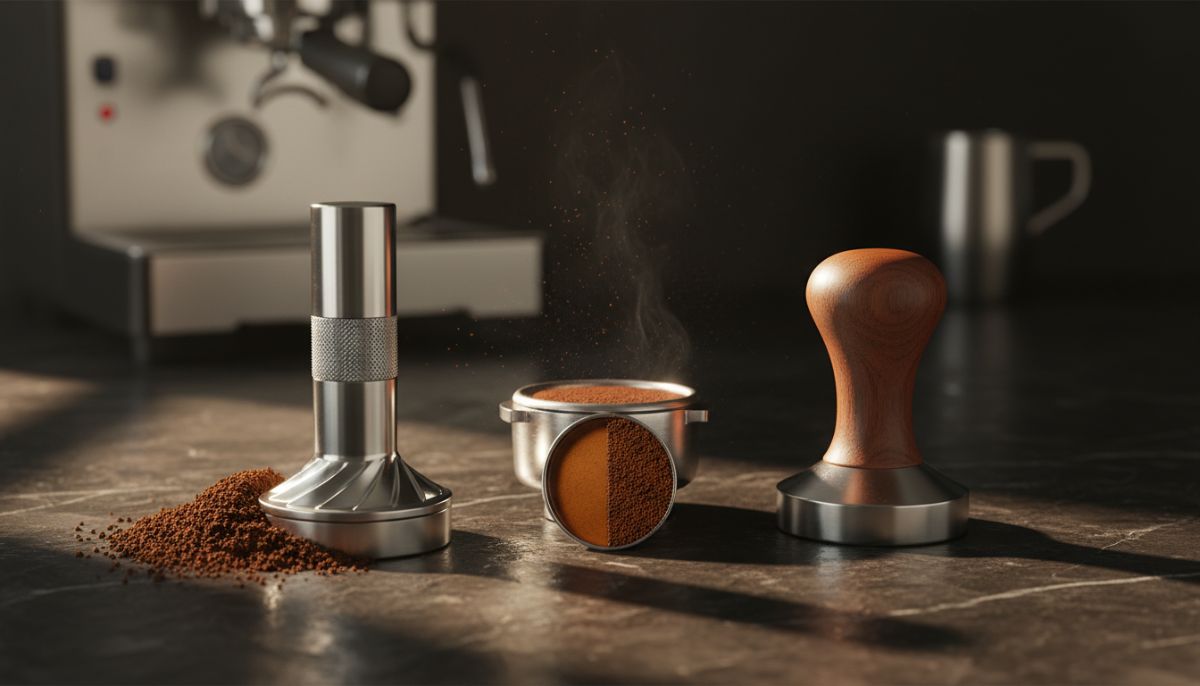
A coffee leveler, often called a distributor, is a tool that sits on the rim of your portafilter basket. It typically features a base with three angled slopes (like a fan) or a wedge shape. When you spin it, these slopes push the coffee grounds around the surface of the basket.
The Goal: Surface Uniformity
The primary purpose of a leveler is to create a perfectly flat, level surface before you apply tamping pressure. If you have a mound of coffee in the center of your basket (a typical result from many grinders), tamping immediately can result in an uneven puck. One side might be denser than the other, leading to uneven water flow.
By spinning a leveler, you redistribute the top layer of coffee, ensuring that when you do tamp, you are pressing down on a flat plane. This helps prevent the “slanted tamp” error that plagues many beginners.
What is a Tamper?
A tamper is a heavy, flat-bottomed tool (usually stainless steel) used to compress the coffee grounds into a solid cake, or “puck.” Unlike the leveler, which moves coffee horizontally, the tamper applies vertical force.
The Goal: Compression and Air Removal
Tamping is not optional. To create the resistance required for espresso extraction (typically 9 bars of pressure), you must remove the air pockets between the coffee grounds. Without tamping, the water would rush through the loose grounds almost instantly, resulting in zero crema and undrinkable, watery coffee.
While traditional tampers rely on manual feel, the market has shifted toward tools that remove variables. For a deeper look at consistency, you might want to read our guide on Spring-Loaded Tampers: Do They Guarantee Espresso Consistency?. These tools ensure you apply perfectly level pressure every single time.
The Great Debate: Distribution vs. Compression
Here lies the core of the controversy. For years, baristas believed that spinning a leveler effectively “distributed” the coffee throughout the entire basket. However, recent experiments and data from refractometers suggest otherwise.
The Shallow Truth About Levelers
Levelers are excellent at smoothing the top 2-3 millimeters of the coffee bed. They create an “Instagram-ready” surface that looks professional. However, they do very little to fix density issues deep inside the basket. If you have a clump of coffee at the bottom of the basket and an air pocket next to it, a leveler will simply smooth the top over these imperfections, hiding them rather than fixing them.
If you tamp a puck that has hidden density variations, water will find the path of least resistance. This causes channeling, where water shoots through one section of the puck, over-extracting that area while under-extracting the rest. To diagnose if this is happening to you, we recommend using a naked portafilter. Check out our guide on Bottomless Portafilters: Using Naked Extraction as a Diagnostic Tool to see what’s really happening underneath the basket.
The Better Alternative: WDT (Weiss Distribution Technique)
If a leveler doesn’t fix deep density issues, what does? Enter the WDT tool. This involves using thin needles to stir the grounds within the portafilter before leveling or tamping. This breaks up clumps and distributes the grounds evenly from top to bottom.
When comparing tools, the hierarchy of importance generally looks like this:
- WDT Tool: Essential for declumping and deep distribution.
- Tamper: Essential for compression.
- Leveler: Optional for surface grooming.
Is the needle method hype, or science? We explored this extensively in our article: The Science of Puck Prep: Does the WDT Tool Really Matter?. Spoiler: It matters more than the spinning leveler.
Do You Need Both? analyzing the Workflow
So, should you buy both? Let’s break down the scenarios where using both makes sense, and where it is redundant.
Scenario A: The Perfectionist (Using Both)
Many home baristas use a “Level then Tamp” workflow. They grind, WDT, spin the leveler to get a flat surface, and then tamp.
Pros: The leveler ensures the coffee bed is perfectly flat before the tamper touches it, reducing the risk of tamping at an angle.
Cons: It adds a step to your workflow and more equipment to clean. You also risk “polishing” the puck too much or disturbing the grounds if the leveler is set too deep.
Scenario B: The Minimalist (Tamper Only)
You grind, WDT to fluff the grounds, tap the portafilter once on the counter to settle the bed (vertical tap), and then tamp straight down.
Pros: Faster workflow, less equipment expense.
Cons: Requires more skill to ensure the tamp is level by eye. If your initial pile of coffee is lopsided, your tamp might end up uneven.
The Hygiene Factor
One downside of using multiple tools like levelers and WDT needles is the mess. Coffee grounds tend to spill over the rim when you are spinning tools around. To keep your station tidy while juggling these accessories, we highly suggest integrating a funnel into your routine. Learn more about how this helps in Dosing Funnels: The Secret to a Waste-Free Workflow.
The Verdict: What Should You Buy?
If you have a limited budget, buy a high-quality tamper and a cheap WDT tool. Skip the expensive leveler. The return on investment for a leveler is diminishing returns compared to good needle distribution.
However, if you struggle with keeping your tamp level—meaning your coffee bed is often sloped to one side—a leveler acts as excellent “training wheels.” By flattening the bed first, it provides a stable platform for your tamper, making it much harder to tamp crookedly. This can reduce instances of uneven flow, which you can learn to spot in our article Channeling 101: How to Spot and Fix Uneven Water Flow.
A Note on Pucks Screens
If you are looking for that next 1% improvement in consistency, you might look beyond the leveler/tamper debate entirely. Placing a mesh screen on top of your tamped puck can prevent water from disturbing the bed, essentially doing the job of a “water buffer.” This is often more effective than leveling alone. Read more about this accessory here: Puck Screens: The Cheap Accessory That Changes Everything.
Conclusion
In the showdown of Levelers vs. Tampers, the tamper wins by default because it is mandatory. The leveler is a creature of convenience and aesthetics. It makes the process feel refined and helps ensure a flat surface, but it cannot replace the deep distribution of WDT or the compression of a tamp.
For the ultimate home setup, focus on your grinder and your puck prep technique. If you have cash to spare, a leveler looks great on the bar and can help with consistency. But if you have to choose one? Take the tamper, grab a paperclip or acupuncture needle for WDT, and start brewing.
Frequently Asked Questions
Generally, no. A leveler distributes the top layer of coffee but does not compress the puck with enough force to remove air pockets. Tamping is required to create the necessary resistance for espresso extraction.
A leveler can help reduce channeling by creating a flat surface for tamping, preventing a sloped puck. However, it does not fix deep density issues within the puck; a WDT tool is better for that.
The leveler should be set deep enough to touch and move the surface grounds but not so deep that it compresses the coffee significantly before you have a chance to tamp properly.
Many competition baristas use distribution tools (levelers) in conjunction with WDT and tamping to ensure the highest possible consistency and presentation scores.
For extraction quality, yes. WDT (Weiss Distribution Technique) addresses the entire depth of the coffee bed, breaking up clumps, whereas a leveler only grooms the top surface.