
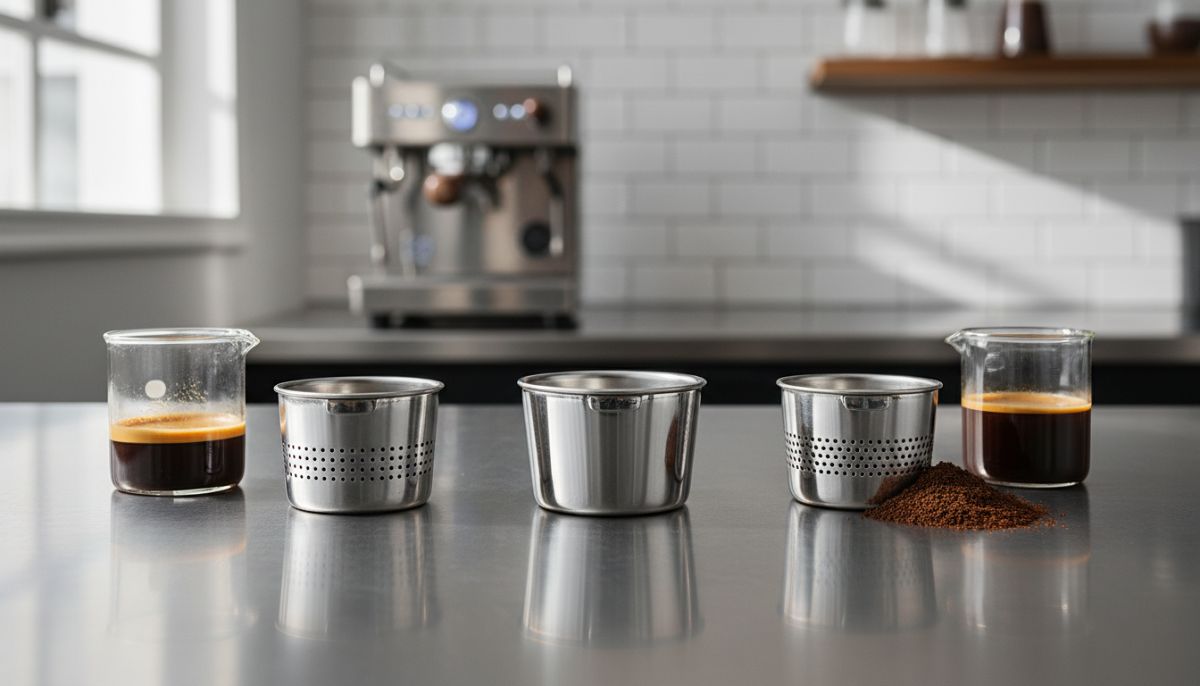
Is a $30 precision filter basket strictly for pros? We analyze VST vs. IMS, hole uniformity, taste differences, and why your tamper might need an upgrade.
Key Takeaways
- The Verdict: Precision baskets significantly improve extraction clarity and consistency but are unforgiving of poor puck prep.
- VST vs. IMS: Choose VST for light roasts and high-clarity shots; choose IMS for a slightly smoother, more forgiving body suitable for medium-dark roasts.
- The Tamper Catch: Upgrading to a VST often necessitates a 58.5mm precision tamper to prevent edge channeling.
- Grind Changes: You must grind finer with precision baskets due to increased flow rates caused by higher total open area.
For many home baristas, the portafilter basket is an afterthought—a generic piece of stamped metal that came with the machine. Yet, this small component acts as the final gatekeeper between your coffee beans and the cup. The debate surrounding precision filter baskets—specifically the titans of the industry, VST and IMS—often centers on a single question: Can a $30 piece of steel actually change the taste of your espresso?
The short answer is yes, but with caveats. Moving from a stock basket to a precision tool is not just an upgrade; it is a diagnostic revelation that exposes every flaw in your tamping and distribution technique. Whether you are chasing higher extraction yields for light roasts or simply want consistency, understanding the physics of these baskets is crucial.
The Hidden Flaws in Stock Baskets
To understand the value of an upgrade, we must first look at the deficiency of the standard equipment. Stock baskets, typical of most consumer and prosumer machines, are manufactured via standard stamping processes. If you were to look at a generic basket under a macro lens, you would likely see inconsistent hole sizes, blocked openings, and jagged metal burrs.
These inconsistencies create uneven resistance. Water, following the path of least resistance, rushes through the larger holes while bypassing the blocked ones. This leads to channeling, where some parts of the puck are over-extracted (bitter) and others are under-extracted (sour).
VST Baskets: The Unforgiving Truth Teller
VST (Voice Systems Technology) baskets are widely considered the gold standard for specialty coffee. They are engineered with zero-defect scanning, ensuring every hole is identical in size and placement. The holes are generally upright and free of burrs, maximizing the “open area” at the bottom of the basket.
This precision allows for a significantly higher flow rate. Because water moves through the puck with less mechanical resistance from the basket itself, you are forced to grind finer to maintain standard shot times. This finer grind increases the surface area of the coffee exposed to water, allowing for higher extraction yields. This is why VST baskets are often paired with light roast espresso, where extracting sweetness and acidity is notoriously difficult.
However, VST baskets are ruthless. If your puck prep is sloppy, or if you simply dump grounds in without distribution, the basket will punish you with distinct channeling. It is a tool for those willing to refine their technique.
IMS Competition Baskets: The Smooth Operator
IMS, an Italian manufacturer, takes a slightly different approach. While their Competition series also features precise, laser-cut holes, the geometry and hole count often differ from VST. IMS baskets tend to have a slightly convex bottom (though many are flat) and a hole pattern that is arguably more forgiving.
A notable feature of IMS is their optional Nanotech coating. This quartz-based non-stick coating makes cleaning incredibly easy—pucks knock out cleanly with zero residue. However, some baristas argue that the coating can affect the flow dynamics or wear off over years of heavy commercial use.
In terms of taste, IMS baskets often produce a shot with slightly more body and texture compared to the clinical clarity of a VST. This makes them a fantastic upgrade for those who enjoy traditional medium-to-dark roasts or chocolate-forward blends.
Sizing, Headspace, and the Dosage Dilemma
One of the most confusing aspects of upgrading is selecting the correct size (e.g., 15g, 18g, 20g, 22g). Unlike stock baskets, which are vague suggestions, precision baskets are rated for specific doses within a +/- 1g range.
Choosing the wrong size leads to headspace issues. If you put 16g of coffee into a 20g VST basket, the gap between the top of the puck and the shower screen (headspace) will be too large, leading to a soupy puck and potential channeling. Conversely, overfilling can fracture the puck when the group head locks in. For a deep dive on this, read our guide on espresso headspace and basket dosing.
The Tamper Problem: Why 58mm Isn’t Enough
Here is the hidden cost of a VST upgrade: your current tamper likely won’t fit. VST baskets are manufactured with straight, vertical walls to ensure uniform extraction all the way to the edge. Standard 58mm tampers leave a tiny gap (an annulus) of uncompressed coffee around the perimeter.
In a high-flow VST basket, water will race down this uncompressed edge—a phenomenon known as “side channeling” or the “donut effect.” To utilize a precision basket properly, you generally need a precision tamper sized at 58.4mm or 58.5mm. We discuss the importance of gear fit further in our comparison of levelers vs. tampers.
Ridged vs. Ridgeless: A Practical Choice
You will often see options for “Ridged” or “Ridgeless” baskets. This refers to the indentation on the side of the basket that locks into the portafilter spring.
- Ridged: Locks securely. The basket won’t fall out when you knock out the puck. However, the ridge can sometimes cause a weak point in the puck structure or make it harder to tamp perfectly level if the tamper catches the ridge.
- Ridgeless: Smooth walls. It offers the cleanest puck release and aesthetics. However, if your portafilter spring is loose, the basket might fly into the knock box along with your coffee grounds.
Taste Test and Performance Data
Is the investment quantifiable? In blind taste tests, shots pulled on VST baskets consistently show higher Total Dissolved Solids (TDS) percentages compared to stock baskets using identical ratio and time parameters. This indicates a more efficient extraction.
| Feature | Stock Basket | VST Precision | IMS Competition |
|---|---|---|---|
| Hole Uniformity | Low (Stamped) | High (Laser Etched) | High (Laser Etched) |
| Flow Rate | Slow / Restricted | High / Fast | Medium-High |
| Grind Requirement | Standard | Finer | Slightly Finer |
| Forgiveness | High (masks errors) | Very Low (exposes errors) | Medium |
| Best For | Beginners | Light Roasts / Clarity | Texture / Daily Driver |
Did You Know?
VST baskets were originally designed alongside a refractometer system to scientifically measure extraction yield. The goal was not just to make a metal filter, but to create a standardized lab instrument that allows baristas in different parts of the world to replicate the exact same brew dynamics. For more on the science of yield, check out our guide on TDS and extraction yield.
Pros and Cons of Upgrading
Pros
- Higher Extraction Yields: Get more flavor out of expensive beans.
- Consistency: Removes hardware variables so you know flavor defects are due to your prep, not the machine.
- Visual Diagnostics: When paired with a bottomless portafilter, flow issues are easier to spot.
Cons
- Cost: Baskets run $30-$40, plus the potential cost of a new 58.5mm tamper ($50-$150).
- Frustration: The “unforgiving” nature means your shots might spray or channel until you improve your distribution skills.
- Maintenance: High-flow holes can clog easier with fines if not cleaned regularly.
Conclusion
Are VST and IMS baskets worth the investment? If you are using fresh, high-quality beans and have a grinder capable of micro-adjustments, absolutely. They unlock a ceiling of flavor clarity that stock baskets physically cannot reach. However, if you are happy with dark roasts and want a low-fuss workflow, the unforgiving nature of a VST basket might introduce more headaches than happiness. For most home baristas, the IMS Competition basket strikes the perfect balance between performance upgrade and daily usability.
Frequently Asked Questions
Yes, you will almost certainly need to grind finer. VST baskets have a higher open surface area, offering less resistance to water flow. To maintain the same shot time, a finer grind is required to build back that resistance.
Ridged baskets have an indentation to lock into the portafilter spring, preventing the basket from falling out when knocking out pucks. Ridgeless baskets have smooth walls for cleaner pucks and aesthetics but may fall out if the retention spring is loose.
You can, but it is not recommended. VST baskets are precision-sized, and a standard 58mm tamper leaves a gap at the edges, leading to ‘donut channeling.’ A 58.4mm or 58.5mm tamper is highly recommended for best results.
VST is generally preferred for light roasts. Its high-flow design allows for finer grinding and higher extraction yields, which helps bring out the acidity and sweetness characteristic of light roasts without muddiness.
Spraying (channeling) occurs because precision baskets do not mask puck preparation errors like stock baskets do. The higher flow reveals uneven distribution or tamping. Improving your WDT (Weiss Distribution Technique) and grinding finer usually fixes this.