
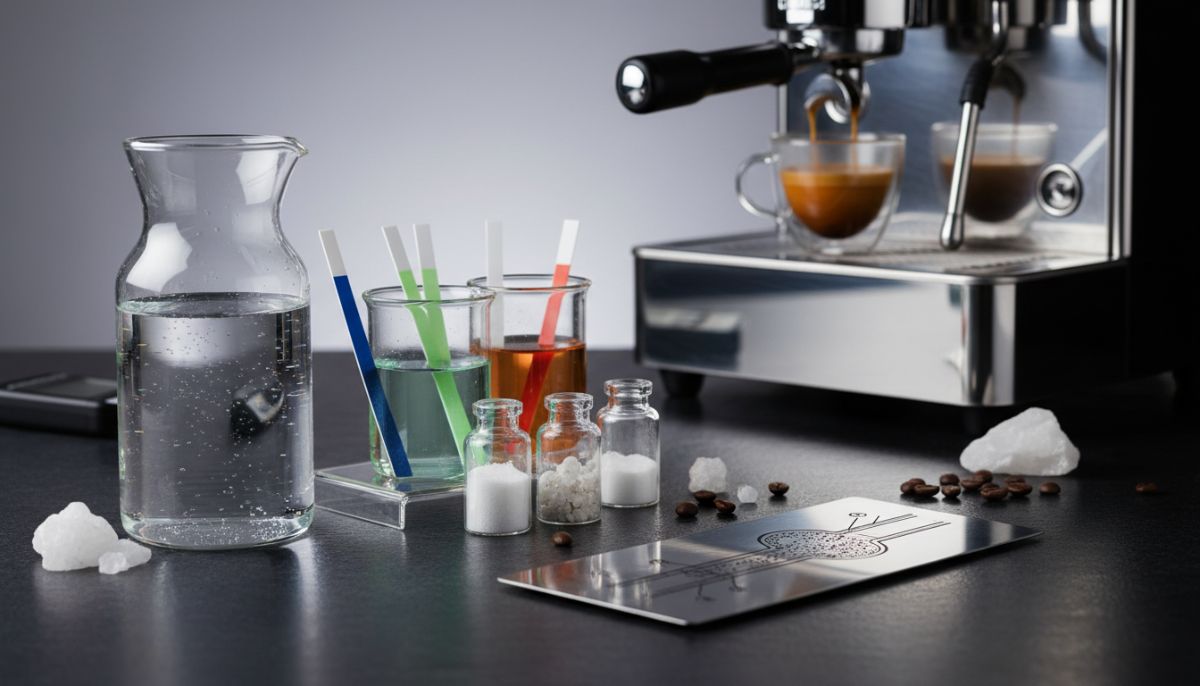
Stop blaming your beans. Discover how magnesium, calcium, and bicarbonates dictate the taste of your shot. This is the ultimate guide to espresso water chemistry, simplified for better flavor and machine longevity.
The Invisible Ingredient in Your Cup
You spend hundreds on a grinder. You obsess over tamping pressure. You buy fresh beans roasted by artisans. Yet, the resulting shot tastes flat, sour, or chalky. The culprit is likely invisible and makes up 98% of what is in your cup: water.
Water is not just a neutral canvas; it is the solvent that extracts flavor compounds from the coffee grounds. Without the right minerals, the water cannot physically hold onto the tasty parts of the coffee bean. Conversely, with the wrong minerals, it will strip the puck of bitter compounds or neutralize the acidity you actually want.
Understanding water chemistry transforms a confusing morning routine into a repeatable science. It is the difference between a “lucky” good shot and a consistently excellent one.
Key Takeaways
- Water is a Solvent: Pure distilled water is aggressive and corrosive; it needs minerals to extract flavor properly.
- Magnesium = Fruitiness: High magnesium levels highlight sweetness and complex acids.
- Bicarbonate = The Buffer: Alkalinity (KH) prevents coffee from tasting too sour but kills acidity if it is too high.
- Scale vs. Flavor: Calcium tastes good but destroys machines. Magnesium and Potassium are safer alternatives.
The Big Three: GH, KH, and pH Simplified
Coffee forums are filled with PhD-level chemistry debates that alienate beginners. Let’s strip away the jargon and focus on the three variables that actually change how your espresso tastes.
1. General Hardness (GH) – The “Flavor Claw”
Think of GH as the muscle of your water. It represents the total amount of magnesium and calcium ions. These minerals act like microscopic claws. As water passes through the coffee puck, these minerals grab onto flavor compounds and pull them into the cup.
If your GH is too low (like in distilled or very soft water), the water is weak. It leaves the flavor compounds behind, resulting in a hollow, sour, or underextracted shot. If you are struggling with this, see our guide on troubleshooting sour espresso to see if water is the missing link.
2. Carbonate Hardness (KH) – The “Acid Tamer”
Also known as Alkalinity or the “Buffer.” KH measures the carbonate and bicarbonate ions in the water. Its job is to neutralize acid. Coffee is naturally acidic. You need some KH to keep the espresso from tasting like battery acid, but too much KH acts like a wet blanket, muting the bright, sparkly notes of a light roast.
3. pH – The Baseline
Ideally, water for coffee should be neutral (around pH 7.0). However, the buffering capacity (KH) is far more important than the starting pH because the coffee puck itself changes the pH of the water instantly upon contact.
The Taste Test: Magnesium vs. Calcium vs. Bicarbonate
Not all minerals create the same sensory experience. By adjusting the ratio of these minerals, you can tune your water to suit your specific coffee beans.
| Mineral | Role in Extraction | Flavor Profile | Machine Risk |
|---|---|---|---|
| Magnesium | Extracts small molecules (acids/sugars). | Enhances sweetness, fruitiness, and complexity. | Low (rarely causes scale). |
| Calcium | Extracts larger molecules. | Adds heavy body, creaminess, and chalky texture. | High (causes limescale buildup). |
| Bicarbonate | Buffers acidity. | Prevents sourness; can taste flat/chalky if too high. | Medium (calcium carbonate causes scale). |
The Scale vs. Flavor Dilemma
This is the hardest pill for home baristas to swallow: the water that tastes the best often harms your machine. Calcium creates a lovely, creamy mouthfeel, but it also precipitates as limescale when heated. This scale clogs boilers and sensors.
If you own an expensive dual boiler or heat exchanger, check out our insights on why tap water is killing your machine. To be safe, many experts recommend the “Rpavlis” approach: using water with zero Calcium hardness and relying purely on Potassium or Sodium Bicarbonate for alkalinity. You lose a tiny bit of body, but your machine will virtually never need descaling.
Did You Know?
Water behaves differently depending on the roast level. Light roasts are naturally more acidic and harder to extract, often requiring softer water with higher magnesium to pull out sweetness. Dark roasts are soluble and low-acid, meaning they require very little buffer (KH) to taste good.
DIY Water Recipes: From Grocery Store to Barista Standard
Stop guessing with tap water. The easiest way to control flavor is to start with a blank slate (Distilled or Reverse Osmosis water) and add minerals back in. This is often called “remineralization.”
1. The “Rpavlis” Recipe (Safe & Simple)
This recipe was popularized by chemistry professor Robert Pavlis. It is completely non-scaling and produces a neutral espresso profile.
- Base: 1 Gallon of Distilled Water.
- Additive: 0.38 grams of Potassium Bicarbonate (or Sodium Bicarbonate / Baking Soda).
- Result: ~50mg/L Alkalinity. Zero Hardness.
- Best For: Protecting machines; Dark to Medium roasts.
2. The High-Extraction “Fruit Bomb”
If you enjoy identifying flavor notes like berries or stone fruit, you need magnesium.
- Base: 1 Gallon of Distilled Water.
- Hardness Additive: 2.5 grams Epsom Salts (Magnesium Sulfate).
- Buffer Additive: 0.8 grams Baking Soda (Sodium Bicarbonate).
- Result: High Magnesium hardness to pull flavor, moderate alkalinity to tame sourness.
- Best For: Light roasts and modern espresso.
Pros and Cons of Water Solutions
Should you mix your own water or buy a filtration system? Here is the breakdown.
DIY Remineralization (Distilled + Minerals)
- Pros: Perfect consistency, zero scale risk, extremely cheap long-term.
- Cons: Requires buying plastic jugs of distilled water, measuring minute amounts of powder.
In-Tank Pitcher Filters (e.g., BWT)
- Pros: Convenient, fits in the reservoir, improves tap water significantly.
- Cons: Inconsistent over time (filter degrades), harder to dial in precise extraction numbers like TDS and Yield.
Commercial Packets (e.g., Third Wave Water)
- Pros: foolproof (dump one stick in a gallon), consistent mineral profile.
- Cons: More expensive per gallon than DIY, standard profiles might be too high in minerals for some tastes.
Dialing In Your Water
Once you have your water sorted, don’t forget that it affects your brewing variables. Harder water extracts faster. If you switch to high-magnesium water, you may need to coarsen your grind slightly or adjust your ratio. Always refer back to the basics of mastering dose and yield when changing your water source.
If you are neglecting your equipment cleaning, even the best water won’t help. A dirty machine adds rancid oils to the cup. Consult our cleaning manifesto to ensure your hardware is as pure as your water.
Conclusion
Water chemistry is the final frontier for the home barista. It bridges the gap between “drinkable” coffee and the syrupy, vibrant shots served in top-tier cafes. You do not need a degree in chemistry to fix your water—you just need to understand that magnesium brings the sweet, bicarbonate checks the sour, and calcium brings the body. Start with a simple recipe, trust your palate, and watch your espresso quality skyrocket.
Frequently Asked Questions
No. Pure distilled water lacks the minerals required to extract flavor compounds from the coffee, leading to flat tasting shots. Furthermore, distilled water is slightly acidic and corrosive, which can damage the metals in your espresso machine boilers over time. Always remineralize it first.
The Specialty Coffee Association (SCA) recommends a Total Hardness of 50–175 ppm CaCO3. However, for home machines, a softer range (50–80 ppm) is often preferred to prevent scale buildup while still allowing for adequate extraction.
Yes. Magnesium is highly efficient at extracting smaller molecules, which include sugars and fruit acids. High-magnesium water often results in a cup profile that is perceived as sweeter and fruitier compared to water high in calcium.
You can lower perceived acidity by increasing the Carbonate Hardness (KH) or alkalinity of your water. Bicarbonates act as a buffer, neutralizing the acids present in the coffee. Be careful not to go too high, or the coffee will taste chalky and flat.
It depends on the brand. Some spring waters are very hard and will scale your machine quickly. Others are too soft. Brands like Crystal Geyser (depending on the source) or Volvic are often cited as espresso-friendly, but you should always check the analysis on the bottle against SCA standards.